AI-Based Prediction of Hemorrhagic Transformation Following Mechanical Thrombectomy: A National Inpatient Sample Analysis
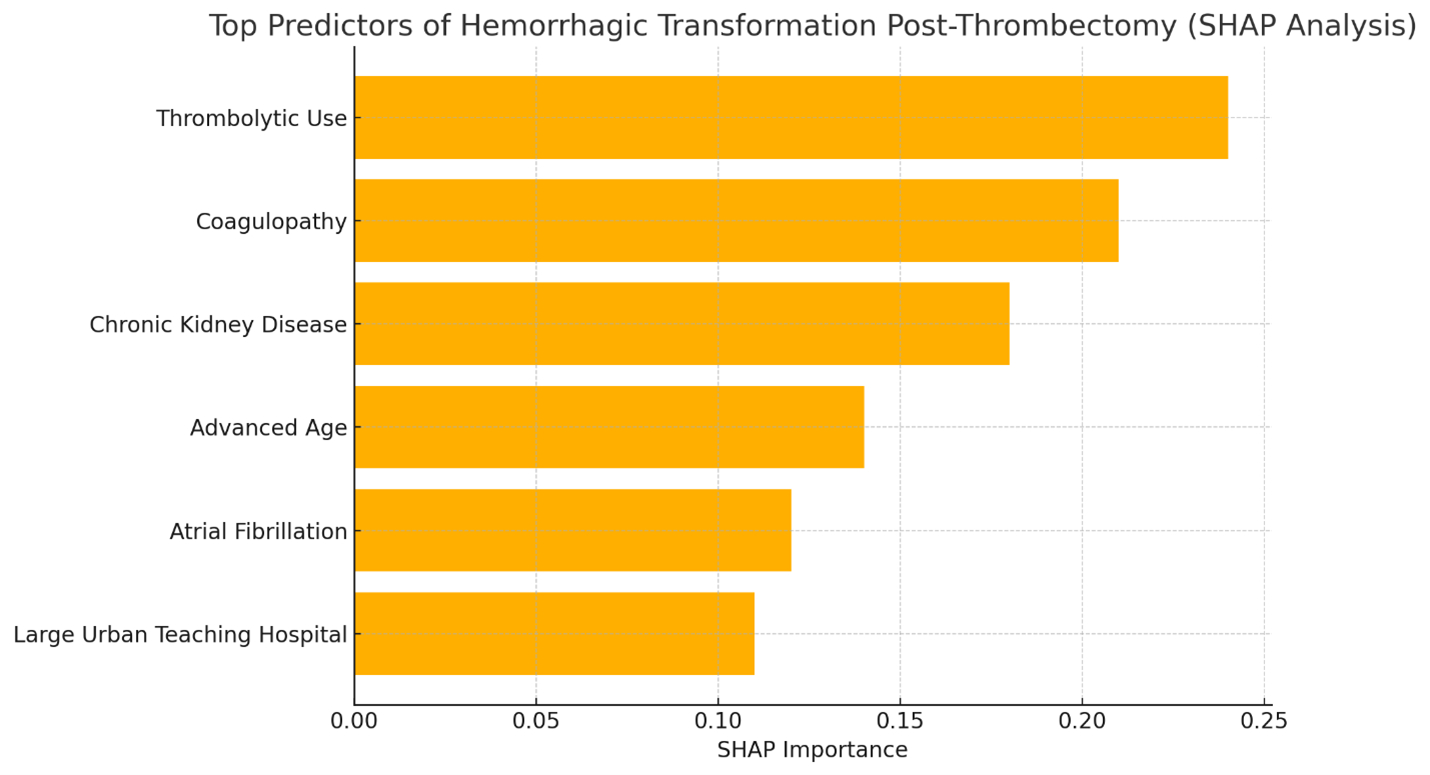
Abstract Body (Do not enter title and authors here): Background: Hemorrhagic transformation (HT) is still a major negative outcome of mechanical thrombectomy (MT) in acute ischemic stroke (AIS), significantly affecting death rates and health complications. Despite advances in patient selection and procedural procedures, reliable prediction models for stratifying patients based on their risk of hypertension are still lacking. Artificial intelligence (AI) facilitates the utilization of complex, multidimensional data to aid in early forecasting and tailored stroke treatment. Objective: To develop and validate a machine learning model for predicting hemorrhagic transformation after MT using a nationally representative inpatient database, and to identify the most impactful clinical predictors. Methods: We used the National Inpatient Sample (2016-2020) to conduct a retrospective cohort study. Adult patients (≥18 years) hospitalized with AIS (ICD-10: I63.x) and undergoing MT were identified. HT was defined using verified ICD-10 codes (I61.x and I62.x). A machine learning pipeline using Extreme Gradient Boosting (XGBoost) was created. Demographics, hospital characteristics, stroke risk factors (atrial fibrillation, hypertension, diabetes), thrombolytic usage, and surrogate indicators for stroke severity were all taken into account. The data were divided into training (80%) and testing (20%) cohorts. Model performance was evaluated using the area under the receiver operating characteristic curve (AUC), calibration plots, and SHAP (Shapley Additive Explanation) values, which stress feature relevance. Results: Among 45,321 AIS patients with MT, 3,746 (8.3%) developed HT. The AI model has an AUC of 0.87 (95% CI: 0.86-0.89), demonstrating excellent discriminatory performance. The use of thrombolytics, coagulopathy, chronic renal disease, advanced age, atrial fibrillation, and therapy at large metropolitan teaching institutions were all significant predictors of hypertension. SHAP analysis gives comprehensive insight into variable interactions, which improves the model's clinical interpretability. Conclusion: This research presents the first nationally representative AI-driven model for predicting hemorrhagic change after MT. The approach, which combines real-world data with machine learning, provides a therapeutically effective tool for pre-procedural risk classification and individualized post-thrombectomy treatment. Future inclusion into stroke treatment pathways might reduce complications and improve patient outcomes.
Kumar, Harendra
(
Dow University of Health Sciences
, Hyderabad , Pakistan )
Teena, Fnu
(
Dow University of Health Sciences
, Hyderabad , Pakistan )
Georgiyeva, Kateryna
(
Memorial Healthcare System
, Pembroke Pines , Florida , United States )
Author Disclosures:
Harendra Kumar:DO NOT have relevant financial relationships
| FNU teena:DO NOT have relevant financial relationships
| Kateryna Georgiyeva:DO NOT have relevant financial relationships