Group Virtual Care for Women with Cardiovascular-Kidney-Metabolic Syndrome: Engagement and Lifestyle Change in a Scalable Model
Abstract Body (Do not enter title and authors here): Introduction: Cardiovascular-kidney-metabolic (CKM) syndrome is a growing public health challenge marked by rising morbidity, mortality, and healthcare costs. Traditional care models often struggle to engage patients, with no-show rates reaching 18–20%. Scalable strategies to engage at-risk patients are urgently needed.
Objective: To assess the impact of a group virtual care model on engagement, experience, and lifestyle behavior change in CKM.
Methods: Systole Health, a virtual group care organization, enrolled cohorts of 3–5 women into a six-week CKM optimization program across 16 U.S. states between April 2024 and March 2025. Eligible participants had documented or self-reported overweight/obesity, hypertension (HTN), dyslipidemia (DLD), and/or (pre)diabetes. Exclusion criteria included active pregnancy and unstable CKM. The intervention included weekly cardiologist-led shared medical appointments, lifestyle health coaching, medication optimization, and coach-led group and individual text support. Attendance was tracked, and satisfaction and self-reported behavior change were assessed via post-program surveys. Linear regression evaluated associations between attendance and changes in BMI, blood pressure, and LDL cholesterol.
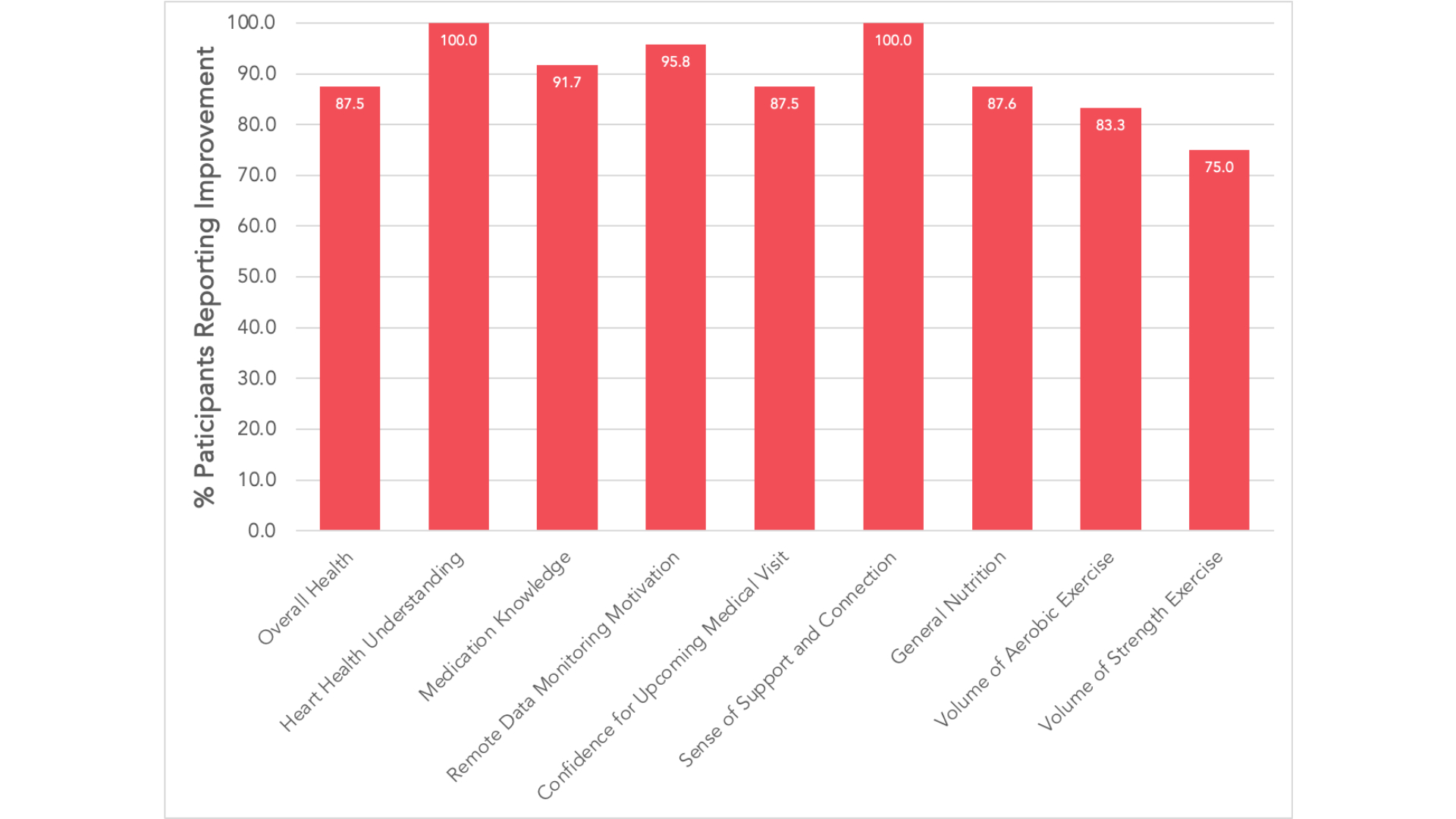
Results: A total of 45 women enrolled, contributing 247 patient visits. Mean age was 52.2 ± 11.5 years; 86.7% were White. Most participants (53.3%) had ≥3 CKM risk factors (BP ≥130/80, LDL-C above guideline-recommended thresholds, BMI ≥27, and/or A1c ≥5.7%); overall, 88.9% had overweight/obesity, 35.6% HTN, 44.4% DLD, and 24.4% (pre)diabetes. Median attendance was 6 of 6 sessions (interquartile range [IQR] 1), with a program completion rate (≥5 sessions) of 85.1%. Median satisfaction and likelihood to recommend were both 10/10 (IQRs 0.5 and 0.25, respectively). Participants reported improvements in heart health understanding (100.0%), medication knowledge (91.7%), motivation to monitor health data (95.8%), confidence preparing for medical visits (87.5), sense of support (100.0%), nutrition (87.6%), cardiovascular exercise (83.3%), and overall health (87.5) (Figure 1). Clinical outcomes trended favorably with higher attendance, though associations were not statistically significant.
Conclusion: A group virtual care model for women with CKM risk factors demonstrated high engagement, satisfaction, and self-reported behavior change, supporting its potential as a scalable, patient-centered strategy for CKM care.
Parmar, Sehej-leen
(
Harvard Medical School
, Boston , Massachusetts , United States )
Cannon, Christopher
(
Brigham and Womens Hospital
, Boston , Massachusetts , United States )
Lee, Simin
(
Systole Health
, Boston , Massachusetts , United States )
Author Disclosures:
Sehej-leen Parmar:DO NOT have relevant financial relationships
| Christopher Cannon:DO have relevant financial relationships
;
Consultant:Chiesi, Amgen, Ascendia, Biogen, BI, BMS, CSL Behring, Genomadix, Lilly, Janssen, Lexicon, Milestone, Novartis, Pfizer, Rhoshan:Active (exists now)
; Research Funding (PI or named investigator):Amgen, Bayer, Cleerly, Esperion, Lexicon, Silence:Active (exists now)
; Research Funding (PI or named investigator):Amgen, Better Therapeutics, Boehringer-Ingelheim (BI), Novo Nordisk:Active (exists now)
| Simin Lee:DO have relevant financial relationships
;
Executive Role:Systole Health:Active (exists now)
; Ownership Interest:Systole Health:Active (exists now)