Logo

American Heart Association

  21
  0


Final ID: MP589

Gaps In Risk Factor Management Prior To Major Adverse Events As First Presentation Of Atherosclerotic Cardiovascular Disease

Abstract Body (Do not enter title and authors here): Background: Atherosclerotic cardiovascular disease (ASCVD) most often manifests initially with a myocardial infarction or stroke. While the aetiology of atherosclerosis and benefits of risk factor (lipids and blood pressure) management are well established, less is known about the effectiveness of ASCVD risk assessment and management in the period leading up to such events.
Aims: To identify patients with a major coronary or cerebrovascular event at first presentation of ASCVD between 2010-23 and assess identification and management of ASCVD risk in the year preceding the event.
Methods: We conducted a retrospective, population-level,observational study using linked anonymised health record data amongst 102,148 patients with a fatal or non-fatal major coronary or cerebrovascular event at first ASCVD diagnosisin Wales (UK). Trends in the documentation of QRISK 10-year risk score, management of LDL-C and blood pressure(BP), and prescription of lipid lowering therapy (LLT) were identified in the year preceding presentation.
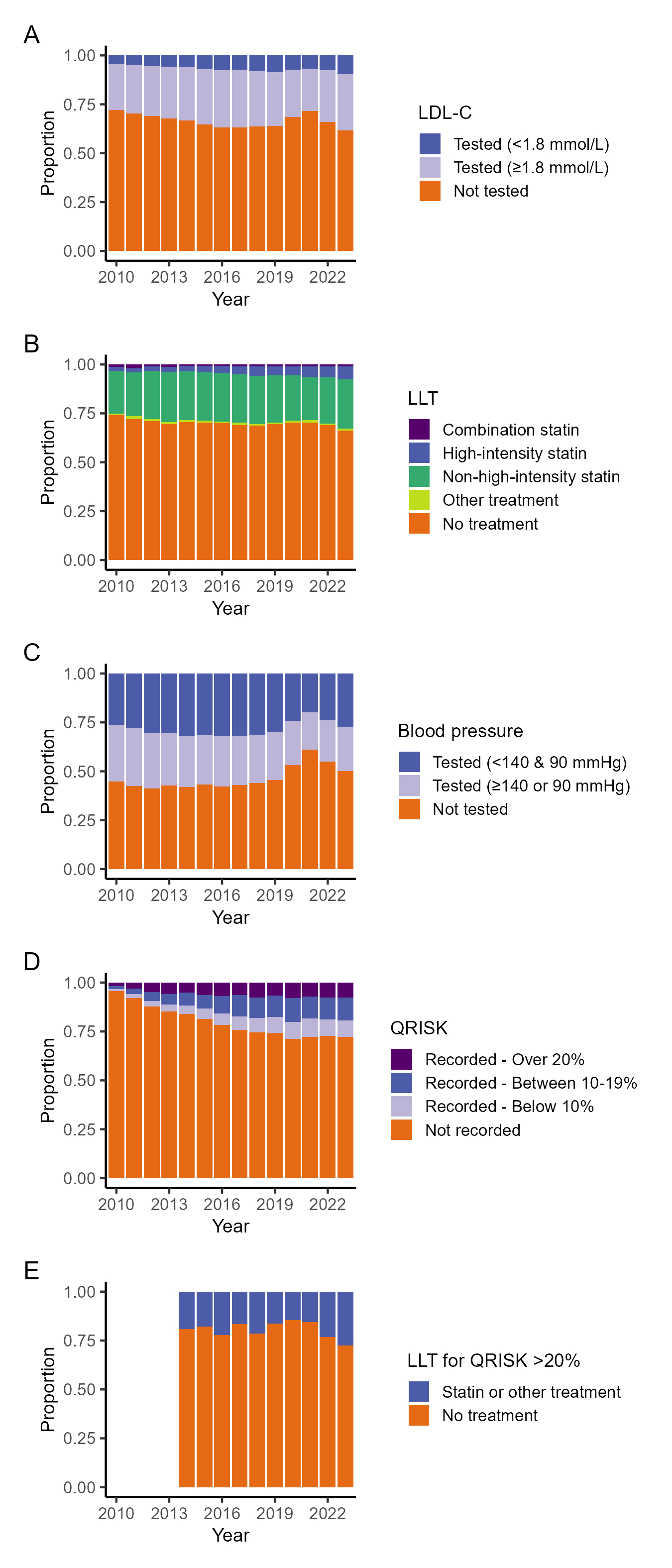
Results: Documentation of LDL-C in the year prior to presentation increased from 27.8% to 38.5% between 2010-23, of which the proportion with a level of <1.8 mmol/L increased from 4.5% to 9.5% (Figure 1A). Prescription of LLT increased from 26.0% to 33.8% between 2010-23, with an increase in the prescribing of high-intensity statin from 2.0% to 6.7% (Figure 1B). Documentation of BP decreased from 55.2% to 49.8% between 2010-23, and achievement of systolic and diastolic BP <140 & 90 mmHg increased, thoughonly from 26.5% to 27.4% (Figure 1C). Documentation of QRISK score within 5-years prior to presentation increased from 16.1% to 27.7% between 2014-23, of which 28.1% scored >20% in 2023 (Figure 1D). Among patients with a recorded QRISK of >20%, only 19.1% were prescribed LLTin 2014, increasing to 27.5% in 2023 (Figure 1E).
Conclusions: Although management of lipids has improved over time in the primary prevention setting, the effectiveness of control of patient's risk factors remains suboptimal at a population level. The majority of patients suffering MI or stroke as their initial presentation of CVD do not have their BP or lipids tested (or controlled when tested) in the year preceding initial presentation with these acute vascular events.Improvements are required in identification of those at risk and management of modifiable risk factors to meet guideline-recommended standards of care at the population level.
  • King, Daniel  ( Swansea University , Swansea , United Kingdom )
  • Harris, Daniel  ( Swansea University , Swansea , United Kingdom )
  • Akbari, Ashley  ( Swansea University , Swansea , United Kingdom )
  • Gravenor, Michael  ( Swansea University , Swansea , United Kingdom )
  • Halcox, Julian  ( Swansea University , Swansea , United Kingdom )
  • Author Disclosures:
    Daniel King: DO NOT have relevant financial relationships | Daniel Harris: No Answer | Ashley Akbari: DO NOT have relevant financial relationships | Michael Gravenor: No Answer | Julian Halcox: No Answer
Meeting Info:

Scientific Sessions 2025

2025

New Orleans, Louisiana

Session Info:

From Development to Deployment: Best Practices for Validating AI/ML Models in Healthcare

Saturday, 11/08/2025 , 01:45PM - 02:55PM

Moderated Digital Poster Session

More abstracts on this topic:
10-Year Trend Analysis of Medicare Payment in Stroke Inpatient Hospital Admission

Wong Ka-ho, Krothapalli Neeharika, Littig Lauren, Champagne Alison, Majersik Jennifer, Reddy Vivek, De Havenon Adam

A Randomized Clinical Trial Evaluating Vitamin D Normalization on Major Adverse Cardiovascular-Related Events Among Acute Coronary Syndrome Patients: The TARGET-D Trial

May Heidi, Colipi Dominique, Whiting Tyler, Muhlestein Joseph, Le Viet, Anderson Jeffrey, Babcock Daniel, Wayman Libby, Bair Tami, Knight Stacey, Knowlton Kirk, Iverson Leslie

More abstracts from these authors:
You have to be authorized to contact abstract author. Please, Login
Not Available