
Logo

American Heart Association

  35
  0


Final ID: Sa3027

Epidemiology of Suspected Sudden Cardiac Death in the Young

Abstract Body (Do not enter title and authors here): Background: The incidence estimates of sudden cardiac death in young people vary widely, ranging from 0.7-10 cardiac deaths per 100,000 persons. The NIH/CDC Sudden Unexpected Infant Death (SUID) and Sudden Death in the Young (SDY) Case Registry aims to compile and use population-based data to understand how and why infants, children and young adults die suddenly and unexpectedly.

Research Question: What is the epidemiology of SDY due to a suspected cardiac cause in the U.S.?

Methods: Using SUID and SDY Case Registry data, we analyzed cases of SDY among residents of 14 participating U.S. jurisdictions, who were 0-21 years of age, died from 2015-2022 and had a suspected cardiac cause of death per a standardized algorithm. We included cases categorized as Explained-Cardiac (a clear cardiac cause based on medical history, circumstances at death and autopsy findings) and Unexplained-Possible Cardiac (personal history of cardiac disease, factors at the time of death suggestive of cardiac etiology, or a family history of a heritable and potentially fatal cardiac condition or sudden unexpected death less than age 50). These cases were analyzed together in a ‘suspected cardiac’ group using descriptive statistics. Mortality rates for cases 0-17 years were calculated using population data from the American Community Survey as the denominator.

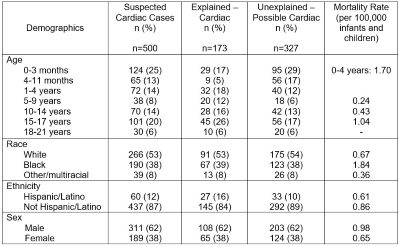
Results: Of the 5021 Case Registry cases, 10% were classified as a suspected cardiac death. Of these, 35% were categorized as Explained-Cardiac, and 65% as Unexplained-Possible Cardiac. Suspected cardiac death was most common in infants (38%). Of all suspected cardiac cases, 40% were witnessed, 20% had a known cardiac diagnosis prior to death and 16% of deaths occurred during exertion. The most common reason cases were categorized as Explained-Cardiac were myocarditis (34%), congenital heart disease (18%), non-hypertrophic cardiomyopathy (17%), and hypertrophic cardiomyopathy (14%). The most common reason cases were categorized as Unexplained-Possible Cardiac was family history (38%). The overall mortality rate of SDY due to a suspected cardiac cause from 2015 to 2022 was 0.82 per 100,000 infants and children.

Conclusions: Suspected cardiac SDY disproportionately affects infants, Black children, and males. It is often witnessed but occurs more often at rest than exertion. These data may further inform risk prevention strategies and secondary prevention efforts such as access to AEDs and CPR training.
  • Gilpin, Kirby  ( Children's National Hospital , Washington , District of Columbia , United States )
  • Burns, Kristin  ( National Institutes of Health , Bethesda , Maryland , United States )
  • Schwartz, Bryanna  ( National Institutes of Health , Bethesda , Maryland , United States )
  • Author Disclosures:
    Kirby Gilpin: DO NOT have relevant financial relationships | Kristin Burns: DO NOT have relevant financial relationships | Bryanna Schwartz: DO NOT have relevant financial relationships
Meeting Info:

Scientific Sessions 2025

2025

New Orleans, Louisiana

Session Info:

Improving Care and Outcomes in Congenital and Pediatric Heart Disease

Saturday, 11/08/2025 , 02:30PM - 03:30PM

Abstract Poster Board Session

More abstracts on this topic:
Acceptability and Gain of Knowledge of Community Educational Tools About Rheumatic Heart Disease Integrated With Screening In Low-Income Settings

Abrams Jessica, Nunes Maria, Diniz Marina, Fraga Lucas, Paula Luiza, Coelho Cecilia, Tacuri Chavez Luz Marina, Lemos Larissa, Correia Julliane, Ribeiro Antonio, Nascimento Bruno, Sable Craig, Spaziani Alison, Zuhlke Liesl, Cardoso Clareci, Vinhal Wanessa, Ribeiro Isabely, Oliveira Kaciane, Amaral Ingred Beatriz

A Comprehensive Study on Machine Learning Models Combining with Oversampling for One-year Persistent Coronary Artery Aneurysm in Kawasaki Disease

Liang Kaizhi, Pang Yusheng, Su Danyan

You have to be authorized to contact abstract author. Please, Login
Not Available