
Logo

American Heart Association

  18
  0


Final ID: MP968

Inhibition of PARP-1 selectively improves diastolic function in diabetic rat: potential role of glycocalyx protection.

Abstract Body (Do not enter title and authors here): Background: Diabetic heart failure is characterised by predominantly diastolic dysfunction and has been associated with impaired cardiac energetics and inflammation. We recently found evidence of increased endothelial glycocalyx damage in a rat model of diabetic heart failure. This was associated with increased myocardial content of 3-nitrotyrosine (3-NT), a “fingerprint” of peroxynitrite. Increased peroxynitrite results in DNA damage, which then activates poly-ADP-ribose polymerase-1 (PARP-1) to initiate DNA repair. In turn, PARP-1 activation will deplete NAD+ and cause energetic impairment.

Hypothesis: We hypothesised that inhibition of PARP-1 would ameliorate cardiac dysfunction observed in diabetic rats, and also the associated impairment of endothelial glycocalyx integrity.

Methods: Diabetic heart failure was induced in 8-week-old male Wistar rats with 12 weeks of modified diets and two doses of streptozotocin at 30mg/kg/d. After induction of diabetes, the rats were randomised to receive 3-aminobenzamide (3-AB) at 40mg/kg/d or saline for 6 weeks (n=17/group). At the end of the study, cardiac function was determined via echocardiography. Plasma concentrations of matrix metalloproteinase-9 (MMP-9), as inflammatory stimulus that mediate glycocalyx damage, markers of glycocalyx damage [syndecan-1 [SD-1], heparan sulfate (HS) and hyaluronan (HA)], and angiopoietin-2 (Ang-2) as inducer of increased vascular permeability were measured, as was 3-NT.

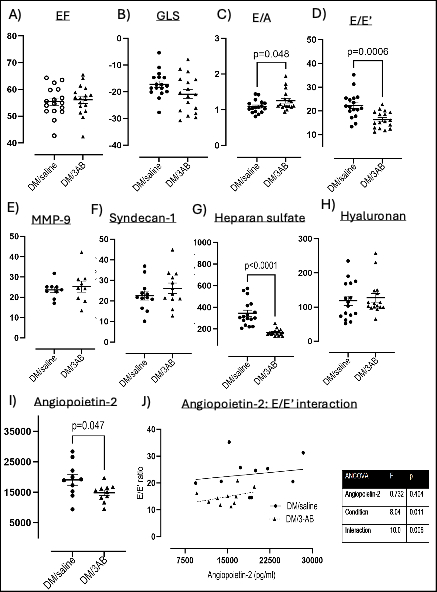
Results: 3-AB treated rats displayed significantly improved diastolic (E/A and E/E’), but not systolic (EF, global longitudinal strain) function (Fig A-D). While 3-AB did not affect plasma MMP-9, SD-1 or HA, there was significant reduction in Ang-2 and HS (Fig E-I). ANCOVA (Fig J) revealed a direct correlation between Ang-2 and E/E’. Lastly, there was no significant difference in 3-NT between groups.

Conclusion: In a rat model of diabetic heart failure, inhibition of PARP-1 with 3-AB for 6 weeks selectively improved diastolic function. There was also reduction in plasma levels of heparan sulfate and angiopoietin-2, suggesting that 3-AB protects the microvascular glycocalyx from damage by PARP-1, presumably by limiting oxidative stress.
  • Negera, Getandale  ( The University of Adelaide , Adelaide , South Australia , Australia )
  • Stafford, Irene  ( CALHN-The Queen Elizabeth Hospital , Adelaide , South Australia , Australia )
  • Surikow, Sven  ( Lyell McEwin Hospital , Elizabeth , South Australia , Australia )
  • Chapman, Matthew  ( Lyell McEwin Hospital , Elizabeth , South Australia , Australia )
  • Dudhwala, Zenab  ( The University of Adelaide , Woodville South , South Australia , Australia )
  • Horowitz, John  ( The University of Adelaide , Woodville South , South Australia , Australia )
  • Chong, Cher-rin  ( The University of Adelaide , Woodville South , South Australia , Australia )
  • Author Disclosures:
    Irene Stafford: DO NOT have relevant financial relationships | Sven Surikow: DO NOT have relevant financial relationships | Matthew Chapman: No Answer | Zenab Dudhwala: DO NOT have relevant financial relationships | John Horowitz: DO NOT have relevant financial relationships | Cher-Rin Chong: DO NOT have relevant financial relationships
Meeting Info:

Scientific Sessions 2025

2025

New Orleans, Louisiana

Session Info:

Heart Failure and Cardiomyopathy: From Bench to Bedside

Saturday, 11/08/2025 , 03:15PM - 04:25PM

Moderated Digital Poster Session

You have to be authorized to contact abstract author. Please, Login
Not Available