
Logo

American Heart Association

  46
  0


Final ID: Wed003

PARP-1 Inhibition Ameliorates LV Diastolic Dysfunction And Selectively Reverses Glycocalyx Damage in A Rat Model of Subacute Diabetic/Hyperglycemic Cardiomyopathy

Abstract Body: Background: Diabetes (DM) significantly increases the risk of heart failure and is associated with increased permeability of the microcoronary glycocalyx. Our previous studies in a rat model of diabetes/hyperglycemia demonstrated that 8 weeks of severe hyperglycemia induced left ventricular (LV) systolic and diastolic dysfunction associated with increased endothelial glycocalyx (eGlx) damage, nitrosative stress, and inflammatory activation.
This study assessed the effects of 3-aminobenzamide (3-AB), a poly (ADP-ribose) polymerase-1 (PARP-1) inhibitor, on these abnormalities.
Methods: 34 male Wistar rats (~250 g, 8 weeks old) were randomly assigned to one of two experimental groups: DM/saline (n=17), and DM/3-AB (n=17). The sample size was powered (α=0.05, β=0.8) to detect a 1 SD difference between groups. DM/hyperglycemia was induced by 11 weeks of high-fat high-sucrose diet and streptozotocin injections. Two weeks post DM induction, the treatment group received daily intraperitoneal injections of 3-AB (40 mg/kg in sterile saline) for 6 weeks, while controls received saline injections.
At the end of the study, cardiac function was assessed via transthoracic echocardiography and contractile reserve evaluated via pacing-induced tachycardia during isolated heart perfusion. Plasma concentrations of syndecan-1 (SD-1) and heparan sulfate proteoglycan (HSPG) were measured as markers of eGlx damage. Cardiac tissue was immunoblotted for thioredoxin-interacting protein (TXNIP) and CD68, markers of inflammasome activation and macrophage/monocyte infiltration, respectively. Unpaired Student’s t-test and 2-way ANOVA with repeated measures were used for statistical comparisons.
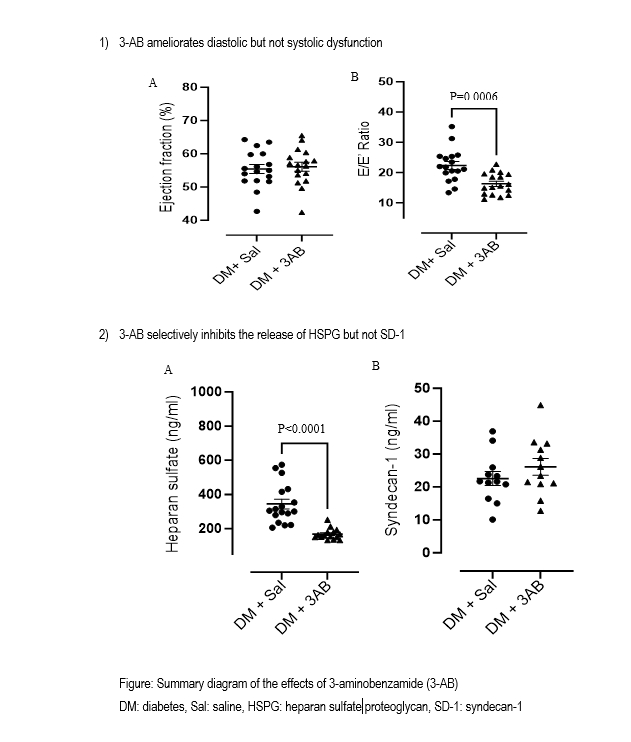
Results: Treatment with 3-AB improved LV diastolic function significantly (E/E' ratio: 16.3 ± 0.86 vs. 22.4 ± 1.33au; mean±SEM, p=0.0006), without significant impact on LV systolic function (LVEF: 56.1 ± 1.35% vs. 55.4 ± 1.35%; p=0.71) or improvement in contractile reserve during pacing-induced tachycardia (ANOVA: F=0.77; p=0.39). 3-AB treatment significantly reduced plasma HSPG concentrations (167.5 ± 8.36 vs. 344.0 ± 28.4 ng/ml; p<0.0001) but had no effect on those of SD-1 (26.1 ± 2.55 vs. 22.6 ± 2.15 ng/ml; p=0.30), or cardiac TXNIP and CD68 content.
Conclusions: 6 weeks of PARP-1 inhibition with 3-AB ameliorated DM-induced LV diastolic dysfunction and selectively restored plasma HSPG, potentially via inhibition of matrix metalloproteinase-induced eGlx damage.
  • Negera, Getandale  ( The University of Adelaide , Adelaide , South Australia , Australia )
  • Stafford, Irene  ( CALHN-The Queen Elizabeth Hospital , Adelaide , South Australia , Australia )
  • Surikow, Sven  ( Lyell McEwin Hospital , Adelaide , South Australia , Australia )
  • Chapman, Matthew  ( Lyell McEwin Hospital , Adelaide , South Australia , Australia )
  • Horowitz, John  ( The University of Adelaide , Adelaide , South Australia , Australia )
  • Chong, Cher-rin  ( The University of Adelaide , Adelaide , South Australia , Australia )
  • Author Disclosures:
    Getandale Negera: DO NOT have relevant financial relationships | Irene Stafford: DO NOT have relevant financial relationships | Sven Surikow: DO NOT have relevant financial relationships | Matthew Chapman: No Answer | John Horowitz: DO NOT have relevant financial relationships | Cher-Rin Chong: No Answer
Meeting Info:

Basic Cardiovascular Sciences 2025

2025

Baltimore, Maryland

Session Info:

Poster Session and Reception 1

Wednesday, 07/23/2025 , 04:30PM - 07:00PM

Poster Session and Reception

More abstracts from these authors:
Inhibition of PARP-1 selectively improves diastolic function in diabetic rat: potential role of glycocalyx protection.

Negera Getandale, Stafford Irene, Surikow Sven, Chapman Matthew, Dudhwala Zenab, Horowitz John, Chong Cher-rin

You have to be authorized to contact abstract author. Please, Login
Not Available