Prolonged QT Interval After Cryptogenic Stroke and Risk of Recurrent Stroke in the ARCADIA Trial
Abstract Body (Do not enter title and authors here): Introduction: Prolonged QT interval has been associated with first stroke of any type in the general population. Whether QT prolongation predicts recurrent stroke is unknown.
Hypothesis: We hypothesized that QT prolongation would be associated with increased risk of recurrent stroke in individuals who recently suffered a cryptogenic stroke.
Methods: The Atrial Cardiopathy and Antithrombotic Drugs in Prevention After Cryptogenic Stroke (ARCADIA) trial randomized individuals with cryptogenic stroke and atrial cardiopathy to apixaban versus aspirin to assess the prevention of recurrent strokes. We excluded participants with missing QT interval data and those who had ventricular conduction defects or pacemakers. The baseline electrocardiogram (ECG) was the first technically adequate ECG to be done after stroke onset. QT interval was corrected for heart rate (QTc) using a cohort-specific correction formula, as well as the Framingham, Hodges, Bazett, and Fridericia formulae. For each QTc variable, prolonged QTc was defined as >450 ms in men or >460 ms in women. Cox proportional hazards models were used to assess the association between QTc and recurrent stroke. Models were adjusted for randomization arm, age, sex, race, smoking, hypertension, diabetes, prior stroke, and N-terminal pro-B-type natriuretic peptide.
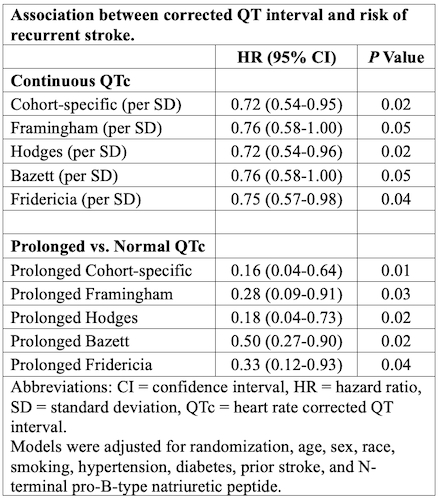
Results: Among 881 participants, 139 (15.8%) had a prolonged cohort-specific QTc. Over a mean of 1.8 years, 62 recurrent strokes of any type occurred (crude rate 7.0%, annualized rate 3.9% per year). After multivariable adjustment, prolongation of cohort-specific QTc was associated with decreased risk of stroke (hazard ratio [95% confidence interval] = 0.72 [0.54-0.95] per standard deviation and 0.16 [0.04-0.64] for prolonged vs. normal QTc). These findings were consistent across all methods of QT correction (Table). Accounting for QRS duration, incident atrial fibrillation, and the competing risk of death did not change the results.
Conclusions: In a population with recent cryptogenic stroke and atrial cardiopathy, QTc prolongation was associated with a lower risk of recurrent stroke. These findings contrast with the association observed between QTc prolongation and stroke in the general population, which may reflect selection bias or bias from ECGs obtained in the acute phase of stroke. If replicated, these findings suggest that repolarization markers like QTc may play different roles in stroke risk stratification for first versus recurrent stroke.
Boursiquot, Brian
(
Columbia University Medical Center
, New York , New York , United States )
Elias, Adi
(
University of California San Francisco
, San Francisco , California , United States )
Kamel, Hooman
(
Weill Cornell Medicine
, New York , New York , United States )
Kronmal, Richard
(
University of Washington
, Seattle , Washington , United States )
Marcus, Gregory
(
University of California San Francisco
, San Francisco , California , United States )
Di Tullio, Marco
(
Columbia University Medical Center
, New York , New York , United States )
Tirschwell, David
(
University of Washington
, Seattle , Washington , United States )
Elkind, Mitchell
(
Columbia University Medical Center
, New York , New York , United States )
Longstreth, W
(
University of Washington
, Seattle , Washington , United States )
Soliman, Elsayed
(
Wake Forest School of Medicine
, Winston Salem , North Carolina , United States )
Author Disclosures:
Brian Boursiquot:DO NOT have relevant financial relationships
| Elsayed Soliman:DO NOT have relevant financial relationships
| Adi Elias:DO NOT have relevant financial relationships
| Hooman Kamel:DO NOT have relevant financial relationships
| Richard Kronmal:DO NOT have relevant financial relationships
| Gregory Marcus:DO have relevant financial relationships
;
Consultant:InCarda :Active (exists now)
; Individual Stocks/Stock Options:InCarda :Active (exists now)
| Marco Di Tullio:DO NOT have relevant financial relationships
| David Tirschwell:DO NOT have relevant financial relationships
| Mitchell Elkind:DO have relevant financial relationships
;
Employee:American Heart Association:Active (exists now)
| W Longstreth:DO NOT have relevant financial relationships