
Logo

American Heart Association

  17
  0


Final ID: MP2570

Predicting Aortic Diameter Expansion in Acute Uncomplicated Type B Aortic Dissection Using a Novel Voxel-Based Statistical Shape Modeling Approach

Abstract Body (Do not enter title and authors here): Background: Type B aortic dissection (TBAD) occurs when a tear develops in the intimal layer of the descending aorta. Aortic expansion remains a major factor limiting acuate uncomplicated TBAD patients’ survival outcomes. Accurately predicting aortic diameter growth may guide the selection of optimal treatment strategies on a patient-specific basis, improving patient survival. We developed a voxel-based statistical shape modeling (SSM) approach for complex, multi-label TBAD anatomies and hypothesized that the extracted shape features could predict aortic growth.
Methods: 55 clinical CT scans from 22 patients at diagnosis and follow-up were obtained. The true and false lumens, dissection flap, fenestrations, and thrombus were segmented from the CT images. Each patient’s geometry included three anatomical components: (1) true and false lumens represented by voxel segmentations, (2) thrombus modeled with a voxel grid within the false lumen, and (3) fenestrations mapped onto a surface pixel grid of the dissection flap. This representation enabled construction of three independent statistical shape models (SSMs) for the individual components. Principal component analysis was applied to each component after converting the voxel- and pixel-based representations into continuous forms. The resulting SSM-derived shape features were used to predict aortic diameter growth rates via linear regression with leave-one-out (LOO) cross-validation.
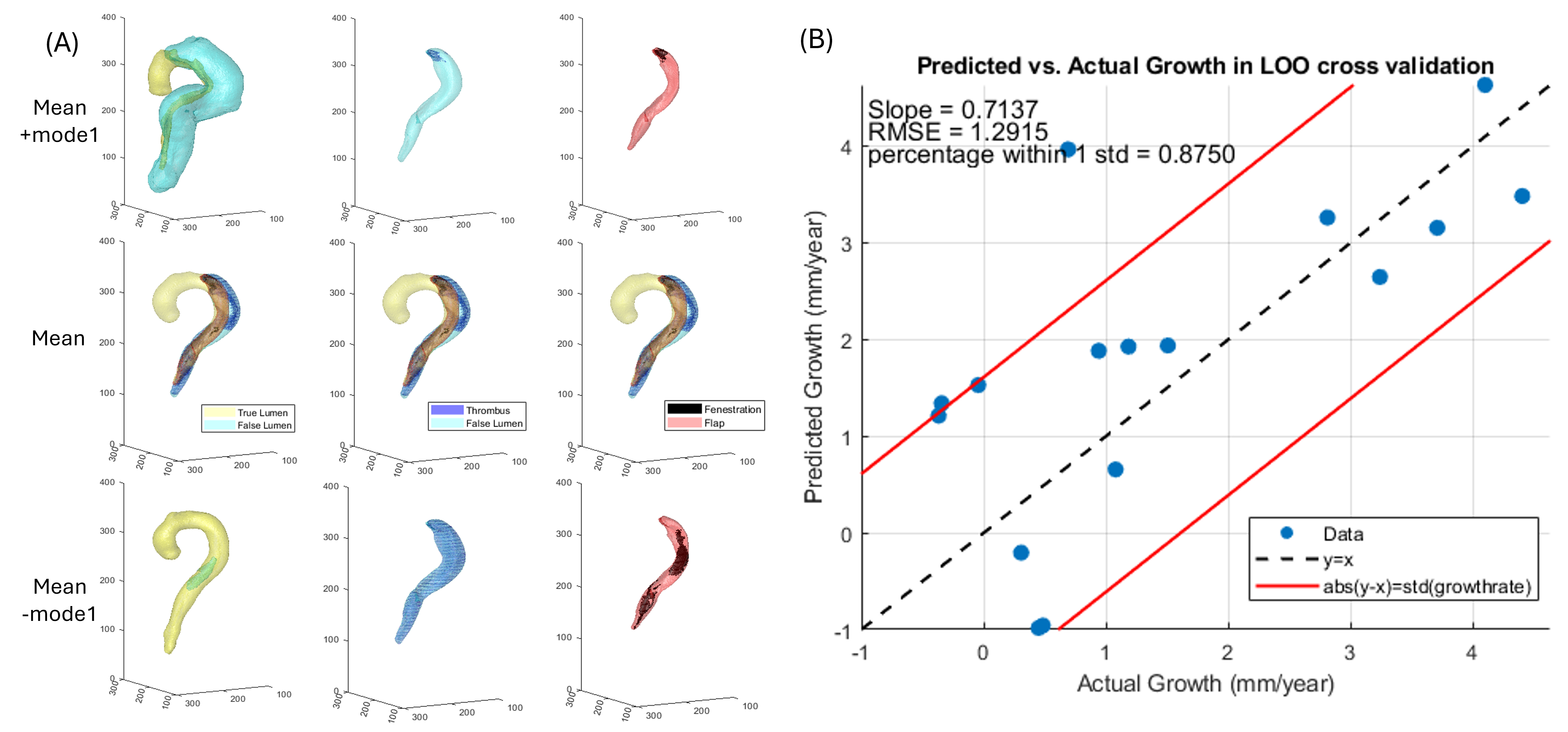
Results: The first eight SSM shape modes from each of the true and false lumen, thrombus, and fenestration models explained 88%, 92%, and 66% of shape variation, respectively. Figure (A) shows the mean TBAD shape and the first mode of variation from each SSM. These anatomical shape features derived from the SSMs were used to predict aortic growth rates using linear regression. Fig. (B) shows the actual versus predicted growth rates from leave-one-out cross-validation. The results demonstrated a root mean square error (RMSE) of 1.29 mm, with 87.5% of the predicted growth rates falling within one standard deviation of the actual growth rates.
Conclusion: The novel voxel-based shape representation enabled the construction of independent SSMs for distinct anatomical components of TBAD, allowing for detailed modeling of complex shape features. The combination of SSM-derived shape features from voxel-based representations with linear regression presents a promising strategy for predicting aortic growth rates.
  • Li, Zhuofan  ( Texas Tech University , Lubbock , Texas , United States )
  • Oshinski, John  ( EMORY UNIVERSITY SCHOOL OF MEDICINE , Atlanta , Georgia , United States )
  • Elefteriades, John  ( Yale University School of Medicine , New Haven , Connecticut , United States )
  • Gleason, Rudolph  ( GEORGIA INSTITUTE OF TECHNOLOGY , Atlanta , Georgia , United States )
  • Leshnower, Bradley  ( EMORY UNIVERSITY SCHOOL OF MEDICINE , Atlanta , Georgia , United States )
  • Liu, Minliang  ( Texas Tech University , Lubbock , Texas , United States )
  • Author Disclosures:
    Zhuofan Li: DO NOT have relevant financial relationships | John Oshinski: No Answer | John Elefteriades: DO NOT have relevant financial relationships | Rudolph Gleason: DO NOT have relevant financial relationships | Bradley Leshnower: DO NOT have relevant financial relationships | Minliang Liu: DO NOT have relevant financial relationships
Meeting Info:

Scientific Sessions 2025

2025

New Orleans, Louisiana

Session Info:

Best of Vascular Imaging

Monday, 11/10/2025 , 10:45AM - 12:00PM

Moderated Digital Poster Session

More abstracts on this topic:
A Machine Learning-Derived Socio-Environmental Risk Score More Accurately Predicts Cardiovascular Events and Better Addresses Health Inequities than Social Deprivation Index

Chen Zhuo, Nasir Khurram, Al-kindi Sadeer, Rajagopalan Sanjay, Ponnana Sai Rahul, Dazard Jean-eudes, Zhang Tong, Dong Weichuan, Okyere Robert, Sirasapalli Santosh, Deo Salil, Khraishah Haitham

Analysis of Polarization Changes in Ascending Aortic Endothelial Cells Induced by Aortic Valve Regurgitation

Tamagawa Yuki, Miyagawa Shigeru, Kawamura Takuji, Harada Akima, Miyake Keisuke, Kawamura Ai, Kido Takashi, Yamashita Kizuku, Shimamura Kazuo, Saito Shunsuke

More abstracts from these authors:
Linking In Vivo Flap Motion to Ex Vivo Flap Thickness in Type B Aortic Dissection: Acute vs Chronic Insights

Cebull Hannah, Dong Hai, Naeem Muhammad, Liu Minliang, Elefteriades John, Gleason Rudolph, Oshinski John, Leshnower Bradley

Hemodynamics of Acute Type B Aortic Dissections with 4D Flow MRI

Cebull Hannah, Naeem Muhammad, Liu Minliang, Dong Hai, Gleason Rudolph, Elefteriades John, Piccinelli Marina, Oshinski John, Leshnower Bradley

You have to be authorized to contact abstract author. Please, Login
Not Available