
Logo

American Heart Association

  23
  0


Final ID: MP1298

Linking In Vivo Flap Motion to Ex Vivo Flap Thickness in Type B Aortic Dissection: Acute vs Chronic Insights

Abstract Body (Do not enter title and authors here): Introduction: Type B aortic dissection (TBAD) is a serious condition that may benefit from early endovascular repair. In the acute phase (aTBAD; <14 days onset), the high compliance of the dissection flap improves success of endovascular repair. In the chronic phase (cTBAD; >90 days onset), the flap stiffens and makes endovascular repair less effective. This study aimed to better characterize dissection flap behavior and understand the cause of stiffening.

Hypothesis: We hypothesize that remodeling of the dissection flap in TBAD leads to decreased dynamic displacement over time, driven by structural thickening and stiffening.

Methods: We combined in vivo imaging and ex vivo tissue analyses. A total of 15 2D phase-contrast magnetic resonance imaging (PC-MRI) datasets were analyzed (4 cTBAD; 11 aTBAD). For dissection flap thickness, a separate cohort of 41 tissue samples were used (20 cTBAD; 10 aTBAD, 11 control). We used an in-house MATLAB code to analyze flap motion in the 2D PC-MRI data. We extracted maximum displacement by calculating the Euclidean distance between corresponding points on the flap at systole and diastole. After surgical excision, dissection flap samples were placed into cryopreservation medium (10% DMSO + 90% RPMI) and stored in a -80 °C freezer. Prior to measurement, tissue was thawed at around 37 °C, and tissue thickness was measured by a micrometer. Control dissection flaps were created by peeling healthy descending aortic tissue at the level of the media and combined intimal and partial medial layers were measured together as control flap thickness. Group differences were assessed using the Mann-Whitney U test.

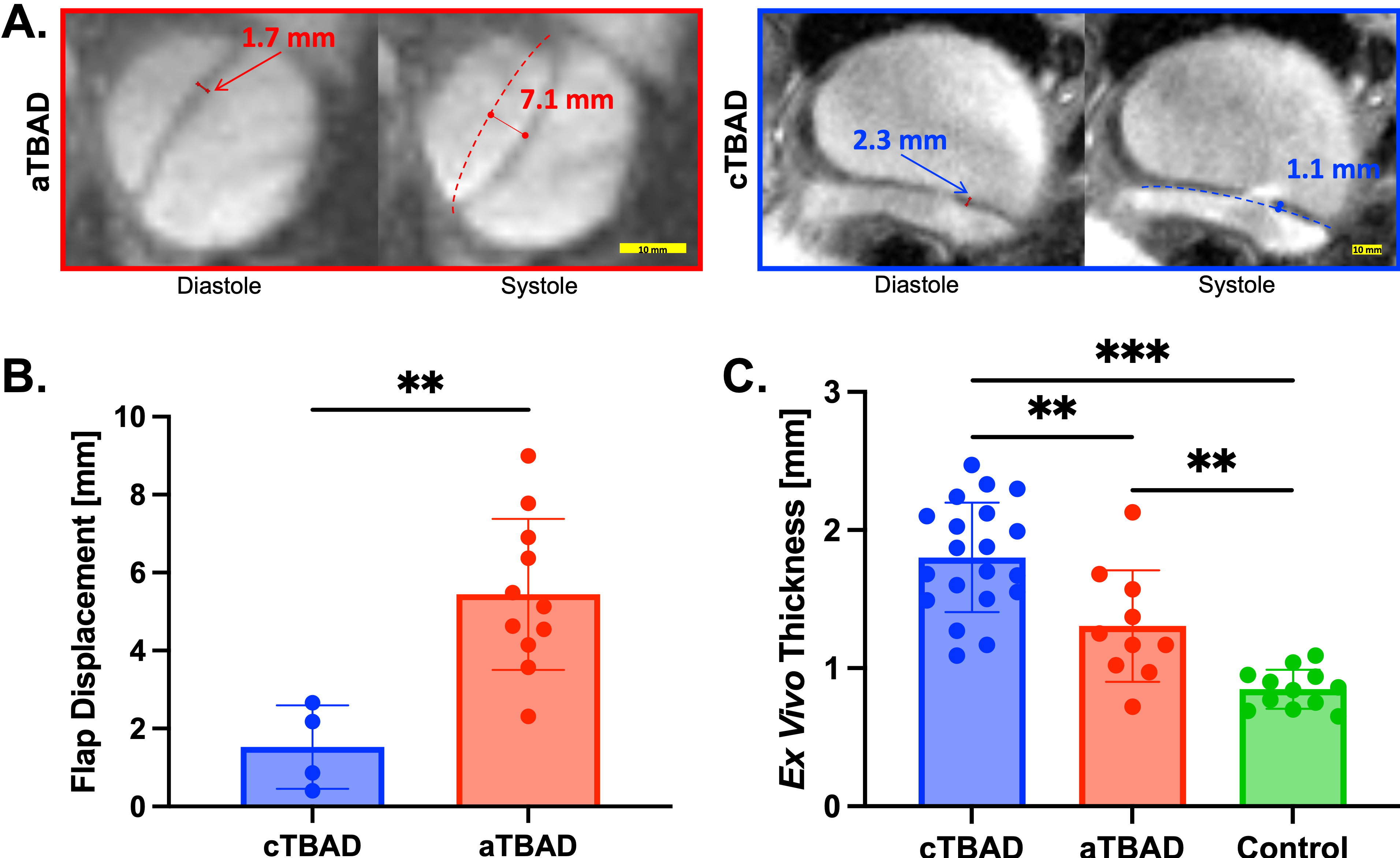
Results: 2D PC-MRI revealed large differences in dissection flap displacement between cTBAD and aTBAD (Fig. 1A,B). Mean maximum displacements in the acute group (5.4±1.9 mm) were significantly higher than chronic (1.5±1.1 mm; p < 0.01). Thickness measurements of the dissection flaps varied greatly: cTBAD = 1.8±0.4, aTBAD = 1.3±0.4, control = 0.8±0.1 mm. All group comparisons revealed significant differences (Fig. 1C). Since bending stiffness is proportional to the cube of thickness, we can also expect a significant increase in chronic dissection flap stiffness.

Conclusions: Dissection flaps in chronic TBAD exhibit reduced motion and increased stiffness compared to the acute phase. These properties are related to structural thickening which highlights the importance of early intervention before adverse remodeling occurs.
  • Cebull, Hannah  ( Emory University , Vermilion , Ohio , United States )
  • Dong, Hai  ( Emory University , Suwanee , Georgia , United States )
  • Naeem, Muhammad  ( Emory University School of Medicine , ATLANTA , Georgia , United States )
  • Liu, Minliang  ( Texas Tech University , Lubbock , Texas , United States )
  • Elefteriades, John  ( Yale University School of Medicine , New Haven , Connecticut , United States )
  • Gleason, Rudolph  ( GEORGIA INSTITUTE OF TECHNOLOGY , Atlanta , Georgia , United States )
  • Oshinski, John  ( SOM: Emory University , Atlanta , Georgia , United States )
  • Leshnower, Bradley  ( EMORY UNIVERSITY SCHOOL OF MEDICINE , Atlanta , Georgia , United States )
  • Author Disclosures:
    Hannah Cebull: DO NOT have relevant financial relationships | Hai Dong: DO NOT have relevant financial relationships | MUHAMMAD NAEEM: No Answer | Minliang Liu: DO NOT have relevant financial relationships | John Elefteriades: DO NOT have relevant financial relationships | Rudolph Gleason: DO NOT have relevant financial relationships | John Oshinski: No Answer | Bradley Leshnower: DO NOT have relevant financial relationships
Meeting Info:

Scientific Sessions 2025

2025

New Orleans, Louisiana

Session Info:

Putting the Vascular Back in CV Imaging: Extra-cardiac Advances in Multimodality Imaging

Sunday, 11/09/2025 , 03:15PM - 04:25PM

Moderated Digital Poster Session

More abstracts on this topic:
Abdominal Aortic Blood Flow and Interstage Growth and Neurodevelopment in Patients with Single Ventricle Heart Disease

Abumregha Osama, Seed Mike, Floh Alejandro, Lee Fu-tsuen, Chetan Devin, Tedesco-bruce Anna, Herridge Joann, Gibson Erika, Honjo Osami, Sananes Renee, Ly Linh

Can IVUS Predict Aortic Remodeling?
The Role of Flap Mobility in Type B Aortic Dissection With TEVAR

Kameda Yuika, Samejima Yusuke, Nemoto Naohiko, Anzai Hitoshi

More abstracts from these authors:
Progressive Flap Thickening Mediated by Wall Shear Stress in Chronic Type B Aortic Dissection

Dong Hai, Liang Xue, Liu Minliang, Cebull Hannah, Naeem Muhammad, Oshinski John, Elefteriades John, Gleason Rudolph, Leshnower Bradley

Hemodynamics of Acute Type B Aortic Dissections with 4D Flow MRI

Cebull Hannah, Naeem Muhammad, Liu Minliang, Dong Hai, Gleason Rudolph, Elefteriades John, Piccinelli Marina, Oshinski John, Leshnower Bradley

You have to be authorized to contact abstract author. Please, Login
Not Available