
Logo

American Heart Association

  24
  0


Final ID: MP1998

HP-13CMRAnalyst: A MATLAB Application for Dynamic Cardiac Metabolic Imaging Analysis Using Hyperpolarized Carbon-13 MRI

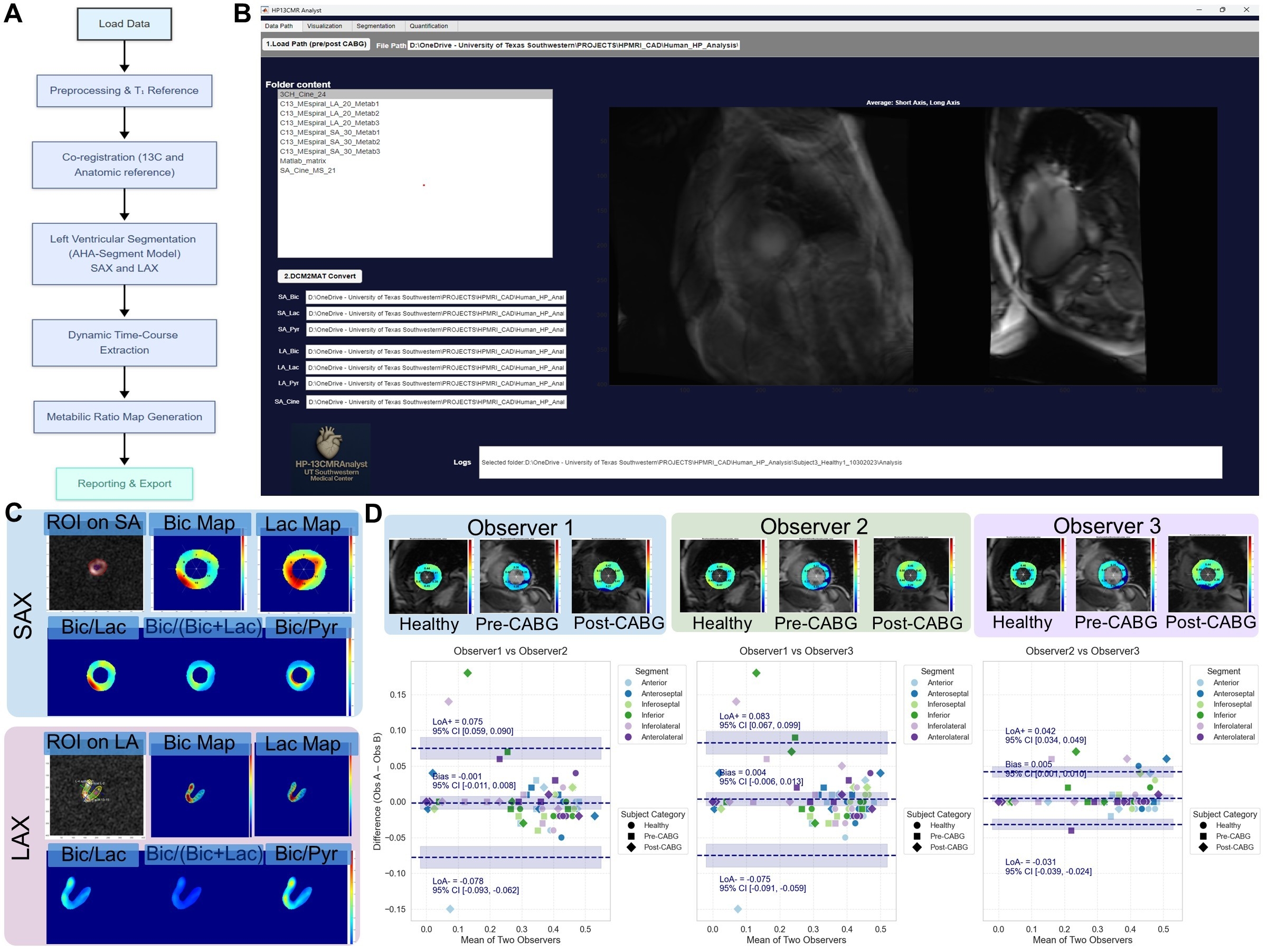
Abstract Body (Do not enter title and authors here): Introduction: Hyperpolarized [1-13C] pyruvate magnetic resonance imaging (HP-13C MRI) enables real-time, noninvasive assessment of myocardial metabolism. While the technique is increasingly applied in cardiac research, dedicated tools for standardized analysis remain limited. We developed HP-13CMRAnalyst, a MATLAB-based application that supports dynamic 13C data processing through semi-automated segmentation, time-course extraction, and metabolic ratio mapping (Figure 1A).
Hypothesis: An integrated platform combining multi-frame 13C data import, cine co-registration, multi-segment analysis, and voxel-level ratio mapping facilitates reproducible quantification of myocardial metabolism.
Methods: HP-13CMRAnalyst was implemented in MATLAB App Designer and distributed as an .mlappinstall package. It accepts DICOM or NIfTI dynamic pyruvate, lactate, and bicarbonate images (∼3 s resolution; ≤ 60 s)(Figure 1B). Cine-registered T1-weighted images guide AHA 17-segment LV segmentation on short axis (SAX) and long axis (LAX) views (Figure 1C). A time slider displays metabolite overlays. Peak intensities are extracted per segment to compute bicarbonate/lactate and bicarbonate/pyruvate ratios. Pixel-wise ratio maps are exported as CSV, MATLAB struct, and PDF summaries.
Results: Eight subjects (n = 4 healthy; n = 4 coronary artery disease [CAD]), each imaged pre- and post-CABG (total n = 12 datasets; age 55 ± 12 years), were processed in < 5 min per dataset on a standard desktop (MATLAB R2024b). Semi-automated versus manual segmentation agreement was high (Dice 0.89–0.93). Inter-observer variability for segmental bicarbonate/(bicarbonate + lactate) ratios were minimal biases < 0.005 and limits of agreement within ± 0.083 across all observer pairs (Figure 1D). Ratio maps qualitatively revealed regional metabolic heterogeneity. Automated reports accurately reflected metadata and segmental summaries. The GUI, logs, and summary files streamline standardized processing.
Conclusions: HP-13CMRAnalyst delivers a rapid (< 5 min), reproducible framework for dynamic HP-13C MRI analysis. By combining semi-automated segmentation and pixel-level ratio mapping with low inter-observer variability, this platform may accelerate adoption of 13C metabolic imaging in human cardiac research.
  • Sharma, Gaurav  ( UT Southwestern Medical Center , Dallas , Texas , United States )
  • Jagtap, Jaidip  ( Mayo Clinic , Rochester , Minnesota , United States )
  • Peltz, Matthias  ( UT Southwestern Medical Center , Dallas , Texas , United States )
  • Malloy, Craig  ( UT Southwestern Medical Center , Dallas , Texas , United States )
  • Jessen, Michael  ( UT Southwestern Medical Center , Dallas , Texas , United States )
  • Author Disclosures:
    Gaurav Sharma: DO NOT have relevant financial relationships | Jaidip Jagtap: DO NOT have relevant financial relationships | Matthias Peltz: DO NOT have relevant financial relationships | Craig Malloy: No Answer | Michael Jessen: No Answer
Meeting Info:

Scientific Sessions 2025

2025

New Orleans, Louisiana

Session Info:

Moving the Needle: Expanding Capabilities in Multimodality Imaging

Monday, 11/10/2025 , 09:15AM - 10:30AM

Moderated Digital Poster Session

More abstracts on this topic:
More abstracts from these authors:
Hyperpolarized Carbon-13 Metabolic Imaging Detects Changes in Cardiac Mitochondrial Metabolism in Patients Before and After Coronary Artery Bypass Graft Surgery

Sharma Gaurav, Mcneil Sarah, Lin Sung-han, Harrison Crystal, Park Jae Mo, Peltz Matthias, Malloy Craig, Jessen Michael

Noninvasive cardiac phenotyping in patients treated with chemo- and immunotherapy for breast cancer

Khashami Fatemeh, Henning Anke, Unni Nisha, Zaha Vlad, Dimitrov Ivan E, Fuetterer Maximilian, Kozerke Sebastian, Harrison Crystal, Huynh Mai, Park Jae Mo, Kovacs Zoltan, Malloy Craig

You have to be authorized to contact abstract author. Please, Login
Not Available