
Logo

American Heart Association

  141
  0


Final ID: MDP597

Invasive Versus Conservative Management Strategy in NSTE-MI in ≥70-Year-Old Patients: A Meta-Analysis.

Abstract Body (Do not enter title and authors here): Background: Ambiguity surrounds invasive management of non-ST-segment elevation myocardial infarction (NSTE-MI) in older adults (≥70 years), and the number of elderly patients undergoing invasive treatment in clinical practice remains relatively low. Data comparing the efficacy of invasive versus conservative medical management for NSTEMI in this population is conflicting due to the under-representation or exclusion of the older population from randomized controlled trials (RCTs).
Methods: We performed a meta-analysis of RCTs to evaluate the long-term outcomes of invasive versus conservative medical strategies in older patients with NSTEMI. Random effects meta-analysis was conducted to estimate the odds ratio (OR) with 95% CI for the individual endpoints of all-cause mortality, cardiovascular (CV) mortality, recurrent myocardial infarction (MI), unplanned revascularization, and readmission for cardiovascular causes.
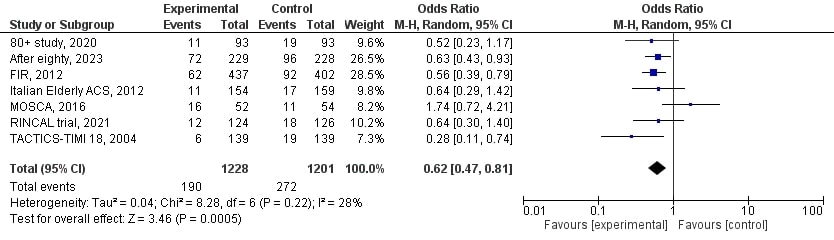
Results: A total of nine RCTs with 4,336 patients (Invasive: 2,368; Control: 1,968) with median follow-ups ranging from 6-63.6 months were included. Compared with a conservative strategy, an invasive strategy was associated with a significantly decreased risk of recurrent MI (OR 0.62, 95% CI 0.47-0.81; p<0.001) (Figure 1) and unplanned revascularization (OR 0.38, 95% CI 0.25-0.56; p<0.001). There was no difference in all-cause mortality (OR 0.81, 95% CI 0.39-1.35; p=0.42) (Figure 2), CV mortality (OR 0.72, 95% CI 0.43-1.23; p=0.23), or readmission for cardiovascular causes (OR 1.21, 95% CI 0.63-2.33; p=0.57) between invasive and conservative management strategies.
Conclusion: In older patients ≥70 years old with NSTE-MI, an invasive strategy reduced the risk of recurrent MI and revascularization when compared with conservative management. However invasive strategy did not offer any benefit in mortality or cardiac-cause related readmission over conservative management.
  • Banga, Akshat  ( Mount Auburn Hospital, Harvard Medical School , Cambridge , Massachusetts , United States )
  • Talaei, Fahimeh  ( McLaren Health , Flint , Michigan , United States )
  • Munjal, Parth  ( Rohilkhand Medical College and Hospital , Bareilly , UP , India )
  • Trivedi, Yash Vardhan  ( Jawaharlal Nehru Medical College , Ajmer , RAJ , India )
  • Rathore, Sawai Singh  ( Dr. Sampurnanand Medical College, Jodhpur, India , Jalore , India )
  • Gurav, Jaiprakash  ( Armed Forces Medical College , Pune , MAH , India )
  • Sah, Biki  ( B.P. Koirala Institute of Health Sciences , Dharan , Nepal )
  • Mautong, Hans  ( John H. Stroger Jr. Hospital of Cook County , Chicago , Illinois , United States )
  • Bansal, Vikas  ( Mayo Clinic Rochester , Rochester , Minnesota , United States )
  • Author Disclosures:
    Akshat Banga: DO NOT have relevant financial relationships | Fahimeh Talaei: DO NOT have relevant financial relationships | Parth Munjal: DO NOT have relevant financial relationships | Yash Vardhan Trivedi: DO NOT have relevant financial relationships | Sawai Singh Rathore: DO NOT have relevant financial relationships | Jaiprakash Gurav: DO NOT have relevant financial relationships | Biki Sah: DO NOT have relevant financial relationships | Hans Mautong: DO NOT have relevant financial relationships | Vikas Bansal: No Answer
Meeting Info:

Scientific Sessions 2024

2024

Chicago, Illinois

Session Info:

Age Effects in ACS

Saturday, 11/16/2024 , 12:50PM - 02:15PM

Moderated Digital Poster Session

More abstracts on this topic:
25-Year Decline in Aortic Aneurysm and Dissection Mortality in the U.S.: Impact of Endovascular Repair and Forecast to 2030

Ali Manzer, Umar Haddaya, Nazir Tahira, Nizam Muhammad, Steafo Lark, Sharif Ayesha, Jehangir Hanzala, Arham Muhammad, Hamza Anfal, Hassan Arbaz, Amjad Ans, Ali Iman, Zuha Zuha

ACS-Specific Gut Microbial and Metabolic Profiles Reveal Diagnostic and Recovery Markers

Xu Jing, Fu Jingyuan, Dai Die, Yang Yanan, Yang Jingang, Gao Shanshan, Wu Chongming, He Jiumin, Chen Weihua, Yang Yue-jin

More abstracts from these authors:
You have to be authorized to contact abstract author. Please, Login
Not Available