The Amyloid Paradox: Breakthrough Therapies Drive Diagnostic Recognition, Not Disease Burden
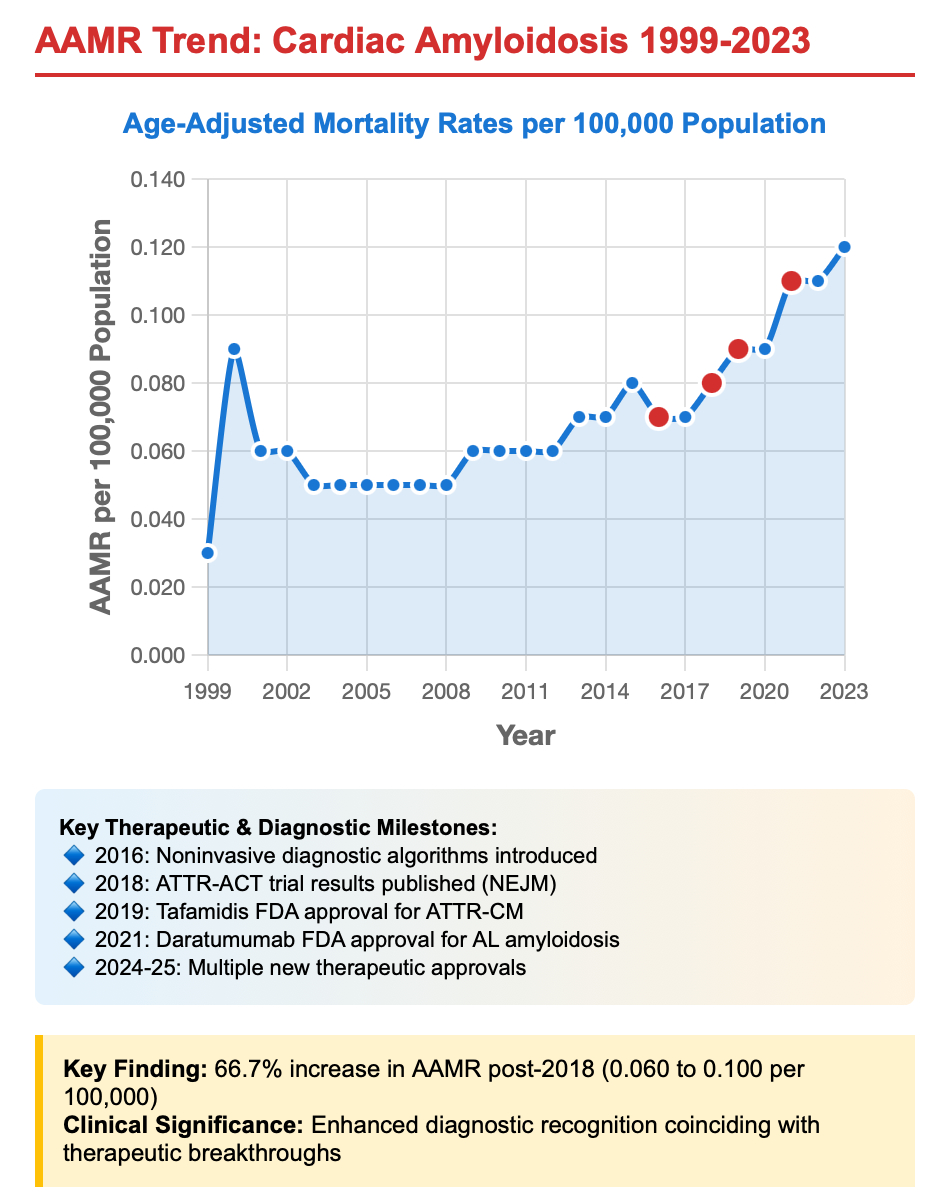
Abstract Body (Do not enter title and authors here): Introduction: Cardiac amyloidosis has undergone revolutionary changes since 2018, with breakthrough therapies demonstrating 30-36% mortality reductions and noninvasive diagnostic algorithms enabling widespread recognition of previously undiagnosed cases. Despite these therapeutic advances, national mortality reporting has paradoxically increased, creating an apparent epidemiological contradiction. Hypothesis: We hypothesized that increased amyloid cardiomyopathy mortality reporting since 2018 reflects enhanced diagnostic recognition of a historically underdiagnosed condition rather than actual increased disease burden, coinciding with therapeutic breakthroughs and diagnostic advances. Methods: We analyzed CDC WONDER Multiple Cause Mortality Data from 1999-2023 for deaths with both amyloidosis (E85.x) and cardiomyopathy (I42.x) ICD-10 codes. Primary outcomes included annual death counts, age-adjusted mortality rates (AAMR) per 100,000 population using the 2000 US Standard Population, and temporal trends comparing the pre-2018 and post-2018 periods. Statistical analysis included percentage changes in average annual deaths and AAMR between periods. Results: Total deaths increased from 66 in 1999 to 330 in 2023, with AAMR rising from 0.03 to 0.12 per 100,000. The pre-2018 period (1999-2017) showed an average annual death of 144.6, with an AAMR of 0.060 per 100,000 (95% CI: 0.05-0.07). The post-2018 period (2018-2023) demonstrated an average annual death of 275.8 with an AAMR of 0.100 per 100,000 (95% CI: 0.09-0.11). This represents a 90.8% increase in average deaths and 66.7% increase in AAMR after 2018. The steepest increases occurred from 2017 (194 deaths, AAMR 0.07, 95% CI: 0.06-0.08) to 2023 (330 deaths, AAMR 0.12, 95% CI: 0.10-0.13), coinciding with the approval of Tafamidis and the widespread implementation of noninvasive diagnostic protocols. Conclusions: The dramatic increase in reported amyloid cardiomyopathy mortality since 2018 parallels the introduction of effective therapies and revolutionary diagnostic capabilities, supporting enhanced case recognition rather than increased disease burden. This epidemiological pattern reflects the transition from an ultra-rare to a recognized, treatable condition, suggesting that massive historical underdiagnosis is now being corrected through improved clinical awareness and diagnostic accessibility.
El Mais, Huda
( Saint Luke's Mid America Heart Inst
, Kansas City
, Missouri
, United States
)
Khan, Abdul Wali
( Saint Luke's Mid America Heart Inst
, Kansas City
, Missouri
, United States
)
Perumalla, Hima Sanjana
( Saint Luke's Mid America Heart Inst
, Kansas City
, Missouri
, United States
)
Modi, Karnav
( Saint Luke's Mid America Heart Inst
, Kansas City
, Missouri
, United States
)
Al-mohtasib, Yazan
( Saint Luke's Mid America Heart Inst
, Kansas City
, Missouri
, United States
)
Asif, Talal
( Saint Luke's Mid America Heart Inst
, Kansas City
, Missouri
, United States
)
Author Disclosures:
Huda El Mais:DO NOT have relevant financial relationships
| Abdul Wali Khan:DO NOT have relevant financial relationships
| Hima sanjana Perumalla:DO NOT have relevant financial relationships
| Karnav Modi:DO NOT have relevant financial relationships
| Yazan Al-Mohtasib:No Answer
| TALAL ASIF:DO NOT have relevant financial relationships