Logo

American Heart Association

  26
  0


Final ID: MP2435

Prevalence of Latent Rheumatic Heart Disease in Brazilian Public Schools: Results 10 Years After Implementation of a Screening Program

Abstract Body (Do not enter title and authors here):
Introduction: Echocardiographic (echo) screening has emerged as an useful tool for identifying latent Rheumatic Heart Disease (RHD), surpassing clinical exam in accuracy. Diagnostic criteria for echo-detected RHD were standardized by the World Heart Federation (WHF) in 2012 and revised in 2023. Screening programs have been implemented across Minas Gerais, Southeast Brazil since 2014. We aimed to assess the prevalence of latent RHD in children and adolescents (ages 5–18) and to compare findings to earlier screening phases prior to program rollout.
Methods: The PROVAR+ program utilizes telemedicine and handheld ultrasound devices (Philips Lumify®) for school-based RHD screening in low-income areas of Minas Gerais. Studies are remotely interpreted by cardiologists in Brazil and the US by telemedicine, using WHF 2012/2023 criteria via a cloud-based platform (Tricefy, USA). We report 24-month screening data from public schools selected by priority criteria of the local board of education. Risk factors were analyzed, and prevalence was compared to results from an earlier cohort screened between 2014–2017 in socio-demographically similar regions (close neighborhoods, with superimposable Human Development Indexes).
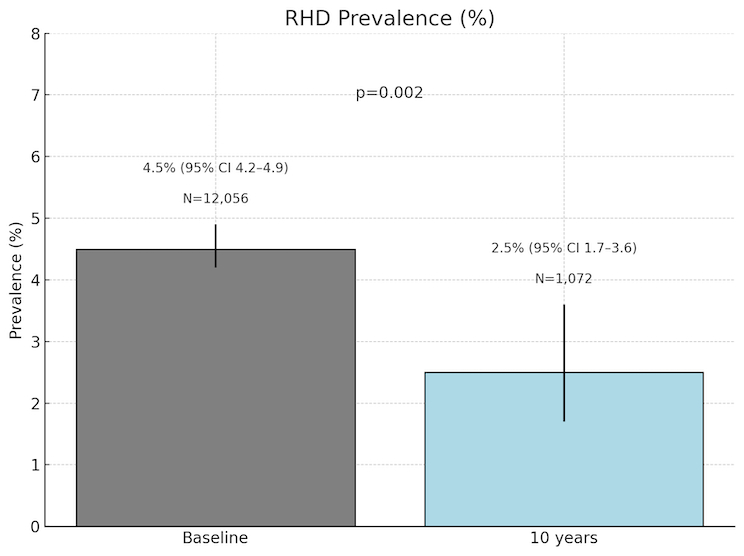
Results: A total of 1,072 students from 8 public schools were screened. Mean age was 14.4±3.7 years; 62% were female. Overall RHD prevalence was 2.5% (95% CI 1.7–3.6), with 2.1% borderline RHD (n=23) and 0.4% definite RHD (n=4). Among borderline cases, 74% (n=17) had isolated mitral regurgitation, 17% (n=4) isolated aortic regurgitation, and 9% (n=2) had ≥2 morphological RHD findings in mitral or aortic valves. Minor congenital heart disease was observed in 18 children (1.7%). Compared to baseline data from 2014–2017 (4.5% (95% CI 4.2 – 4.9) prevalence among 12,056 schoolchildren screened), the current prevalence was significantly lower (p=0.002). Prevalence was similar by sex (female: 2.7% vs. male: 2.2%, p=0.69) and by age (<14 vs. ≥14 years: 1.6% vs. 3.2%, p=0.12). Household crowding (number of residents) did not differ between those with and without RHD (4.1±1.3 vs. 3.7±1.1, p=0.07).
Conclusions: The prevalence of latent RHD among Brazilian children remains significantly high, but a reduction was observed 10 years after the implementation of health education and screening initiatives, presumably due to the combined impact of these locally applied strategies. These findings are important for informing public health policies aimed at addressing RHD.
  • Nascimento, Bruno  ( Universidade Federal de MG , Belo Horizonte , Brazil )
  • Souza, Isadora  ( Universidade Federal de MG , Belo Horizonte , Brazil )
  • Bozzi Soares Santiago, Maria Luiza  ( Universidade Federal de MG , Belo Horizonte , Brazil )
  • Freitas, Bruna  ( Universidade Federal de MG , Belo Horizonte , Brazil )
  • Angelo, Gabriel  ( Universidade Federal de MG , Belo Horizonte , Brazil )
  • Jardim Pereira, Klicia  ( Universidade Federal de MG , Belo Horizonte , Brazil )
  • Spaziani, Alison  ( Children's National Hospital , Washington , District of Columbia , United States )
  • Ribeiro, Antonio Luiz  ( Universidade Federal de MG , Belo Horizonte , Brazil )
  • Sable, Craig  ( Ochsner Children's Hospital , New Orleans , Louisiana , United States )
  • Nunes, Maria  ( Universidade Federal de MG , Belo Horizonte , Brazil )
  • Tacuri Chavez, Luz  ( Universidade Federal de MG , Belo Horizonte , Brazil )
  • Oliveira, Kaciane  ( Universidade Federal de MG , Belo Horizonte , Brazil )
  • Amaral, Ingred Beatriz  ( Universidade Federal de MG , Belo Horizonte , Brazil )
  • Lemos, Larissa  ( Universidade Federal de MG , Belo Horizonte , Brazil )
  • Coelho, Cecilia  ( Universidade Federal de MG , Belo Horizonte , Brazil )
  • Santos, Brenno  ( Universidade Federal de MG , Belo Horizonte , Brazil )
  • De Paula, Luiza  ( Universidade Federal de MG , Belo Horizonte , Brazil )
  • Author Disclosures:
    Bruno Nascimento: DO NOT have relevant financial relationships | Isadora Souza: DO NOT have relevant financial relationships | Maria Luiza Bozzi Soares Santiago: No Answer | Bruna Freitas: No Answer | Gabriel Angelo: DO NOT have relevant financial relationships | Klicia Jardim Pereira: No Answer | Alison Spaziani: DO NOT have relevant financial relationships | Antonio Luiz Ribeiro: DO NOT have relevant financial relationships | Craig Sable: DO NOT have relevant financial relationships | Maria Nunes: DO NOT have relevant financial relationships | Luz Tacuri Chavez: DO NOT have relevant financial relationships | Kaciane Oliveira: No Answer | Ingred Beatriz Amaral: No Answer | Larissa Lemos: No Answer | CECILIA COELHO: No Answer | Brenno Santos: DO NOT have relevant financial relationships | Luiza de Paula: DO NOT have relevant financial relationships
Meeting Info:

Scientific Sessions 2025

2025

New Orleans, Louisiana

Session Info:

Social Determinants and Disparities in Cardiovascular Outcomes in pediatric and congenital heart disease

Monday, 11/10/2025 , 10:45AM - 11:55AM

Moderated Digital Poster Session

More abstracts on this topic:
Anticoagulation versus antiplatelet for secondary prevention in embolic stroke of undetermined source: The Cardiac Abnormalities in Stroke Prevention and Risk of Recurrence Study

Siegler James, Aboul-nour Hassan, De Havenon Adam, Culbertson Collin, Melkumova Emiliya, Jillella Dinesh, Dumitrascu Oana, Doolittle Charles, Yahnke Ian, Sathya Anvitha, Brown Samantha, Penckofer Mary, Kang Jieun, Bowman Anna, Brorson James, Shahrivari Mahan, Elangovan Cheran, Sloane Kelly, Alvi Muhammad, Krishnaiah Balaji, Kam Wayneho, Farooqui Mudassir, Badillo Goicoechea Elena, Nahab Fadi, Rojas-soto Diana, Sharma Richa, Thottempudi Neeharika, Nedelcu Simona, Smith Matthew, Herpich Franziska, Glover Patrick, Chahien Dalia, Sehgal Siddharth, Eklund Kelsey, Liebeskind David, Linares Guillermo, Daniel Jean-philippe, Al Kasab Sami, Singh Eesha, D'souza Marissa, Gaudio Elizabeth, Aziz Yasmin, Yaghi Shadi, Salehi Omran Setareh, Stretz Christoph, Thon Jesse, Lineback Christina, Khasiyev Farid, Kerrigan Deborah, Ali Hamid

A Comparison of Outcomes in Heart Failure Patients with and without Iron Deficiency Anemia: A National Database Analysis

Bess Olva, Quevedo Ramirez Andres, Shaka Abdultawab, Oredipe Omotola, Bello Jeremiah, Shaka Hafeez

More abstracts from these authors:
Acceptability and Gain of Knowledge of Community Educational Tools About Rheumatic Heart Disease Integrated With Screening In Low-Income Settings

Abrams Jessica, Nunes Maria, Diniz Marina, Fraga Lucas, Paula Luiza, Coelho Cecilia, Tacuri Chavez Luz Marina, Lemos Larissa, Correia Julliane, Ribeiro Antonio, Nascimento Bruno, Sable Craig, Spaziani Alison, Zuhlke Liesl, Cardoso Clareci, Vinhal Wanessa, Ribeiro Isabely, Oliveira Kaciane, Amaral Ingred Beatriz

Mitral Valve-in-Valve in Rheumatic Heart Disease: Challenges in the Presence of Severe Calcification of the Surgical Bioprosthesis

Nascimento Bruno, Andrade Evandro, Sable Craig, Marino Marcos, Marino Barbara, Reis Filho Fernando Antonio, Marino Roberto Luiz, Diamante Lucas, Ruback Bomfim Aurea, Coelho Cecilia, Couto Luis, Vasconcellos Alexandre

You have to be authorized to contact abstract author. Please, Login
Not Available