
Logo

American Heart Association

  99
  0


Final ID: MP859

Excess Apolipoprotein B Improves Risk Assessment of All-Cause Mortality in Patients with Aortic Stenosis: Insights from the ARISTOTLE Study

Abstract Body (Do not enter title and authors here): Aims
Discordance analyses showed that apolipoprotein B (apoB) is better for assessing cardiovascular disease risk than low-density lipoprotein cholesterol (LDL-C) and non-high-density lipoprotein cholesterol (non-HDL-C). However, its additional value beyond LDL-C or non-HDL-C in aortic stenosis (AS) remains underexplored.
Methods
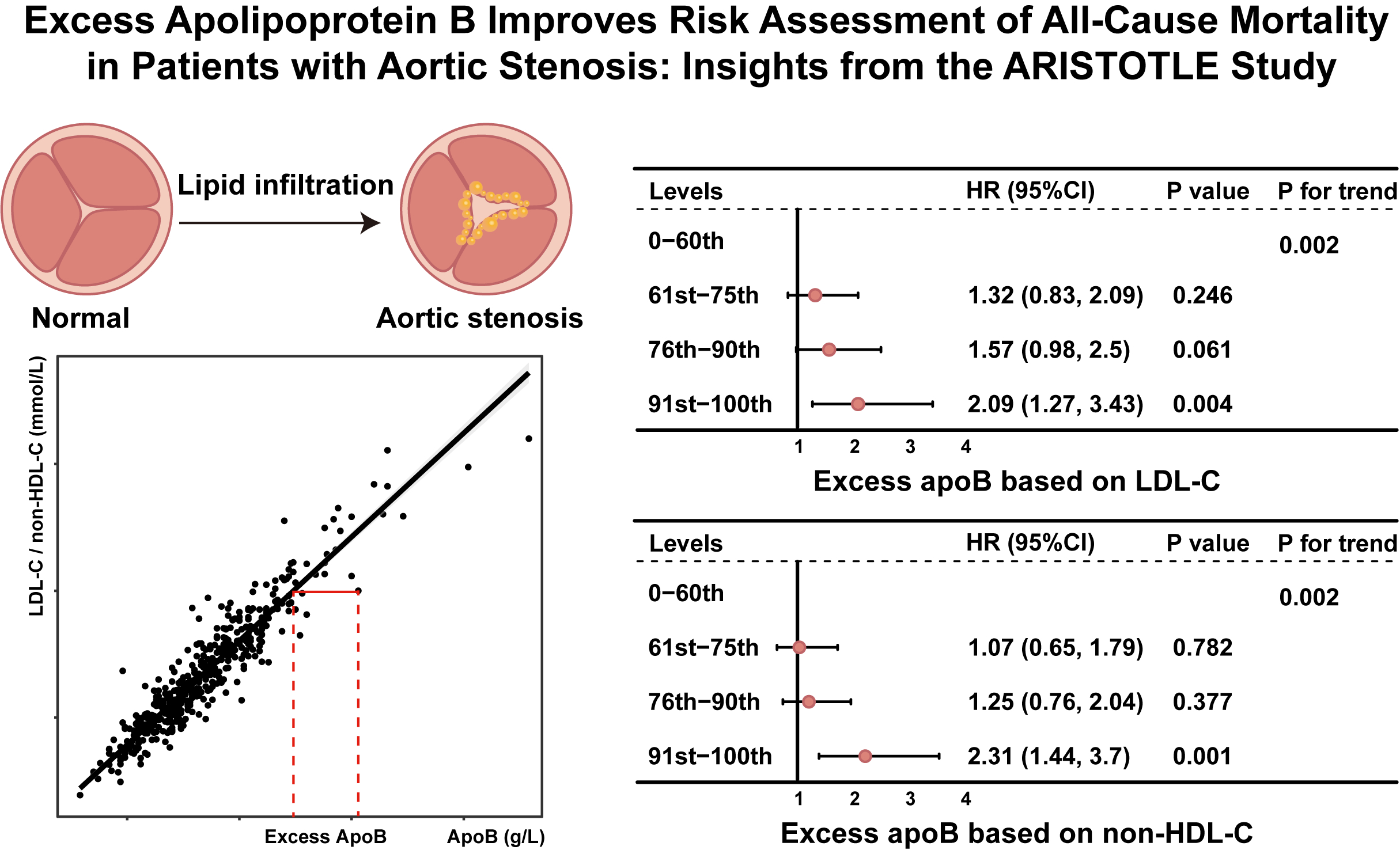
Moderate to severe AS patients (n=467) from ARISTOTLE study were included. Excess apoB was defined as the difference between the observed apoB and the expected apoB based on their given LDL-C or non-HDL-C level. Association of excess apoB with the risk of all-cause mortality was assessed by Cox proportional hazards regressions with 95% confidence intervals (CIs). Additionally, the incremental value incorporating excess apoB into standard models for predicting outcome was evaluated.
Results
ApoB and LDL-C were highly correlated (r=0.92), with LDL-C account for 84% of the variability in apoB levels. A dose-dependent association was observed between excess apoB based on LDL-C and the risk of all-cause mortality in AS patients. For each one standard deviation (SD) increase in excess apoB, the multivariate-adjusted hazard ratio (HR) for all-cause mortality was 1.021 (95%CI, 1.004-1.038). The multivariable adjusted HR for excess apoB >12.71 mg/dL was 1.998 (95% CI: 1.233-3.237). When excess apoB was added to the standard risk model, the prediction accuracy significantly improved, as indicated by notable changes in the C-statistic, continuous NRI, and IDI (all P-values < 0.05). Similar improvements in prediction were observed when excess apoB was calculated based on non-HDL-C.
Conclusions
Excess apoB was dose-dependently associated with an increased risk of all-cause mortality in moderate to severe AS.
Key words: excess ApoB, aortic stenosis, all-cause mortality, LDL-C, non-HDL-C
  • Xie, Mengjie  ( Sun Yat-Sen University , Guangzhou , China )
  • Xiong, Zhenyu  ( Sun Yat-Sen University , Guangzhou , China )
  • Xinxue, Liao  ( Sun Yat-Sen University , Guangzhou , China )
  • Zhuang, Xiaodong  ( SUN YAT-SEN UNIVERSITY , Guangzhou , China )
  • Author Disclosures:
    Mengjie Xie: No Answer | Zhenyu Xiong: DO NOT have relevant financial relationships | Liao Xinxue: No Answer | Xiaodong Zhuang: No Answer
Meeting Info:

Scientific Sessions 2025

2025

New Orleans, Louisiana

Session Info:
More abstracts on this topic:
A Health Coach-Based Multi-Level Personalized Strategy Lowers LDL-Cholesterol and Enhances Lipid Control in Veterans with Atherosclerotic Cardiovascular Disease – The VA Lipid Optimization Reimagined Quality Improvement Project at VA New York Harbor Healthcare System

Chen Tina, Ingerman Diana, Haley Leah, Salovaara Priscilla, Nicholson Andrew, Illenberger Nicholas, Natarajan Sundar

A transformative LDL cholesterol–lowering in vivo CRISPR gene editing medicine that functionally upregulates LDLR in mice and non-human primates

Newmark Judith, Raghav Jimit, Jaskolka Michael, Diner Benjamin, Soman Vikram, Jinadasa Tushare, Apte Ameya, Wu Meng, Bottega Steve, Thakkar Mansi, Agosto Luis, Wrighton Paul, Majithia Deep, Jambard Shreya, Jansson-fritzberg Linnea, Jones Mark, Fletcher Jillian, Weiss Mckenzie, Kaye Emily, Steward Briana, Bochicchio James, Pietrasiewicz Stephen, Iovino Salvatore, Marco Rubio Eugenio, Trong Phan Huu, Chander Nisha, Kazemian Mohammadreza, Lam Kieu, Reid Steve, Dinsmore Michael, Teslovich Tanya, Xie Jenny, Gupta Anshul, Amin Parth, Burkly Linda, Thompson Morgan, Rizal Salu, Bilodeau Maxime, Dong Ruhong, Zhen Wei

You have to be authorized to contact abstract author. Please, Login
Not Available