Logo

American Heart Association

  19
  0


Final ID: MP929

To Cath or Not to Cath? A Loeys-Dietz Clinical Dilemma

Abstract Body (Do not enter title and authors here): Loeys-Dietz syndrome (LDS) is a connective tissue disorder that affects the arterial system causing aneurysms, tortuosities, and dissections. Spontaneous coronary dissection (SCAD) in this population is extremely rare. Here we discuss the complex clinical decision-making in a patient with LDS presenting with chest pain and acute myocardial injury.
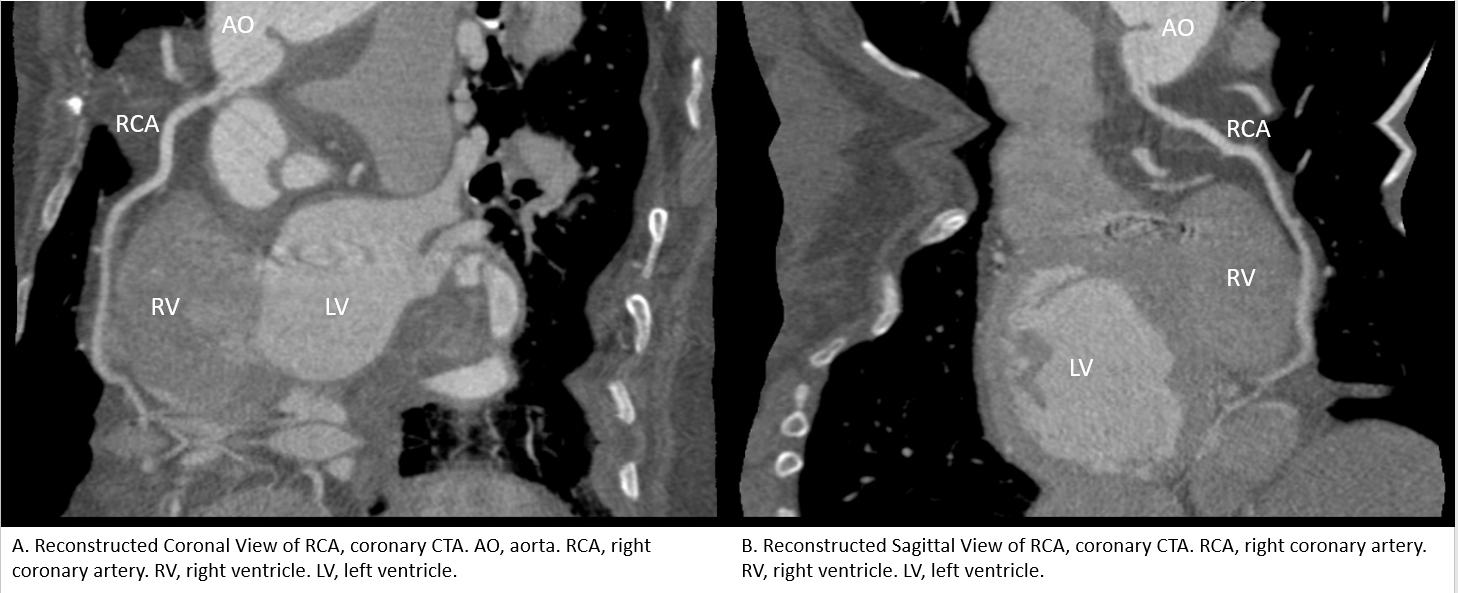
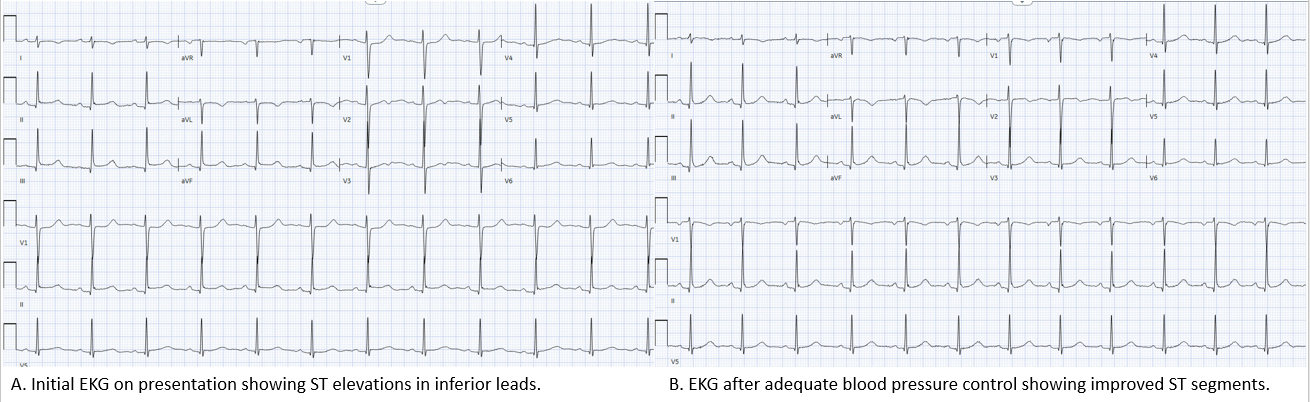
A 30-year-old female with LDS (TGFBR2 mutation) presented to the emergency room with sudden-onset chest pain radiating to her left flank. She had a complex history having initially undergone valve-sparing aortic root replacement later followed by concomitant aortic valve replacement and aortic aneurysm repair for recurrent root dilation and aortic insufficiency. She also had various dissections and aneurysms involving the aorta and peripheral vessels that were being closely monitored. Her blood pressure was 200/100. A CTA of the chest was obtained revealing a new dissection of descending thoracic aorta. High-sensitivity troponin levels rose from 33 to 1200 over 1.5 hours and EKG showed subtle, upsloping, inferior ST elevations. Emergent echocardiogram demonstrated basal to mid inferior wall hypokinesis. Blood pressure control with esmolol and clevidipine improved her chest pain. There was resolution of her ST changes on subsequent EKGs. Therefore, emergent coronary angiography was not pursued. Still, the acute myocardial injury pattern along with EKG and echocardiographic findings were concerning for myocardial infarction, particularly SCAD. Obstructive coronary artery disease was felt to be unlikely given her age and clinical context. Cardiac catheterization was discussed but deferred due to her complex vascular anatomy with dissections and tortuosity placing her at a high risk of access complications. We instead decided to obtain a coronary CTA for risk stratification. It raised concern for dissection of the RCA. However, the study was limited due to possible streaking artifact. Due to the patient’s clinical stability, a conservative approach was chosen. She was already on anticoagulation with coumadin for her history of mechanical MVR, and beta blocker therapy. No other medications were added.
SCAD in LDS is quite rare and if diagnosed, is more associated with SMAD3 mutation. In this patient population, weighing risks and benefits of making such a diagnosis is important. Here, conservative management was felt to be the best option.
  • Neerumalla, Pooja  ( Lehigh Valley Health Network , Allentown , Pennsylvania , United States )
  • Parfianowicz, Dominic  ( Lehigh Valley Health Network , Allentown , Pennsylvania , United States )
  • Vyas, Apurva  ( Lehigh Valley Health Network , Allentown , Pennsylvania , United States )
  • Author Disclosures:
    Pooja Neerumalla: DO NOT have relevant financial relationships | Dominic Parfianowicz: No Answer | Apurva Vyas: No Answer
Meeting Info:

Scientific Sessions 2025

2025

New Orleans, Louisiana

Session Info:

Vascular Genetics, Genomics, and Risk Scores

Saturday, 11/08/2025 , 03:15PM - 04:30PM

Moderated Digital Poster Session

More abstracts on this topic:
Accuracy of Angiographic Identification of Culprit Lesions in Women with MINOCA

Shwayder Elianna, Li Vincent, Smilowitz Nathaniel, Serrano Claudia, Elbaum Lindsay, Shah Binita, Hochman Judith, Hausvater Anais, Reynolds Harmony

A Growing Burden of Electronic Medical Record Messages in ACHD Care

Dailey Schwartz Andrew, Alegria Jorge

You have to be authorized to contact abstract author. Please, Login
Not Available