Scientific Sessions 2025
/
Aortic Disease
/
Aortic Dissection-Related Mortality in Hypertensive U.S. Adults: A 25-Year Portrait of Trends and Disparities From 1999 to 2023
American Heart Association
127
0
Final ID: Su3141
Aortic Dissection-Related Mortality in Hypertensive U.S. Adults: A 25-Year Portrait of Trends and Disparities From 1999 to 2023
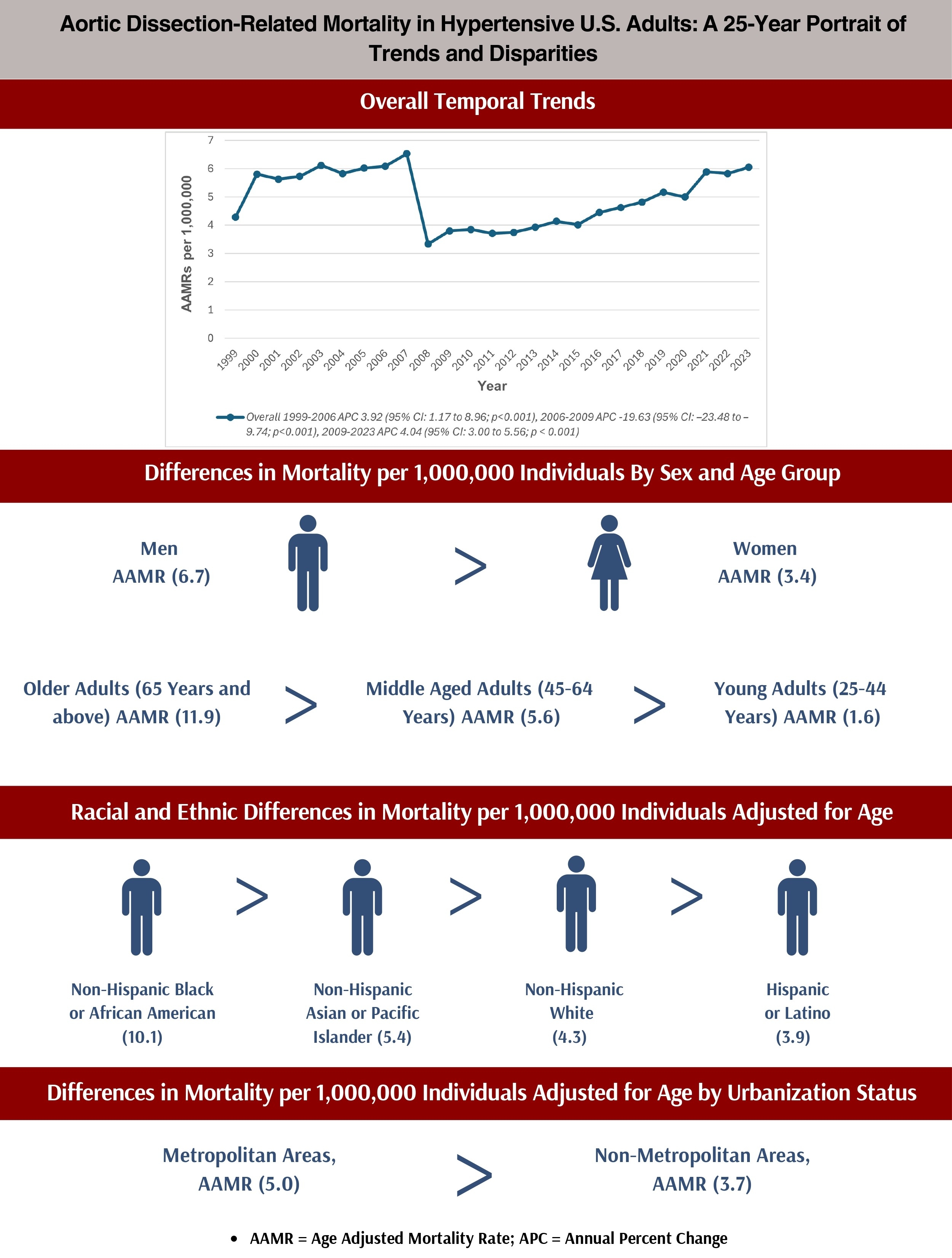
Abstract Body (Do not enter title and authors here): Background Aortic dissection is a life-threatening cardiovascular emergency with hypertension recognized as its most significant modifiable risk factor. Despite advances in diagnosis and management, mortality rates remain high, particularly in vulnerable populations. Analyzing long-term trends and demographic differences in aortic dissection-related deaths among people with hypertension can help guide more effective and equitable prevention efforts. Methods We analyzed CDC WONDER death certificate data from 1999 to 2023 to identify U.S. adults aged 25 years and older with hypertension (ICD-10: I10–I15) who had aortic dissection (ICD-10: I71.0) listed as the underlying cause of death. Age-adjusted mortality rates (AAMRs) were computed and stratified by sex, age group, race/ethnicity, and urbanization status (available through 2020). Temporal trends were evaluated using annual percent changes (APCs) with 95% confidence intervals, with statistical significance set at p<0.05. Results A total of 26,844 deaths due to aortic dissection (any part) were reported among U.S. adults with hypertension between 1999 and 2023. From 1999 to 2006, the AAMR increased significantly from 4.3 to 6.1 per 1,000,000 (APC: 3.92; 95% CI: 1.17 to 8.96), followed by a significant decline to 3.8 in 2009 (APC: –19.63; 95% CI: –23.48 to –9.74). AAMRs then rose significantly to 6.1 in 2023 (APC: 4.04; 95% CI: 3.00 to 5.56). Throughout the study period, men had higher AAMRs compared to women (men: 6.7 vs. women: 3.4). AAMRs were highest among older adults aged 65 years and above (11.9) and lowest among young adults aged 25-44 years (1.6). By race/ethnicity, the highest AAMRs were observed in the Non-Hispanic (NH) Black/African American population (10.1), followed by NH Asian/Pacific Islander (5.4), NH White (4.3), and Hispanic (3.9) populations, while the NH American Indian/Alaska Native population had unreliable or suppressed AAMRs throughout the study period. Metropolitan residents had higher AAMRs (5.0) than those in non-metropolitan areas (3.7). Conclusions Aortic dissection-related mortality among hypertensive U.S. adults has shown a rising trend over the recent years, with particularly high rates observed in men, older adults, NH Black/African American individuals, and those living in metropolitan areas. These findings highlight the need for focused preventive strategies and resource allocation targeting these high-risk groups to reduce the burden of aortic dissection-related deaths.
Ahmed, Syed Areeb
(
Rawalpindi Medical University
, Rawalpindi , Pakistan )
Saeed, Humza
(
Rawalpindi Medical University
, Rawalpindi , Pakistan )
Unus, Ahmad Talha
(
Benazir Bhutto hospital, Rawalpindi
, Jauharabad District Khush , Pakistan )
Afaq, Rana Muhammad
(
Rawalpindi Medical University
, Rawalpindi , Pakistan )
Mayo, Jawad Zafar
(
Rawalpindi Medical University
, Rawalpindi , Pakistan )
Goyal, Priya
(
Dayanand Medical College and Hospital
, Ludhiana , Punjab , India )
Author Disclosures:
Syed Areeb Ahmed:DO NOT have relevant financial relationships
| Humza Saeed:DO NOT have relevant financial relationships
| Ahmad Talha Unus:DO NOT have relevant financial relationships
| Rana Muhammad Afaq:DO NOT have relevant financial relationships
| Jawad Zafar Mayo:DO NOT have relevant financial relationships
| Priya Goyal:DO NOT have relevant financial relationships