Polygenic background for QT interval influences disease penetrance in individuals with genotype-positive congenital long QT syndrome
Abstract Body (Do not enter title and authors here): Background: Congenital long QT syndrome (LQTS) is characterized by a prolongation of the heart rate-corrected QT interval (QTc) and an increased risk of syncope, seizure and sudden cardiac arrest/death (SCA/SCD). Genome-wide association studies have identified numerous QT interval-influencing loci of small effect sizes. Herein, we sought to investigate whether a polygenic background for the QT interval contributes to the phenotypic heterogeneity in patients with genotype-positive LQTS.
Methods: We used summary statistics from a recent genome-wide meta-analysis for QT interval (n = 117,532) to derive 160 different polygenic scores for QT interval (PGSQT) using LDpred2-grid, each comprising ~1.4 million common variants with varying assumptions of the underlying genetic architecture. Next, we applied these PGSQT to predict the QTc value in a genetically unrelated, European ancestry subset of the ‘All of Us’ cohort with available electrocardiogram and genetic data (n=6,404), where the best performing PGSQT was determined based on explained variance. Next, using 225 patients with genetically confirmed LQTS who were evaluated in the Mayo Clinic Windland Smith Rice Genetic Heart Rhythm Clinic, we tested the effect of the best performing PGSQT on QTc duration and LQTS-associated cardiac events (defined as a composite of syncope, seizures, sustained ventricular arrhythmia, appropriate ICD shocks, and SCA/SCD) using Bayesian regression models.
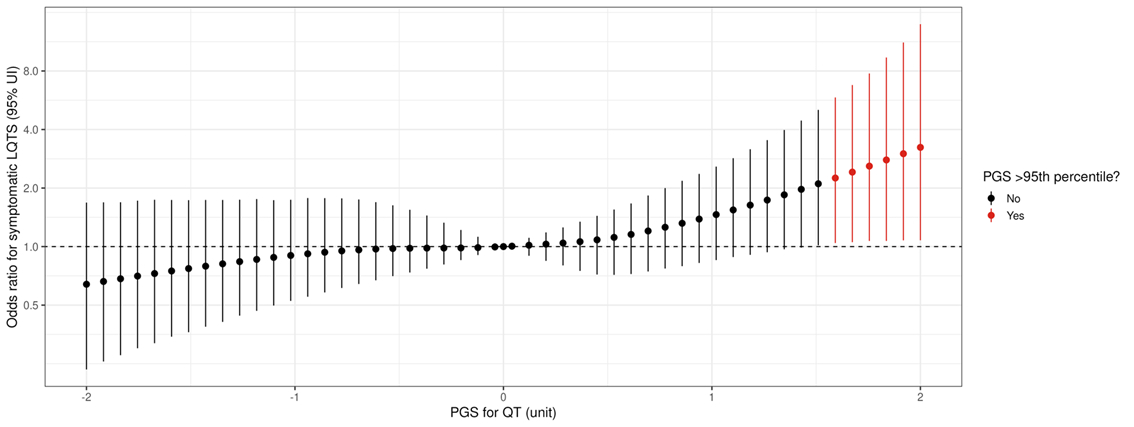
Results: Overall, the best performing PGSQT explained 11.8% of the variance in the QTc in the ‘All of Us’ cohort. Among patients with genotype-positive LQTS (n [%]; KCNQ1 125 [55.6], KCHN2 76 [33.8], SCN5A 21 [9.3], Other 3 [1.3]), those with higher PGSQT had a higher QTc (predicted mean QTc [95% uncertainty interval], 95th percentile vs 50th percentile for PGSQT, 478 ms [464-491] vs 459 ms [449-468]). In comparison to the median PGS, those LQTS patients with a PGSQT >95th percentile were more than twice as likely to have experienced a LQTS-associated cardiac event (Odds ratio [95% UI], 95th percentile vs 50th percentile for PGSQT; 2.16 [1.02-5.41]), (Figure).
Conclusions: Individuals with genotype-positive LQTS who have high polygenic susceptibility for QTc prolongation are more likely to phenotypically exhibit a higher QTc value and experience potentially life-threatening LQTS-associated cardiac events. Accounting for polygenic background may refine risk stratification strategies for patients with genotype-positive LQTS
Dikilitas, Ozan
(
Mayo Clinic
, Rochester , Minnesota , United States )
Bos, Johan
(
Mayo Clinic College of Medicine
, Rochester , Minnesota , United States )
Tester, David
(
MAYO CLINIC COLLEGE OF MEDICINE
, Rochester , Minnesota , United States )
Neves, Raquel
(
Mayo Clinic
, Rochester , Minnesota , United States )
Bains, Sahej
(
Mayo Clinic
, Rochester , Minnesota , United States )
Giudicessi, John
(
Mayo Clinic
, Rochester , Minnesota , United States )
Ackerman, Michael
(
Mayo Clinic
, Rochester , Minnesota , United States )
Author Disclosures:
Ozan Dikilitas:DO NOT have relevant financial relationships
| Johan Bos:DO NOT have relevant financial relationships
| David Tester:No Answer
| Raquel Neves:DO NOT have relevant financial relationships
| Sahej Bains:DO NOT have relevant financial relationships
| John Giudicessi:DO have relevant financial relationships
;
Consultant:Avidity Biosciences:Active (exists now)
; Consultant:Nuevocor Therapeutics:Active (exists now)
; Consultant:Citizen Health:Active (exists now)
| Michael Ackerman:DO have relevant financial relationships
;
Consultant:Abbott:Active (exists now)
; Royalties/Patent Beneficiary:UpToDate:Active (exists now)
; Royalties/Patent Beneficiary:Thryv Therapeutics:Active (exists now)
; Royalties/Patent Beneficiary:Solid Biosciences:Active (exists now)
; Royalties/Patent Beneficiary:Prolaio:Active (exists now)
; Royalties/Patent Beneficiary:ARMGO Pharma:Active (exists now)
; Royalties/Patent Beneficiary:AliveCor:Active (exists now)
; Consultant:Tenaya Therapeutics:Active (exists now)
; Consultant:Medtronic:Active (exists now)
; Consultant:Invitae:Past (completed)
; Consultant:Illumina:Active (exists now)
; Consultant:Bristol Myers Squibb:Past (completed)
; Consultant:Boston Scientific:Active (exists now)
; Consultant:BioMarin Pharmaceutical:Past (completed)