Risk of Hospitalization in Patients with Heart Failure Exposed to Extreme Heat and Poor Air Quality in the Western United States
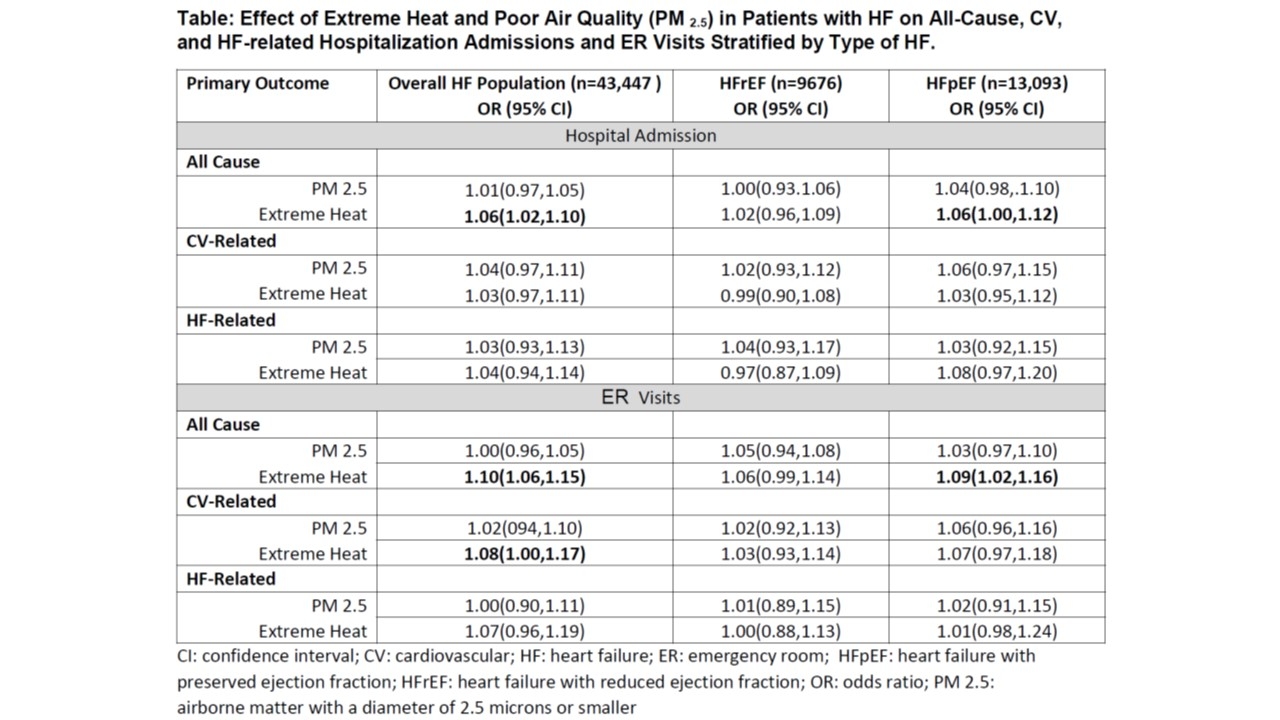
Abstract Body (Do not enter title and authors here): Introduction Patients with underlying cardiovascular (CV) disease are vulnerable to adverse health events related to extreme weather. Limited data exist in those with heart failure (HF). In the western U.S., where heat waves and wildfire exposure are common, understanding the impact of heat on HF–related outcomes is critical for prevention and clinical management. Research Question/Hypothesis We examined the risk of hospitalizations and emergency room (ER) visits associated with short-term exposure to extreme heat and poor air quality in HF patients stratified by HF type. Methods Using 2021 Medicare data, we identified patients with HF before January 1, 2021, residing in 11 western U.S. states (Arizona, California, Colorado, Idaho, Montana, New Mexico, Nevada, Oregon, Utah, Washington, and Wyoming). The primary outcomes included all-cause, CV, and HF-related hospitalizations and ER visits. A case-crossover design was used, with case days defined as the event date and control days matched by day of the week within the same month. Patients were stratified based on HF type and identified on inpatient or outpatient diagnoses prior to the case day. Conditional logistic regression was applied to estimate odds ratios (ORs) for outcomes associated with extreme heat exposure, defined as daily maximum temperature above the 85th percentile of the local decadal average, adjusting for airborne particulate matter (PM2.5.) levels and public holidays. Results We identified 43,447 HF patients (mean age 73 ±16 years) of whom 9,676 had HF with reduced ejection fraction (HFrEF) and 13,093 HF with preserved ejection fraction (HFpEF). Only extreme heat exposure was associated with a 6% increased odds for all-cause hospitalization (OR 1.06; 95% CI: 1.02,1.10); 10% increase in all-cause ER visits (OR:1.10; 95% CI 1.06-1.15); and 8% increase CV-related ER visits (OR 1.08; 95% CI: 1.00–1.17). These effects were demonstrated primarily in HFpEF and not HFrEF (Table). Conclusion Short-term extreme heat exposure but not poor air quality was associated with an increased risk of hospitalization and ER visits in HF patients residing in the Western US, especially in those with HFpEF. This heightened vulnerability may be due to impaired thermoregulation and reduced cardiovascular adaptability in those with HFpEF
Yang, Lanting
(
University of California San Deigo
, San Deigo , California , United States )
Hernandez, Inmaculada
(
University of California San Deigo
, San Deigo , California , United States )
Gabriel, Nico
(
University of Colorado Skaggs School of Pharmacy
, Aurora , Colorado , United States )
Tang, Shangbin
(
University of California San Deigo
, San Deigo , California , United States )
Blackburn, Hayley
(
University of Montana Skaggs School of Pharmacy
, Missolua , Montana , United States )
Page, Robert
(
University of Colorado Skaggs School of Pharmacy
, Aurora , Colorado , United States )
Author Disclosures:
Lanting Yang:DO NOT have relevant financial relationships
| Inmaculada Hernandez:No Answer
| Nico Gabriel:No Answer
| Shangbin Tang:DO NOT have relevant financial relationships
| Hayley Blackburn:DO have relevant financial relationships
;
Speaker:Blue Shield California:Expected (by end of conference)
| Robert Page:DO NOT have relevant financial relationships