
Logo

American Heart Association

  19
  0


Final ID: MP554

Physical Activity Change After Myocardial Infarction and Subsequent Risk of Cardiovascular Events

Abstract Body (Do not enter title and authors here): Introduction: Data are scarce regarding the long-term impact of physical activity (PA) change on new and recurrent ischemic events following myocardial infarction (MI). We hypothesized that increased PA was associated with a lower risk of major adverse cardiovascular events (MACE) after MI.
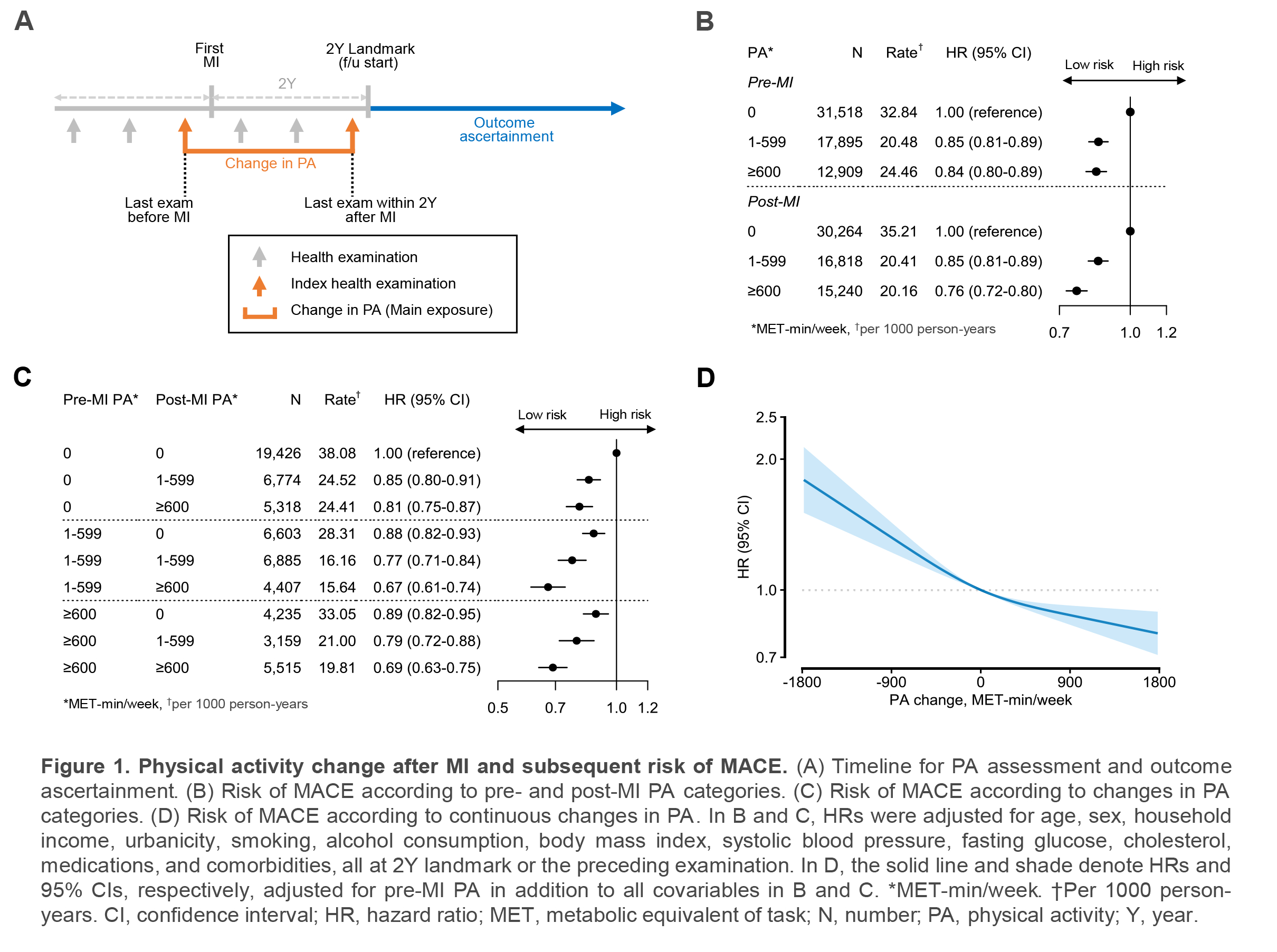
Methods: From the Korean National Health Insurance Service database, we identified all incident cases of acute MI in 2009–2019 and included adults aged ≥19 years at first MI who underwent health examinations during a pre-MI look-back and a 2-year post-MI landmark period (Figure A). PA was self-reported at each examination using a modified International PA Questionnaire and was categorized as 0 metabolic equivalent of task (MET)-min/week (inactive), 1–599 MET-min/week (active but not meeting guideline), or ≥600 MET-min/week (active, meeting guideline), or modeled continuously using restricted cubic splines. Primary outcome was the first occurrence of MACE (composite of all-cause death, stroke, or recurrent MI) after the landmark. Secondary outcomes included cardiovascular death, first occurrence of each component of MACE, and total (first and subsequent) occurrence (ie, recurrent event analysis) of MACE.
Results: Over a median follow-up of 6.1 years after the 2-year landmark among 62,322 adults who had first MI (median age at landmark, 64 years; 20.3% women), 10,693 primary outcome events occurred. After multivariable adjustment, higher PA levels (1–599 or ≥600 MET-min/week) after first MI were associated with a lower risk of MACE (HR [95% CI]: 0.85 [0.81–0.89] and 0.76 [0.72–0.80], respectively) compared with 0 MET-min/week (Figure B). Participants who increased PA from 0 MET-min/week to 1–599 or ≥600 MET-min/week had a lower risk of MACE than those who remained inactive (HR [95% CI]: 0.85 [0.80–0.91] and 0.81 [0.75–0.87], respectively; Figure C). Conversely, participants who decreased PA from ≥600 MET-min/week to 1–599 or 0 MET-min/week had a higher risk of MACE than those who maintained PA (HR [95% CI]: 1.15 [1.02–1.30] and 1.29 [1.16–1.42], respectively). An inverse dose-response association was observed between PA change and the risk of MACE (Figure D). Findings were consistent for first and total occurrence of secondary outcomes.
Conclusions: Increases in PA after MI were associated with a lower risk of MACE, whereas decreases in PA were associated with a higher risk. These findings highlight the importance of promoting PA for long-term secondary prevention after MI.
  • Shin, Sojung  ( Yonsei University , Seoul , Korea (the Republic of) )
  • Cheon, Dae Young  ( Dongtan Sacred Hospital , Suwon , Korea (the Republic of) )
  • Khil, Jaewon  ( Yonsei Univ College of Medicine , Seoul , Korea (the Republic of) )
  • Lee, Jaeyong  ( Yonsei Univ College of Medicine , Seoul , Korea (the Republic of) )
  • Ha, Kyoung Hwa  ( Yonsei Univ College of Medicine , Seoul , Korea (the Republic of) )
  • Lee, Hyeok-hee  ( BIDMC , Boston , Massachusetts , United States )
  • Kim, Hyeon Chang  ( Yonsei Univ College of Medicine , Seoul , Korea (the Republic of) )
  • Lee, Hokyou  ( Yonsei Univ College of Medicine , Seoul , Korea (the Republic of) )
  • Author Disclosures:
    Sojung Shin: DO NOT have relevant financial relationships | Dae Young Cheon: DO NOT have relevant financial relationships | Jaewon Khil: No Answer | Jaeyong Lee: DO NOT have relevant financial relationships | Kyoung Hwa Ha: DO NOT have relevant financial relationships | Hyeok-Hee Lee: DO NOT have relevant financial relationships | Hyeon Chang Kim: No Answer | Hokyou Lee: DO NOT have relevant financial relationships
Meeting Info:

Scientific Sessions 2025

2025

New Orleans, Louisiana

Session Info:

Exercise Training, Cardiac Rehabilitation, and Physical Activity: Let's Be Active!

Saturday, 11/08/2025 , 03:15PM - 04:30PM

Moderated Digital Poster Session

More abstracts on this topic:
A Machine Learning Approach to Simplify Risk Stratification of Patients with Atherosclerotic Cardiovascular Disease

Li Hsin Fang, Gluckman Ty, Nute Andrew, Weerasinghe Roshanthi, Wendt Staci, Wilson Eleni, Sidelnikov Eduard, Kathe Niranjan, Swihart Charissa, Jones Laney

Association Between Regular Yoga Practice and Reduced Incidence of Acute Coronary Syndrome in Hypertensive Adults

Nnadi Ekendilichukwu, Masara Maureen, Offor Rita, Yosry Nashwa, Nigussie Bisrat, Atere Muhammed, Graham-hill Suzette

More abstracts from these authors:
Blood Pressure and Cardiovascular Outcomes in Adults with Diabetes and Chronic Kidney Disease

Lee Hyeok-hee, Jhee Jong Hyun, Kim Eun Jin, Kim Hyeon Chang, Shimbo Daichi, Lee Hokyou

Association of Cumulative Cardiovascular Health Score Through Young Adulthood With Cardiovascular-Kidney Outcomes in Midlife

Lee Hokyou, Lee Hyeok-hee, Kim Eun Jin, Jhee Jong Hyun, Kim Hyeon Chang

You have to be authorized to contact abstract author. Please, Login
Not Available