
Logo

American Heart Association

  20
  0


Final ID: MP1157

Transverse aortic stenosis (TAC) hearts based on NFAT-regulator of calcineurin-1 indicate nonlinear phenotypes coordinated with dysregulation of angiocrine-angiogenesis switch

Abstract Body (Do not enter title and authors here): Calcineurin (Cn) and NFAT activation contribute to cardiac hypertrophy. The Down syndrome critical region gene (Dscr)-1 plays a crucial role in the feedback modulation of NFAT activation, which is involved in adaptive processes of angiogenesis and inflammation. Recent findings suggest that typical artificial conditional mutations and conventional null mutations can lead to opposing phenotypes, making it crucial to consider complex, non-cell-autonomous events in clinically relevant knockout and GWAS studies.
In our research using a Dscr-1-/-; ApoE-/- hyperlipidemia model, we found lipoma and corneal opacity in peripheral blood vessels, but no atherosclerosis in the aorta. Thus, we performed TAC surgery on both Dscr-1-/- and wild-type (WT) mice to further explore the role of the NFAT-DSCR-1 pathway.
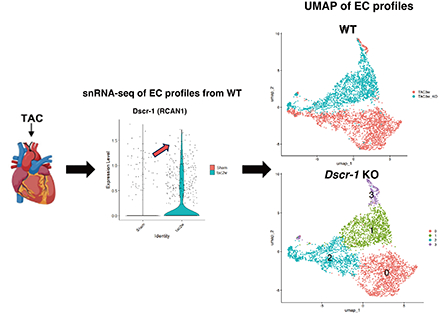
Single-nucleus RNA sequencing (snRNA-seq) analysis of post-TAC revealed a rapid increase in Dscr-1 expression in the myocardium, endothelial cells (ECs), macrophages, and fibroblasts. Within one week, Dscr-1-/- mice showed excessive inflammatory leukocytes infiltration, but neovascularization were significantly impaired, leading to increased lethality without compensatory cardiac hypertrophy. SnRNA-seq from Dscr-1-/- hearts revealed that they displayed a notable reduction in angiocrine genes like Neuregulin1, Igfbp7, and Fgf14 in the EC subgroup. Furthermore, expressions of most EC-specific marker genes were markedly reduced.
DSCR-1 is a stress marker induced under severe conditions. Our study highlights that the loss of protective DSCR-1 in the TAC model leads to lethal outcomes due to myocardial ischemia and severe inflammation, rather than NFAT-driven hypertrophy. This withdrawal of angiocrine factors likely inhibits the protective angiogenic response. Collectively, our study provides a potential therapeutic target for cardiovascular failure based on the Cn-NFAT/Dscr-1 signaling axis.
  • Funasaki, Shintaro  ( Kumamoto University , Kumamoto , Japan )
  • Katoh, Manami  ( The University of Tokyo , Tokyo , Japan )
  • Fujiu, Katsuhito  ( The University of Tokyo , Tokyo , Japan )
  • Nomura, Seitaro  ( The University of Tokyo , Tokyo , Japan )
  • Arima, Yuichiro  ( Kumamoto University , Kumamoto , Japan )
  • Minami, Takashi  ( Kumamoto University , Kumamoto , Japan )
  • Author Disclosures:
    Shintaro Funasaki: No Answer | Manami Katoh: DO NOT have relevant financial relationships | Katsuhito Fujiu: No Answer | Seitaro Nomura: No Answer | Yuichiro Arima: No Answer | Takashi Minami: DO NOT have relevant financial relationships
Meeting Info:

Scientific Sessions 2025

2025

New Orleans, Louisiana

Session Info:

New Mechanisms in Aneurysm, Stenosis, and Aortic Disease

Saturday, 11/08/2025 , 09:15AM - 10:15AM

Moderated Digital Poster Session

More abstracts on this topic:
You have to be authorized to contact abstract author. Please, Login
Not Available