Global Burden of Ischemic Heart Disease Attributable to Particulate Matter: A GBD 2021 Analysis by Sociodemographic Index and Region (1990–2021)
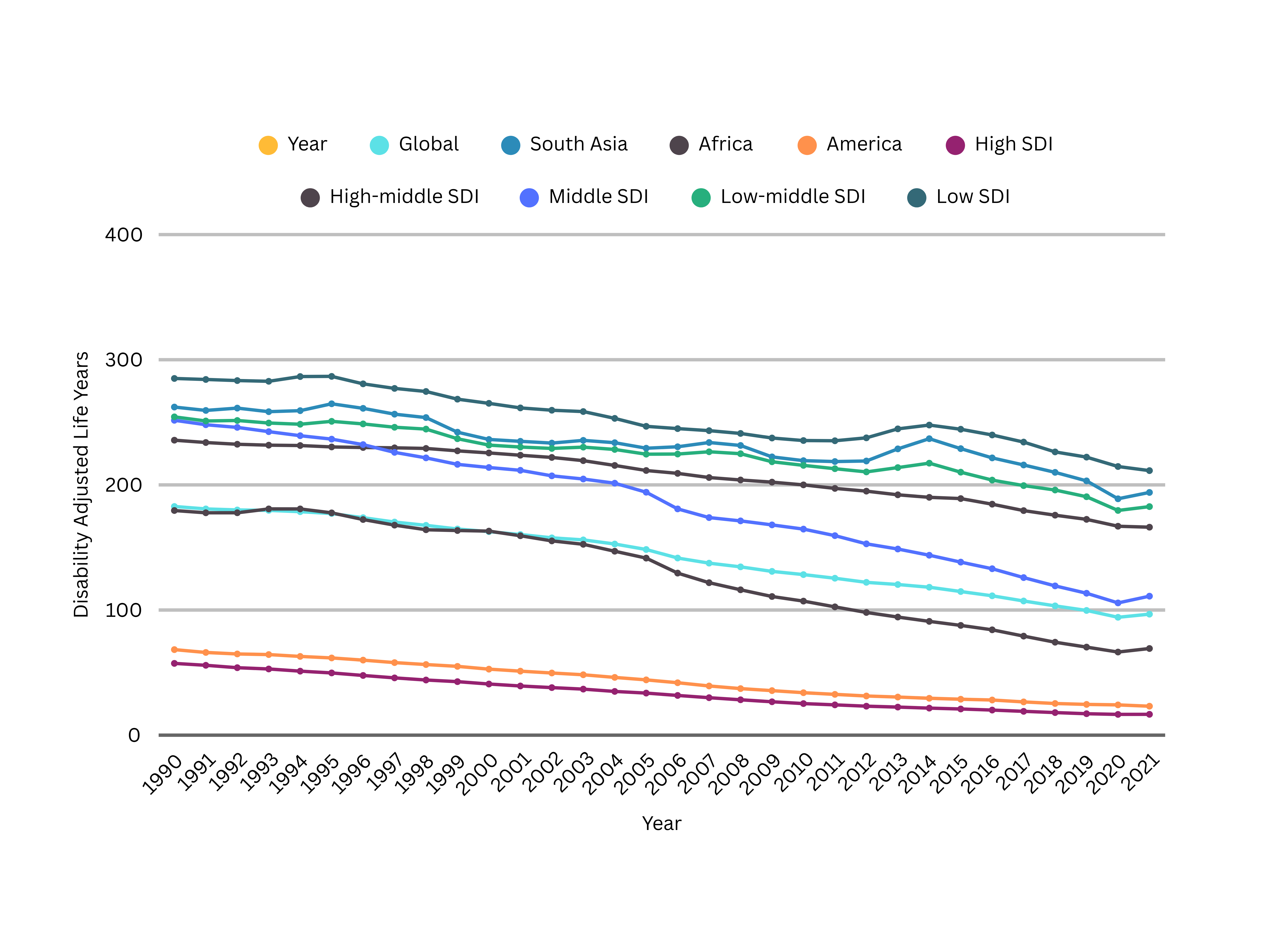
Abstract Body (Do not enter title and authors here): Introduction: Ischemic heart disease (IHD) is a leading contributor to morbidity and mortality worldwide. Exposure to particulate matter has emerged as a major risk factor for ischemic heart disease. Aim: Our study analyzes the influence of exposure to particulate matter and Sociodemographic Index (SDI) regions on the burden of ischemic heart disease across the developing and developed world. Methods: The data from Global Burden of Disease (GBD) 2021 was used to analyze the age-standardized death rates and disease-adjusted life years (DALYs) across high-middle, high, low-middle, low, and middle SDI regions as well as America, South Asia, and Africa from 1990 to 2021. Joinpoint regression analysis was used to evaluate annual percent change (APC) and average annual percent change (AAPC) with 95% confidence intervals. Results: A significant global decline in IHD death rates and DALYs attributable to particulate matter exposure was observed from 1990-2021. The AAPC in deaths was -2.11%, with the steepest declines in high SDI countries (-3.93%) and America (-3.41%). Low SDI regions saw the smallest decline (-0.95%), while South Asia and Africa showed modest reductions (-1.02% and -1.13%, respectively). High-middle, middle, and low-middle SDI regions had AAPCs of -3.05%, -2.70%, and -1.09%, respectively. DALYs followed a similar trend globally (AAPC: -2.22%), with the greatest reductions in America (-3.52%) and high SDI countries (-3.45%). After 2014, the decline of DALY accelerated, especially in South Asia (-3.37%) and Africa (-2.80%). However, a deceleration occurred after 2019, particularly in high-middle SDI regions (2019–2021 APC: -1.52% for deaths, -1.38% for DALYs) and high SDI regions (-1.52% and -1.03%, respectively). Conclusion: Despite a global decrease in mortality and disability due to IHD, the disparities among high and low SDI areas underscore the importance of equitable healthcare systems. Moreover, a decrease in progress after 2019 warrants the need to develop sustained policy efforts to maintain momentum and further accelerate the improvement in global health.
Shaukat, Muhammad Talha
(
King Edward Medical University
, Lahore , Pakistan )
Rehman, Wania
(
King Edward Medical University
, Lahore , Pakistan )
Shahzaib, Muhammad
(
King Edward Medical University
, Sialkot , Pakistan )
Roshaan, Muhammad
(
King Edward Medical University
, Lahore , Pakistan )
Afzal, Nimra
(
King Edward Medical University
, Lahore , Pakistan )
Gill, Seemab Imtiaz
(
Carle Health
, Urbana , Illinois , United States )
Rahman, Saad Ur
(
Lahey Hospital and Medical Center
, Bedford , Massachusetts , United States )
Ganatra, Sarju
(
Lahey Hospital and Medical Center
, Burlington , Massachusetts , United States )
Dani, Sourbha
(
LAHEY HOSPITAL MEDICAL CENTER
, Burlington , Massachusetts , United States )
Author Disclosures:
Muhammad Talha Shaukat:DO NOT have relevant financial relationships
| Wania Rehman:DO NOT have relevant financial relationships
| Muhammad Shahzaib:DO NOT have relevant financial relationships
| Muhammad Roshaan:DO NOT have relevant financial relationships
| Nimra Afzal:No Answer
| Seemab Imtiaz Gill:DO NOT have relevant financial relationships
| Saad Ur Rahman:DO NOT have relevant financial relationships
| Sarju Ganatra:DO have relevant financial relationships
;
Consultant:Ultrasight:Past (completed)
; Consultant:Humana:Past (completed)
| Sourbha Dani:DO NOT have relevant financial relationships