A phenomapping-informed machine learning tool estimates individualized cardiometabolic effects from Tirzepatide and generalizes to a new population.
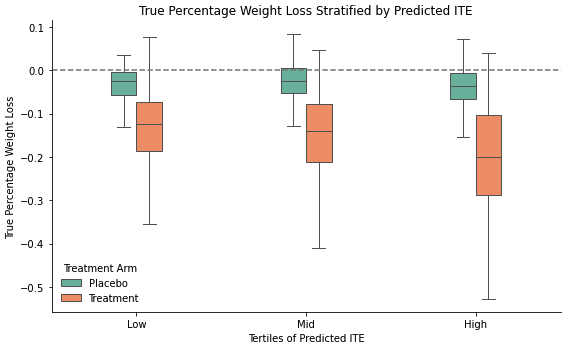
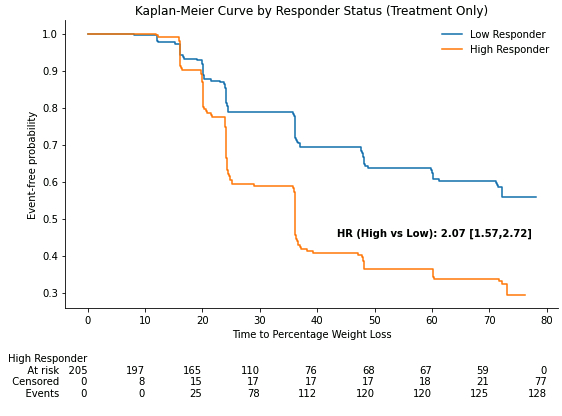
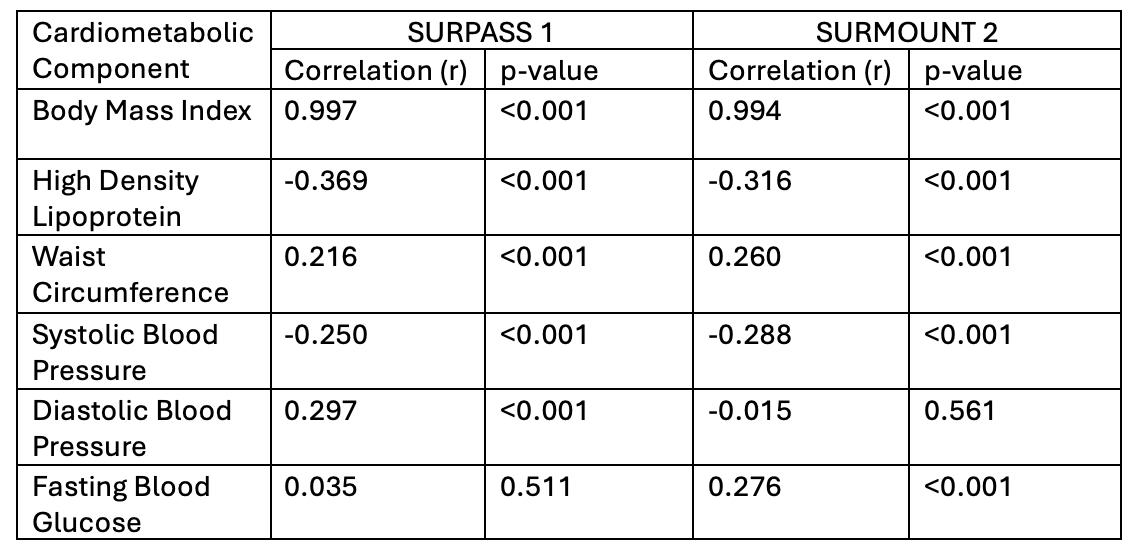
Abstract Body (Do not enter title and authors here): Background: Tirzepatide induces weight loss (WL), but its precise use among those more likely to benefit from WL and experience cardiometabolic effects can enable more scalable deployment. Phenotypic heterogeneity within RCT participants may reveal markers of response. Hypothesis: A phenomapping-informed machine learning tool derived from a phase 3 Tirzepatide RCT can define its individualized treatment effect (ITE) on weight loss and components of metabolic syndrome (MS) and generalize to another RCT population. Methods: In SURPASS-1, we calculated pairwise participant Gower’s distance similarity using 46 pre-randomized baseline characteristics and fit linear mixed models of neighborhoods with phenotypic similarity to estimate the ITE of percent WL and MS components (BMI, waist circumference, SBP, DBP, fasting glucose (FBG), and HDL change). We then trained XGBoost models with Boruta SHAP to predict the ITE of Tirzepatide on WL and each of the MS components. Then, we evaluated whether the ITE tool deployed in SURMOUNT-2 identified those with high predicted WL with mean difference ITE across responder tertiles, and the HR of time to reach WL >15% faster of high vs low responders. We then correlated predicted ITE of WL and each of the MS components in both RCTs. Results: In SURPASS-1 (n=357, 166 (46%) female, 64 (18%) obese), median WL was -8.2 v. -1.3% (-13.6, -4.6 v. -3.1, 1.0, 25, 75% IQR, T v P.) Our tool, developed in SURPASS-1, showed a significant treatment-ITE interaction (p< .001) for WL, BMI, HDL, and waist circumference, (p=.002) for DBP, and (p=0.014) for FGB and significant stratification of responders by ITE tertile compared to true WL (one-way ANOVA .p<.001) The most informative features were female sex, hypertension, age, FBG, baseline weight, and SBP. The validation RCT, SURMOUNT-2, (n=936, 476 (51%) female, 936 (100%) obese), had a significant treatment-ITE interaction estimate (p=.045). High responders had a predicted mean difference of WL of 15.7% (13.5%-17.9%, p <.001), moderate, 13.0% (10.9%-15.0%, p<.001), and low, 11.2% (9.0%-13.0%, p<.001) (one-way ANOVA p <.001, Fig. A). High responders had a faster time to WL > 15% than low with a median 36 vs 72 weeks, HR 2.1 (1.6-2.7, Fig. B). There were significant correlations (p<.001) between the predicted ITE of WL and MS components (Table 1). Conclusions: A machine learning tool can predict individualized WL and pleiotropic cardiometabolic effects by Tirzepatide in a new patient population.
Thangaraj, Phyllis
(
Yale University
, New Haven , Connecticut , United States )
Oikonomou, Evangelos
(
Yale School of Medicine
, New Haven , Connecticut , United States )
Khera, Rohan
(
Yale School of Medicine
, New Haven , Connecticut , United States )
Author Disclosures:
Phyllis Thangaraj:DO NOT have relevant financial relationships
| Evangelos Oikonomou:DO have relevant financial relationships
;
Consultant:Caristo Diagnostics, Ltd:Past (completed)
; Consultant:Ensight-AI, Inc:Active (exists now)
; Ownership Interest:Evidence2Health, LLC:Active (exists now)
| Rohan Khera:DO have relevant financial relationships
;
Research Funding (PI or named investigator):Bristol-Myers Squibb:Active (exists now)
; Research Funding (PI or named investigator):NovoNordisk:Active (exists now)
; Research Funding (PI or named investigator):BridgeBio:Active (exists now)