Single-Lead ECG AI Model Accurately Predicts Moderate-to-Severe Hyperkalemia in Multi-Hospital External Validation
Abstract Body (Do not enter title and authors here): Background: Hyperkalemia represents a life-threatening electrolyte disorder with substantial mortality risk, particularly in patients with chronic kidney disease (CKD) and end-stage renal disease. Current diagnostic approaches are limited by nonspecific clinical presentation and low sensitivity of conventional ECG interpretation. An AI algorithm has been previously developed to predict hyperkalemia from single-lead ECGs (AccurKardia, US). However, the performance of this algorithm in geographically distinct populations remains unknown.
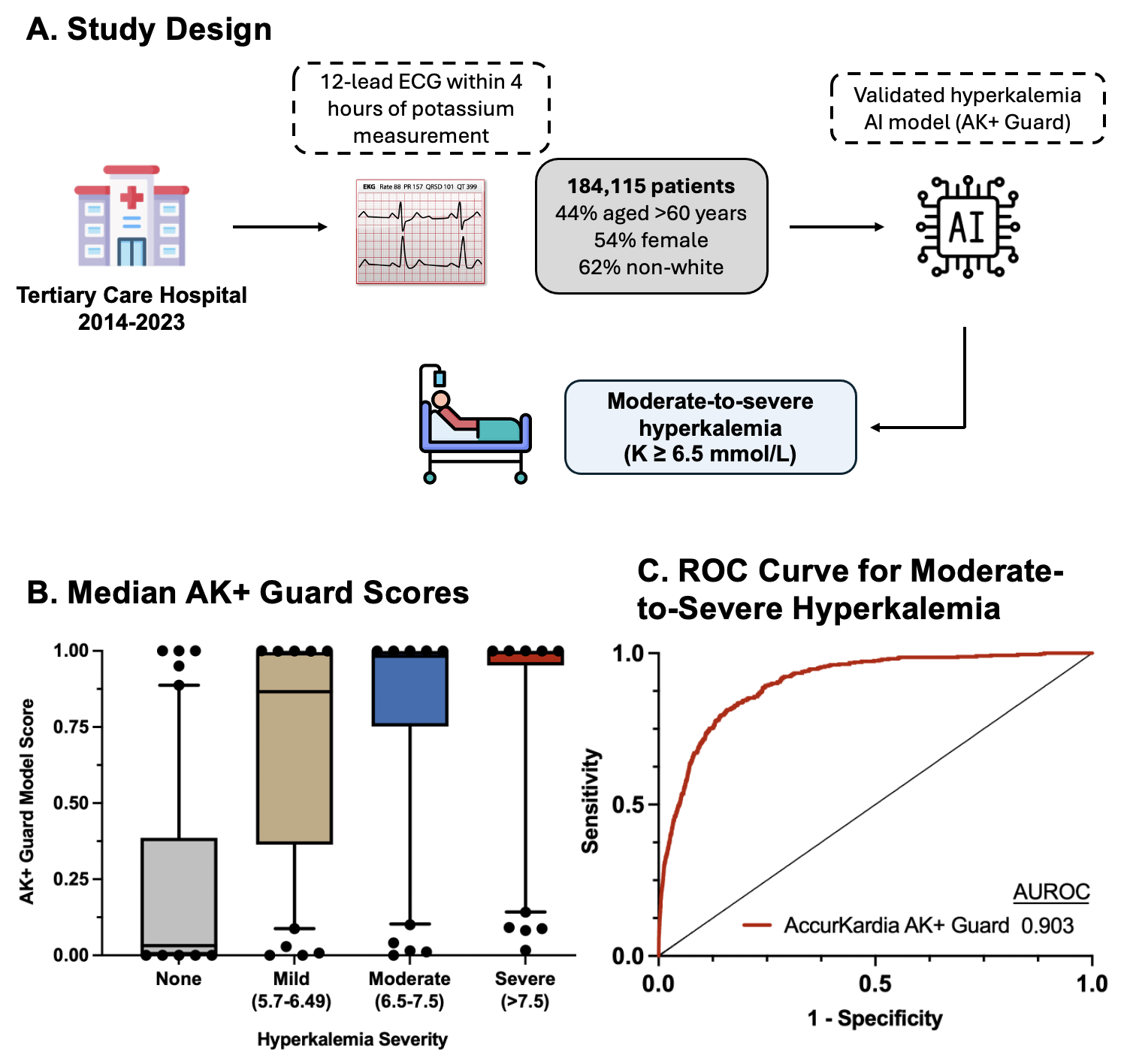
Methods: We performed a retrospective study utilizing de-identified electronic health records from Sharp HealthCare (seven-hospital system, San Diego, California, 2014-2023) (Figure 1A). Inclusion criteria comprised adult patients (≥22 years) with resting 12-lead ECGs and temporally matched serum potassium measurements (≤4 hours separation). Exclusions included cardiac pacing, atrial arrhythmias, significant conduction abnormalities (QRS ≥140ms), and excessive signal artifact (≥10% noise). The primary endpoint was moderate-to-severe hyperkalemia (serum potassium ≥6.5 mmol/L). The previously trained algorithm was applied to Lead-I ECG data using its original decision threshold. Performance metrics and 95% confidence intervals were computed using bias-corrected bootstrap resampling.
Results: Among 184,115 ECG-potassium pairs, 440 had moderate-to-severe hyperkalemia (≥6.5 mmol/L). Patient characteristics included 62% non-white ethnicity, 54% female, and mean age 56 years. Comorbidities included diabetes (35%), cardiovascular disease (27%), and CKD (23%). The AI model demonstrated a stepwise increase in median scores across hyperkalemia severity categories: not hyperkalemia (182,580 pairs, median score 0.018), mild hyperkalemia 5.7-6.49 mmol/L (1,095 pairs, median score 0.865), moderate hyperkalemia 6.5-7.49 mmol/L (343 pairs, median score 0.985), and severe hyperkalemia ≥7.5 mmol/L (97 pairs, median score 0.998) (Figure 1B).Algorithm performance demonstrated sensitivity 82.3% (95% CI: 78.4-85.7%), specificity 82.5% (82.3-82.7%), and AUROC 0.903 (Figure 1C).
Conclusions: Machine learning-based single-lead ECG analysis accurately predicted moderate-to-severe hyperkalemia detection in a large, diverse external validation cohort. The algorithm demonstrated excellent discriminatory supporting potential clinical implementation for automated hyperkalemia screening in high-risk ambulatory populations.
Razvi, Nav
(
Accurkardia
, Ipswich , United Kingdom )
Segar, Matthew
(
Texas Heart Institute
, Houston , Texas , United States )
Lambeth, Kaleb
(
Texas Heart Institute
, Houston , Texas , United States )
Lau, Wei Ling
(
University of California-Irvine
, Newport Coast , California , United States )
Paisley, Robert
(
Texas Heart Institute
, Houston , Texas , United States )
Razavi, Mehdi
(
Texas Heart Institute
, Houston , Texas , United States )
Author Disclosures:
Nav Razvi:No Answer
| Matthew Segar:DO have relevant financial relationships
;
Executive Role:ReCODE Medical:Active (exists now)
; Speaker:Otsuka:Past (completed)
; Advisor:Idorsia:Past (completed)
; Executive Role:descendantsDNA:Active (exists now)
| Kaleb Lambeth:No Answer
| Wei Ling Lau:DO NOT have relevant financial relationships
| robert paisley:No Answer
| Mehdi Razavi:DO NOT have relevant financial relationships