Periaortic Fat Inflammation on Preprocedural CT Predicts Long-Term Mortality in Patients Undergoing Transcatheter Aortic Valve Replacement
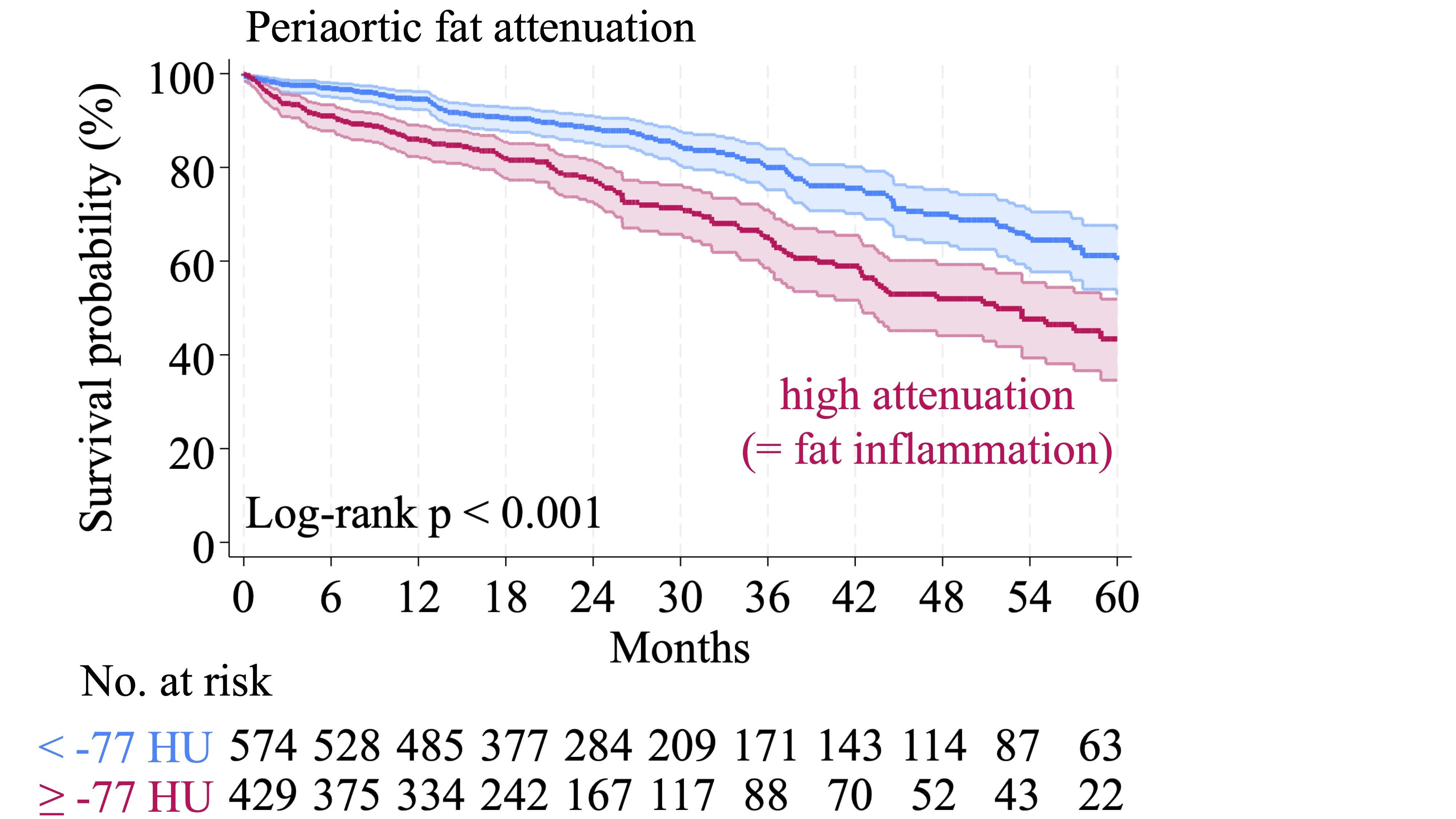
Abstract Body (Do not enter title and authors here): Background: Chronic inflammation is a key driver of cardiovascular disease progression and may impact transcatheter aortic valve replacement (TAVR) outcomes. Higher periaortic adipose tissue (PAAT) attenuation reflects aortic wall inflammation and can be measured on routine preprocedural CT. Yet, its prognostic value in TAVR patients remains unclear. Aim: To explore whether PAAT attenuation predicts long-term mortality in TAVR patients beyond traditional risk factors. Methods: We retrospectively analyzed preprocedural CT scans from consecutive TAVR patients treated at a single tertiary center between 2013 and 2023. The aorta was automatically segmented using a deep learning-based segmentation tool (TotalSegmentator) from the sinotubular junction to the distal infrarenal segment. PAAT attenuation was defined as the mean attenuation (Hounsfield units, HU) of all voxels within a 10mm radial cylinder around the aortic wall and an attenuation range of -190 to -30 HU. PAAT attenuation was associated with 5-year all-cause mortality using Cox regression models, adjusting for technical parameters (tube voltage, signal-to-noise ratio, BSA-indexed PAAT volume) and clinical covariates (age, sex, BMI, and Society of Thoracic Surgeons [STS] risk score). Incremental predictive value of PAAT attenuation was evaluated using Harrell’s C-statistic, and a high-attenuation threshold was derived by Euclidean distance within a receiver operating characteristic framework. Results: The study included 1,003 patients (51.5 % male, mean age 80±8y, BMI 28.6±6.0 kg/m2, median STS score 4.3 [2.5–7.0]%), followed for a median 22 (14–37) months; 5-year mortality rate was 23.6% (n=237). Mean PAAT attenuation was -77.3±7.3 HU. Non-survivors had higher mean PAAT attenuation than survivors (-75.9 vs -77.8 HU, P<0.001), Figure 1. Those with high PAAT attenuation (>-77 HU) were slightly older, and more often female (both P≤0.05). PAAT attenuation independently predicted mortality (aHR [per 10 HU] 1.71, 95%-CI: 1.29–2.26; P<0.001) after adjustment. Adding PAAT attenuation to the clinical model (age, sex, BMI, STS score) improved discrimination for 5-year death (Harrell’s C from 0.69 to 0.70; P<0.001). Conclusions: High periaortic fat attenuation on preprocedural CT independently predicts long-term mortality in patients undergoing TAVR. Quantifying PAAT inflammation may offer additional prognostic value beyond established clinical risk factors and refine preprocedural risk stratification.
Brendel, Jan
(
Massachusetts General Hospital
, Boston , Massachusetts , United States )
Hadzic, Ibrahim
(
Massachusetts General Hospital
, Boston , Massachusetts , United States )
Mayrhofer, Thomas
(
Center for Preventive Medicine and Digital Health, University of Heidelberg
, Mannheim , BW , Germany )
Cooke, Lauren
(
Massachusetts General Hospital
, Boston , Massachusetts , United States )
Langenbach, Isabel
(
Massachusetts General Hospital
, Boston , Massachusetts , United States )
Langenbach, Marcel
(
Massachusetts General Hospital
, Boston , Massachusetts , United States )
Kerkovits, Nora
(
Massachusetts General Hospital
, Boston , Massachusetts , United States )
Juhasz, Vencel
(
Massachusetts General Hospital
, Boston , Massachusetts , United States )
Jung, Matthias
(
Massachusetts General Hospital
, Boston , Massachusetts , United States )
Yucel, Evin
(
Massachusetts General Hospital
, Boston , Massachusetts , United States )
Raghu, Vineet
(
Massachusetts General Hospital
, Boston , Massachusetts , United States )
Lu, Michael
(
Massachusetts General Hospital
, Boston , Massachusetts , United States )
Aerts, Hugo
(
CARIM & GROW, Maastricht University
, Maastricht , Netherlands )
Douglas, Pamela
(
DUKE UNIVERSITY DUMC
, Durham , North Carolina , United States )
Foldyna, Borek
(
Massachusetts General Hospital
, Boston , Massachusetts , United States )
Author Disclosures:
Jan Brendel:DO have relevant financial relationships
;
Research Funding (PI or named investigator):German Research Foundation (DFG):Active (exists now)
| Evin Yucel:No Answer
| Vineet Raghu:DO NOT have relevant financial relationships
| Michael Lu:No Answer
| Hugo Aerts:No Answer
| Pamela Douglas:DO have relevant financial relationships
;
Researcher:HeartFlow:Past (completed)
; Other (please indicate in the box next to the company name):UpToDate- author:Active (exists now)
; Advisor:Novo Nordisk:Active (exists now)
; Advisor:Amgen:Active (exists now)
; Advisor:Foresite Labs:Past (completed)
; Advisor:Cleerly:Past (completed)
| Borek Foldyna:No Answer
| Ibrahim Hadzic:DO NOT have relevant financial relationships
| Thomas Mayrhofer:No Answer
| Lauren Cooke:No Answer
| Isabel Langenbach:No Answer
| Marcel Langenbach:No Answer
| Nora Kerkovits:DO NOT have relevant financial relationships
| Vencel Juhasz:DO NOT have relevant financial relationships
| Matthias Jung:No Answer