Visceral adipose tissue accumulation is associated with incident fatal and non-fatal cardiovascular events: evidence from population-based cohorts in Latin America
Abstract Body (Do not enter title and authors here): Introduction: Visceral adipose tissue (VAT) is a key contributor to adverse cardiometabolic outcomes. However, its direct measurement via imaging techniques is costly and impractical in primary care settings, particularly in low- and middle-income countries. The Metabolic Score for Visceral Fat (METS-VF), a previously validated index based on simple clinical and biochemical parameters, provides an accessible estimate of VAT (eVAT) in grams. Nevertheless, its association with incident fatal and non-fatal cardiovascular events remains understudied in Latin America. Research Question: Is higher eVAT associated with an increased risk of incident fatal and non-fatal cardiovascular events in Latin American adults?
Methods: We analyzed data from adults without type 2 diabetes participating in the Cohorts Consortium of Latin America and the Caribbean (CC-LAC). eVAT was estimated using the following equation: METS-VF = 4.466 + 0.011(Ln(METS-IR))^3 + 3.239(Ln(WHtr))^3 + 0.319*(Sex) + 0.594*(Ln(Age))**, where METS-IR = (Ln((2*G0) + TG0) * BMI) / (Ln(HDL-C)). We applied Cox proportional hazards regression models to estimate adjusted hazard ratios (aHR) for fatal and non-fatal cardiovascular events per 100 g increase and by eVAT quartiles. Models were adjusted for age, sex, residence, smoking status, non-HDL cholesterol, systolic blood pressure, and prior diabetes diagnosis.
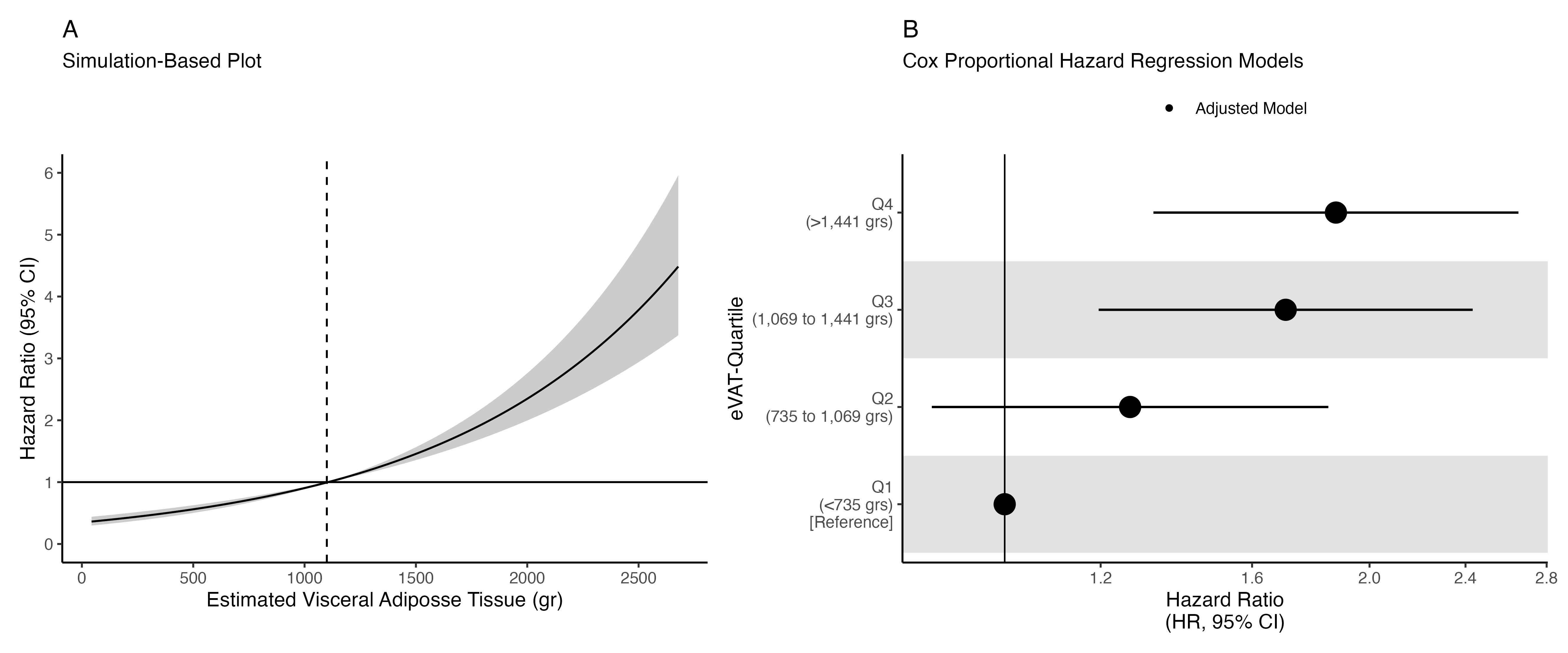
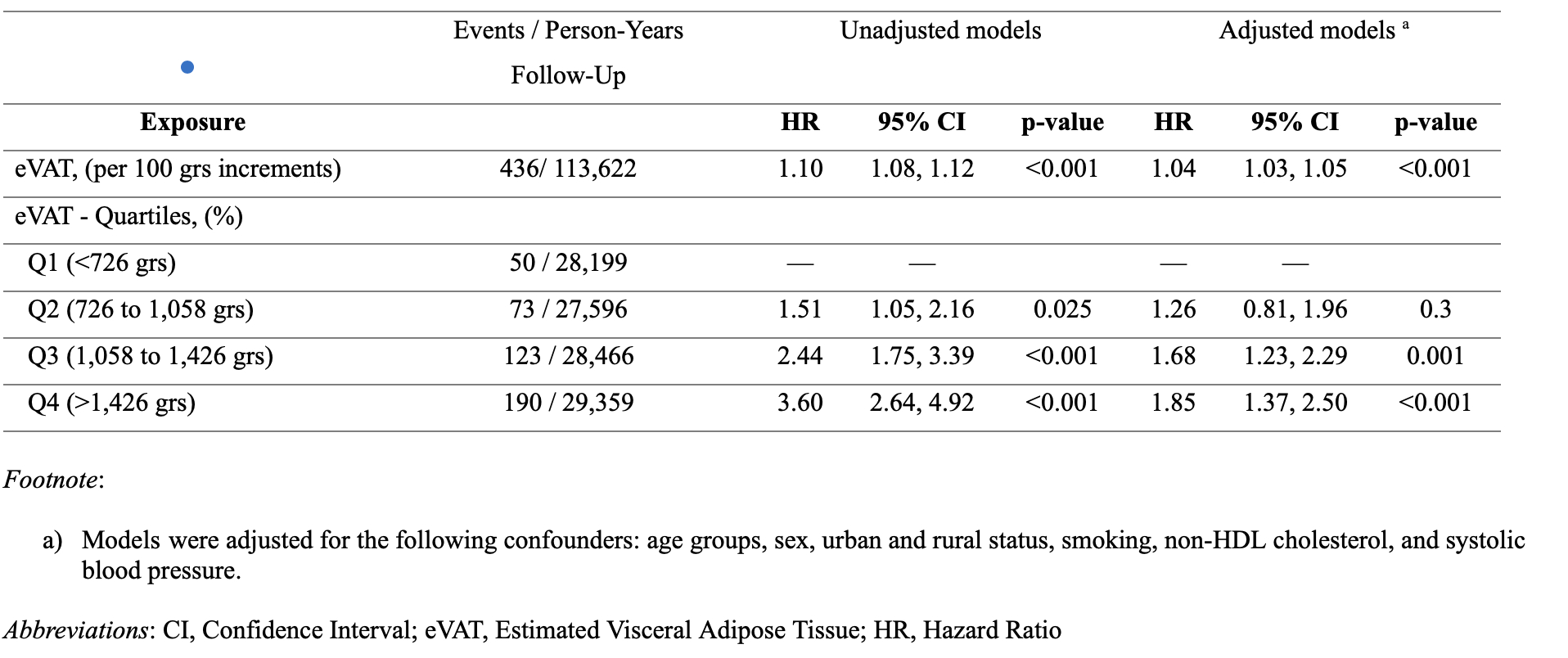
Results: Among 23,097 adults (median age: 52) followed for a total of 113,622 person-years, 436 participants (1.9%) experienced an incident cardiovascular event (262 [1.1%] non-fatal; 174 [0.75%] fatal). Each 100 g increase in eVAT was associated with a 4% higher risk of any cardiovascular event (95% CI: 1.03–1.05). Compared to the lowest quartile (<726 g), participants in the third (1,058–1,426 g) and fourth (>1,426 g) quartiles had 68% (95% CI: 1.23–2.29) and 85% (95% CI: 1.37–2.50) higher risk, respectively. Stratified analyses showed consistent associations across subgroups, with a stronger effect observed among overweight individuals (p-for-interaction < 0.001).
Conclusion: In this large, prospective cohort of Latin American adults without diabetes, higher eVAT was significantly associated with increased risk of cardiovascular events. These findings underscore the role of visceral adiposity in cardiovascular disease development and the need to incorporate its assessment in primary care risk stratification. METS-VF may serve as a practical tool to support this objective in resource-limited settings
Torres-chavez, Mario Cesar
(
National Institute of Cardiology Ignacio Chavez
, Mexico City , Mexico )
Bello-chavolla, Omar Yaxmehen
(
National Institute of Geriatrics
, Mexico City , Mexico )
Martinez-luna, Jesus Ernesto
(
National Institute of Cardiology Ignacio Chavez
, Mexico City , Mexico )
Suárez Velázquez, María Fernanda
(
National Institute of Cardiology Ignacio Chavez
, Mexico City , Mexico )
Antonio-villa, Neftali Eduardo
(
National Institute of Cardiology Ignacio Chavez
, Mexico City , Mexico )
Latin America And The Caribbean, Cohorts Consortium Of
(
Cohorts Consortium of Latin America and The Caribbean
, Mexico City , Mexico )
Author Disclosures:
Mario Cesar Torres-Chavez:DO NOT have relevant financial relationships
| Omar Yaxmehen Bello-Chavolla:No Answer
| Jesus Ernesto Martinez-Luna:No Answer
| María Fernanda Suárez Velázquez:No Answer
| Neftali Eduardo Antonio-Villa:No Answer
| Cohorts Consortium of Latin America and The Caribbean:No Answer