
Logo

American Heart Association

  24
  0


Final ID: MP290

Does invasive hemodynamic monitoring reduce mortality? A Meta-Analysis of pulmonary artery catheterization in cardiogenic shock

Abstract Body (Do not enter title and authors here): Introduction
Cardiogenic shock is a life-threatening complication of decompensated heart failure, with elevated in-hospital mortality rates despite advances in treatment. Pulmonary artery catheterization (PAC) provides detailed hemodynamic data that may guide therapy in shock states, yet its routine use has declined following neutral trials in broader heart failure populations. The benefit of PAC in patients with cardiogenic shock remains uncertain.

Research question
In patients with cardiogenic shock, does the use of pulmonary artery catheter compared to standard therapy reduce in-hospital mortality?

Methods
We conducted a systematic review and meta-analysis including both observational studies and randomized controlled trials that compared the use of PAC versus no PAC in patients with cardiogenic shock. A comprehensive search was carried out in PubMed, Scopus, Cochrane CENTRAL, and Web of Science databases. Data were pooled using a random-effects model, and the certainty of the evidence was assessed using the GRADE approach. Primary outcomes included mortality, while secondary outcomes were length of hospital stay and procedure-related complications.

Results
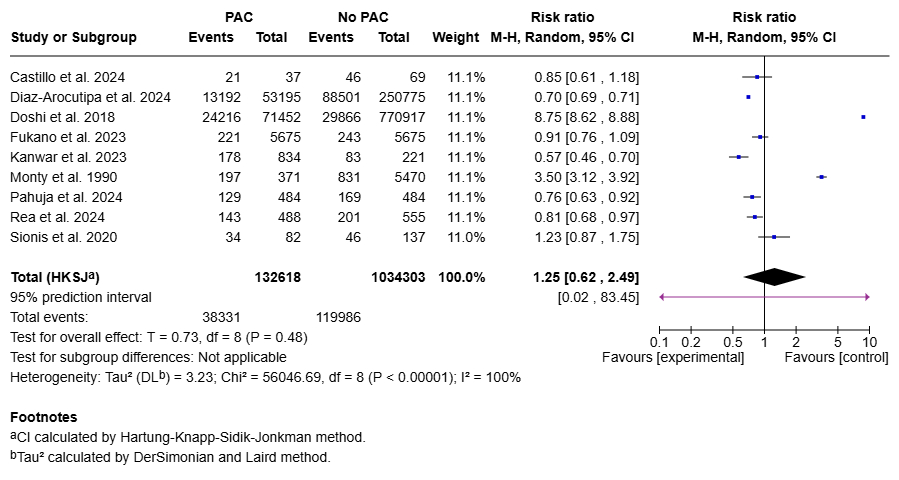
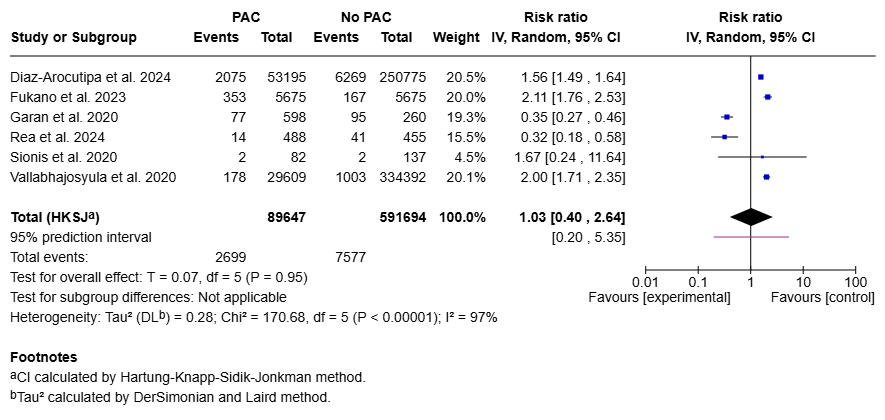
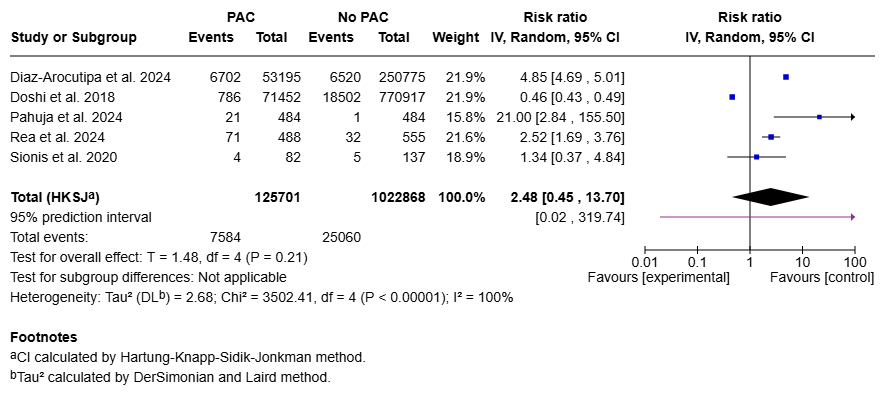
Nine studies including over 1.1 million patients with cardiogenic shock were analyzed. PAC was not associated with reduced in-hospital mortality compared to no PAC (RR 1.25, 95% CI 0.62–2.49; p=0.48). No significant differences were found in the use of vasoactive agents (RR 1.12, 95% CI 0.94–1.34; p=0.13), renal replacement therapy (RR 1.06, 95% CI 0.25–4.53; p=0.90), intra-aortic balloon pump (RR 2.00, 95% CI 0.84–4.73; p=0.09), ECMO (RR 1.03, 95% CI 0.40–2.64; p=0.95), or durable ventricular assist device implantation (RR 2.48, 95% CI 0.45–13.70; p=0.21). All outcomes showed high heterogeneity and wide prediction intervals, indicating substantial variability and uncertainty in treatment effects across studies.

Conclusion
PAC was not associated with significant benefits in mortality or major clinical endpoints. These findings suggest that PAC use should be individualized, and highlight the need for prospective trials to better define which patients may derive benefit from invasive hemodynamic monitoring.
  • Torres-chavez, Mario Cesar  ( Facultad de Medicina Mexicali , Mexicali , Mexico )
  • Gasca, Jose  ( Universidad Santiago de Cali , Cali , Colombia )
  • Ramos Pillado, Francisco  ( UABC , Tijuana , Mexico )
  • Calderon-fernandez, Adolfo  ( UABC , Tijuana , Mexico )
  • Author Disclosures:
    Mario Cesar Torres-Chavez: DO NOT have relevant financial relationships | Jose Gasca: DO NOT have relevant financial relationships | Francisco Ramos Pillado: DO NOT have relevant financial relationships | Adolfo Calderon-Fernandez: DO NOT have relevant financial relationships
Meeting Info:

Scientific Sessions 2025

2025

New Orleans, Louisiana

Session Info:

Navigating Complexity in Cardiogenic Shock: Therapy, Monitoring, and Recovery Challenges

Saturday, 11/08/2025 , 03:15PM - 04:25PM

Moderated Digital Poster Session

More abstracts from these authors:
Use Of Argatroban Plus Antiplatelet Therapy In Patients With Non-Cardioembolic Stroke: A Systematic Review And Meta-Analysis.

Aragon Cortes Amiel, Calderon-fernandez Adolfo, Ramos Pillado Francisco, Natera Dilmareth, García Díaz Susana Guadalupe, Cueva Luis E., López Mena Diego

Comparative Effectiveness of Percutaneous Mitral Valve Repair, Surgery, and Medical Therapy in Patients with Mitral Regurgitation: A Network Meta-Analysis

Gasca Jose, Cueva Luis E., Aragon Cortes Amiel, Torres-chavez Mario Cesar, Rojas Tellez Luis Giovanni, Choque Ayala Luz Camila, Calderon-fernandez Adolfo, García Loera Arantza, Pech Burgos Luis Alejandro

You have to be authorized to contact abstract author. Please, Login
Not Available