
Logo

American Heart Association

  19
  0


Final ID: MP576

Increased Inflation-Adjusted Medicare Reimbursement for Cardiac Electrophysiology Procedures from 2013 to 2022

Abstract Body (Do not enter title and authors here): Introduction:
Medicare is the largest health care payer in the U.S., and private-payer reimbursement is often influenced by Medicare rates. Thus, trends in Medicare reimbursement have implications for specialty practice patterns. However, literature on Medicare trends for cardiac electrophysiology (EP) procedures is limited. Medicare sets rates by assigning relative value units (RVUs) to services, each linked to a Current Procedural Terminology (CPT) code. RVUs are multiplied by a conversion factor to calculate reimbursement.

Research Question:
What are the inflation-adjusted Medicare reimbursement trends for EP procedures for 2013-2022?

Methods:
The Medicare Physician and Other Practitioners by Geography and Service Dataset was queried for EP CPT codes. Medicare Part B reimbursements were compiled and averaged for 2013-2022, limited to facility settings. All rates and conversion factors were adjusted for inflation to 2022 dollars using the Consumer Price Index. Aggregate reimbursement rates were weighted by each CPT code’s share of annual Medicare expenditures. Codes were categorized by procedure type as EP studies/ablations or implantable electronic devices.

Results:
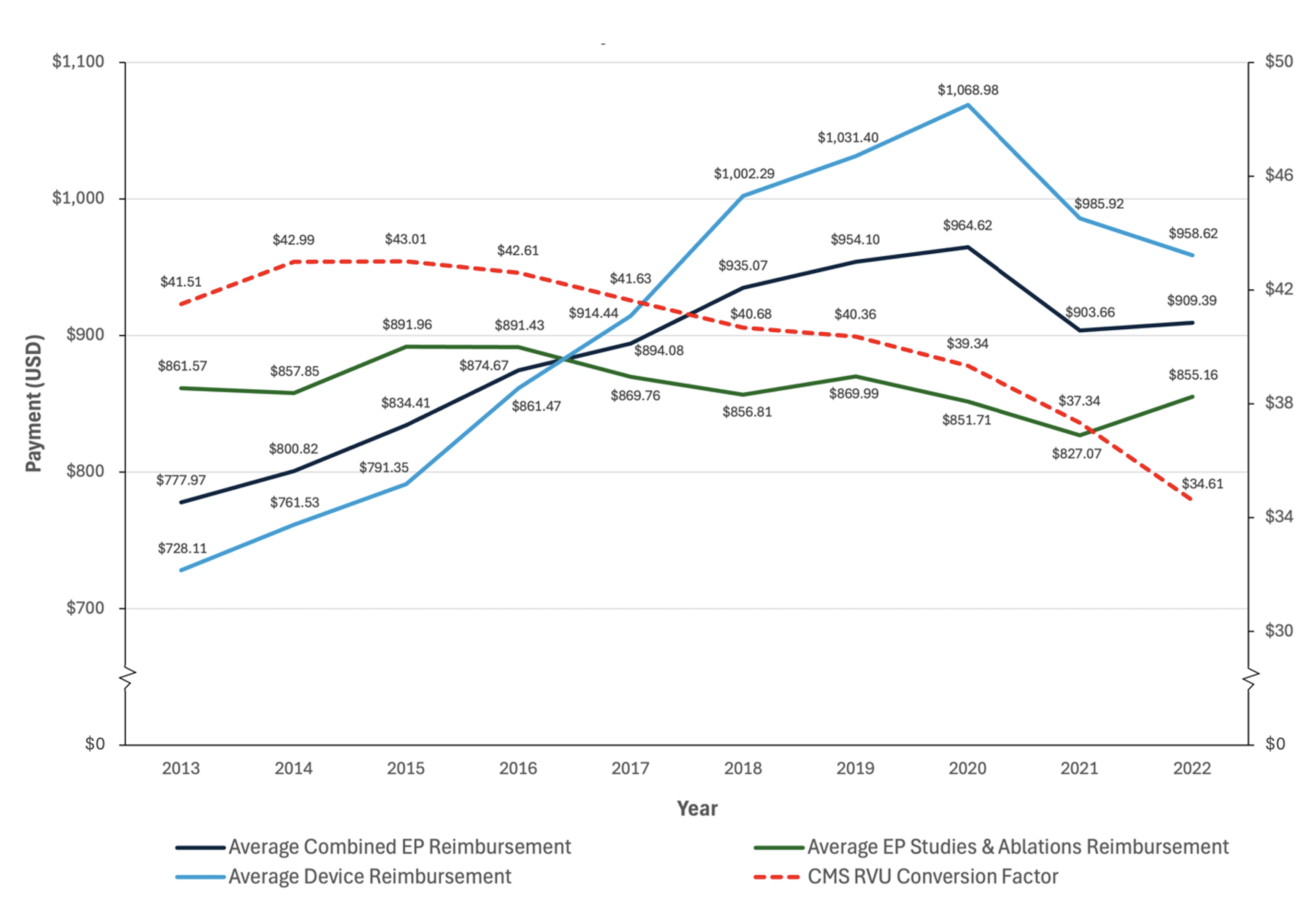
Inflation-adjusted average reimbursement for all EP procedures increased 16.9% from 2013 to 2022. EP studies/ablations saw a 0.7% decrease, while implantable devices increased 31.7%. Over the same period, the Medicare RVU conversion factor declined by 16.6% (Figure 1).

EP studies/ablations grew as a share of Medicare EP expenditures from 37.4% in 2013 to 47.6% in 2022, while implantable devices declined from 62.6% to 52.4%. Volumes for EP studies/ablations rose by 48.1%, while implantable devices declined by 27.8%. Among devices, pacemaker expenditure fell 14.6% with a 25.7% volume drop, and implantable cardioverter-defibrillator expenditure fell 12.2% with a 40.5% volume drop. Among EP studies/ablations, ventricular tachycardia ablation expenditure rose 38.2% with a 59.7% volume increase, supraventricular tachycardia ablation expenditure fell 17.3% with a 4.5% volume drop, and atrial fibrillation (AF) ablation expenditure increased 169.5% and volume grew 210.0%.

Conclusions:
From 2013 to 2022, inflation-adjusted Medicare reimbursement for EP procedures grew despite a declining RVU conversion factor. This trend was driven by increased implantable devices reimbursement and rising EP studies/ablation volume, particularly AF ablation, which may reflect expanding evidence favoring ablation for AF.
  • Moe, Daniel  ( University of Iowa , Iowa City , Iowa , United States )
  • Puri, Pranav  ( University of Iowa , Iowa City , Iowa , United States )
  • Farjo, Peter  ( University of Iowa , Iowa City , Iowa , United States )
  • Dominic, Paari  ( University of Iowa , Iowa City , Iowa , United States )
  • Author Disclosures:
    Daniel Moe: DO NOT have relevant financial relationships | Pranav Puri: DO NOT have relevant financial relationships | Peter Farjo: No Answer | Paari Dominic: DO have relevant financial relationships ; Consultant:Boston Scientific:Active (exists now) ; Consultant:Biosense Webster:Active (exists now)
Meeting Info:

Scientific Sessions 2025

2025

New Orleans, Louisiana

Session Info:

Changing Patterns in Cardiovascular Disease: From Epidemiologic Surveillance to Actionable Insights

Saturday, 11/08/2025 , 10:45AM - 11:40AM

Moderated Digital Poster Session

More abstracts on this topic:
Atrial Fibrillation Ablation Outcomes by Hospital Academic Status: A Nationwide Comparative Analysis using TriNetX Registry

Osama Muhammad, Shabbir Muhammad Raffey, Baig Ahmad Ullah, Ahsan Waseh, Imtiaz Mahrukh

4D Cardiac Optogenetics Enable Complex Arrhythmia Modelling and Precise Interventional Simulation

Wexler Yehuda, Grinstein Harel, Landesberg Michal, Glatstein Shany, Huber Irit, Arbel Gil, Gepstein Lior

You have to be authorized to contact abstract author. Please, Login
Not Available