Scientific Sessions 2025
/
Clinical Case: Box of Chocolates
/
A Rare Case of Genetic Cardiomyopathy: SCN5A mutation-associated Multifocal Ectopic Premature Purkinje-related Complexes Syndrome with Heart Failure with Improved Ejection Fraction
American Heart Association
123
0
Final ID: MP2489
A Rare Case of Genetic Cardiomyopathy: SCN5A mutation-associated Multifocal Ectopic Premature Purkinje-related Complexes Syndrome with Heart Failure with Improved Ejection Fraction
Abstract Body (Do not enter title and authors here): Introduction Inherited cardiomyopathies and channelopathies can be clinically challenging to diagnose and manage. SCN5A mutation-associated Multifocal Ectopic Premature Purkinje-related Complexes (MEPPC) syndrome is less common.
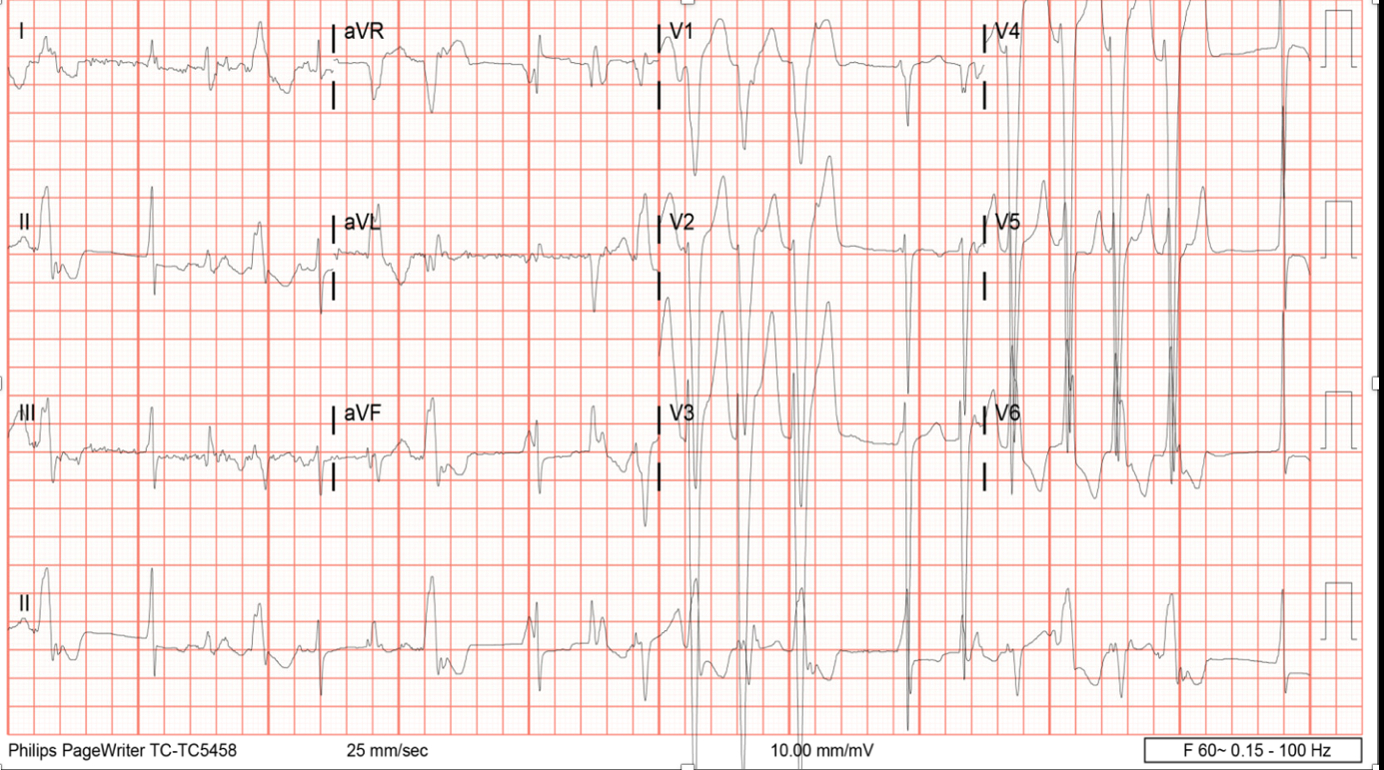
Case Description A 33-year-old man with WPW syndrome status post ablation, hypertension, and paroxysmal atrial fibrillation presented to the emergency room with dizziness, decreased exercise tolerance, and fatigue. Blood pressure was 138/107 mmHg, heart rate 138 bpm, and normal oxygen saturation. Troponin I was negative, and EKG showed new wide complex tachycardia, LBBB, multifocal PACs, and PVCs. The echocardiogram noted severe LVH, diffuse hypokinesis, and a newly reduced LVEF of 15-20%, with LVEDD of 6 cm. Cardiac MRI had no evidence of infiltrative disease, infarct, or fibrosis. Exercise SPECT was negative for ischemia. He was discharged on a beta blocker, ACE inhibitor, and MRA. He had recurrent VT and PVCs despite being on amiodarone. Atrial fibrillation was controlled after PVI ablation. LV function remained <35%, and a dual-chamber ICD was implanted for primary prophylaxis.
Treatment/Outcomes He had incessant PVC and VT, with multiple ICD shocks on follow-up, leading to the ablation of three PVC morphologies localized to the lateral RVOT and the inferolateral RV. No VT was inducible on attempted VT ablation. Repeat cardiac MRI and PET scan were negative for infiltrative disease. Genetic testing revealed a heterozygous SCN5A mutation with a clinical diagnosis of MEPPC. Given his recurrent VT and cardiomyopathy, he was listed as a Status 6 after cardiac transplant evaluation. He was on maximally tolerated doses of all four GDMT pillars and Flecainide. A follow-up echocardiogram after 6 months of treatment showed a recovered LVEF of 55-60%. His transplant listing was removed due to recovery. He has not experienced any more VT episodes.
Discussion/Conclusion MEPPC is a rare, inherited, autosomal dominant SCN5A-related cardiac syndrome. The mutation results in a gain-of-function of the sodium channel, leading to hyperexcitability of the fascicular-Purkinje system. It is often associated with dilated cardiomyopathy and can lead to sudden cardiac death. Genetic counseling and testing are important in diagnosis. Treatment of MEPPC includes the use of Flecainide. LV dysfunction requires optimal GDMT. In this case, complete LV function recovery was achieved with excellent rhythm control on flecainide along with maximally tolerated GDMT.
Osei, Albert
(
University of Pittsburgh Med Cen
, Pittsburgh , Pennsylvania , United States )
Howard, Ato
(
University of Pittsburgh Med Cen
, Pittsburgh , Pennsylvania , United States )
Bhonsale, Aditya
(
University of Pittsburgh Med Cen
, Pittsburgh , Pennsylvania , United States )
Hickey, Gavin
(
University of Pittsburgh Med Cen
, Pittsburgh , Pennsylvania , United States )
Author Disclosures:
Albert Osei:DO NOT have relevant financial relationships
| Ato Howard:DO NOT have relevant financial relationships
| Aditya Bhonsale:DO NOT have relevant financial relationships
| Gavin Hickey:DO NOT have relevant financial relationships