Association of Biologic Therapy in Inflammatory Bowel Disease and Risk of Cardiac Arrhythmias: A Multicenter Cohort Study
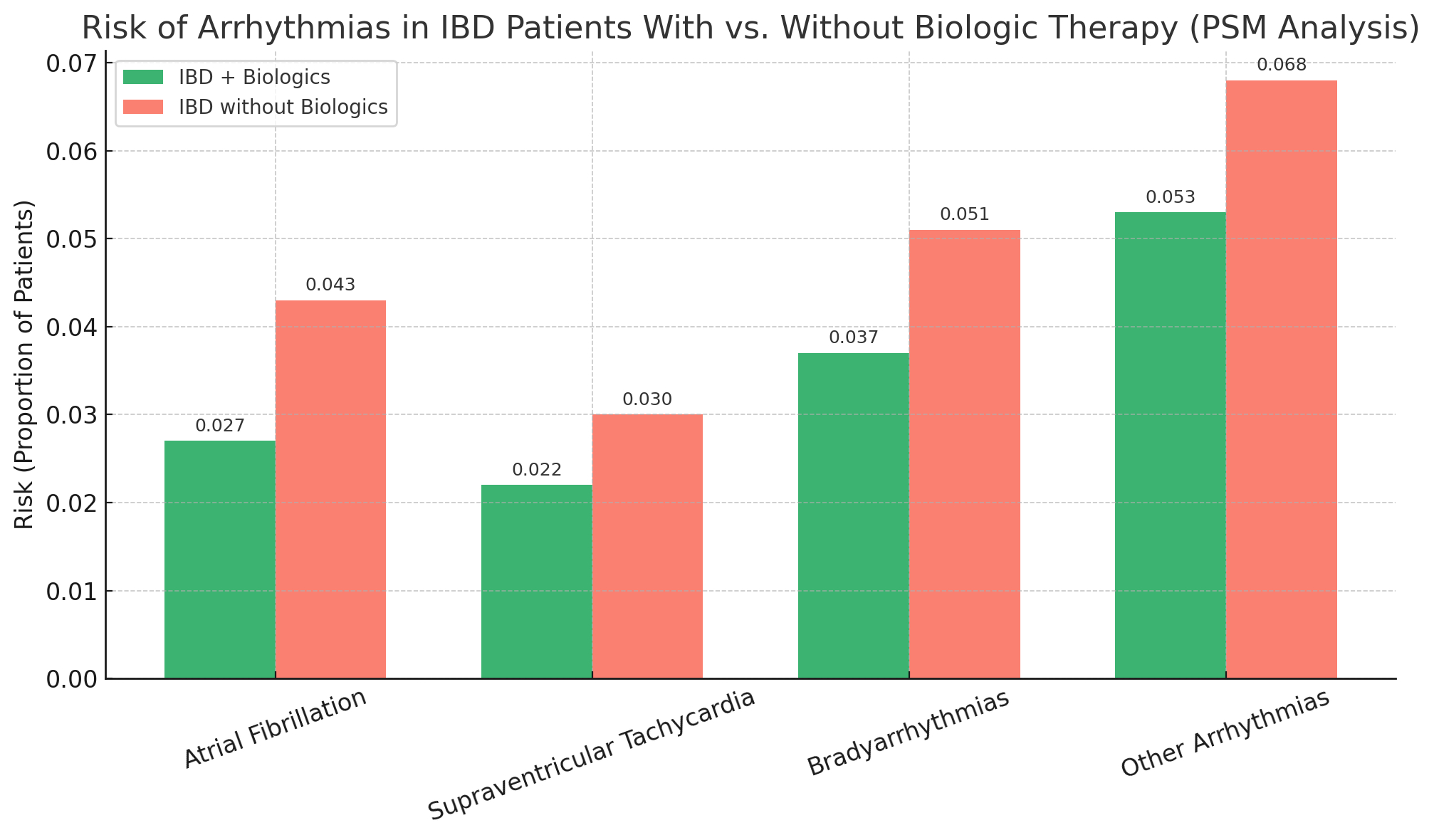
Abstract Body (Do not enter title and authors here): Introduction/Background: Patients with inflammatory bowel disease (IBD) are at increased risk for cardiac arrhythmias due to chronic systemic inflammation. The potential protective effects of biologic therapy against arrhythmias have not been well established in large population data. Research Question/Hypothesis: We hypothesized that IBD patients treated with biologic agents have a lower risk of developing cardiac arrhythmias compared to IBD patients who have not received biologics. Goals/Aims: To compare the incidence and burden of atrial fibrillation (AF), supraventricular tachycardias (SVT), bradyarrhythmias, and other arrhythmias in IBD patients with vs. without biologic therapy, using a propensity score–matched analysis. Methods/Approach: Using the TriNetX Research USA network, we identified two cohorts of IBD patients: those exposed to biologic therapy (n=101,711) and those who have not received biologics (n=486,879). IBD was defined using ICD-10 codes for Crohn’s disease and ulcerative colitis. One-to-one propensity score matching (PSM) was performed based on demographics and clinical variables to balance baseline characteristics. Patients with arrhythmias prior to the index event were excluded. Outcomes included AF (I48), SVT (I47–I49), bradyarrhythmias (I44–R00), and other arrhythmias (I45–I49), assessed using risk difference, odds ratios (OR), Kaplan-Meier survival, and event frequency analyses. Results/Data: Post-matching, the biologics and non-biologics cohorts were well balanced (n=98,543 each for AF analysis). The biologics cohort had a significantly lower risk of AF (2.7% vs. 4.3%; OR 0.619, 95% CI: 0.594–0.645, p<0.001), SVT (2.2% vs. 3.0%; OR 0.742, 95% CI: 0.710–0.777), bradyarrhythmias (3.7% vs. 5.1%; OR 0.703), and other arrhythmias (5.3% vs. 6.8%; OR 0.766). Kaplan-Meier analysis showed higher arrhythmia-free survival in the biologics cohort across all arrhythmia subtypes (p<0.001). The number of arrhythmia events was also lower in the biologics group for AF (mean 10.9 vs. 12.2, p=0.016) and bradyarrhythmias (2.6 vs. 2.8, p=0.025). Conclusion(s): In a large propensity-matched real-world cohort of IBD patients, biologic therapy was associated with a significantly reduced risk and burden of cardiac arrhythmias. These findings suggest a possible cardioprotective role for biologics in chronic inflammatory diseases and warrant prospective validation.
Singh, Birgurman
( Saint Peter's University Hospital
, New Brunswick
, New Jersey
, United States
)
Garg, Archit
( Saint Peter's University Hospital
, New Brunswick
, New Jersey
, United States
)
Singh, Anmol
( U Conn
, Hartford
, Connecticut
, United States
)
Bhagat, Umesh
( Cleveland Clinic
, Cleveland
, Ohio
, United States
)
Singh, Birsukhman
( IGMC Shimla
, Chandigarh
, India
)
Kaur, Nirmal
( Cardiometabolic Institute NJ
, Basking Ridge
, New Jersey
, United States
)
Author Disclosures:
Birgurman Singh:DO NOT have relevant financial relationships
| Archit Garg:DO NOT have relevant financial relationships
| Anmol Singh:DO NOT have relevant financial relationships
| Umesh Bhagat:No Answer
| Birsukhman Singh:DO NOT have relevant financial relationships
| Nirmal Kaur:DO NOT have relevant financial relationships