
Comparison of One-Year Survival between Norwood and Hybrid Pathways for Hypoplastic Left Heart Syndrome Infants- A Multicenter Registry Data Analysis
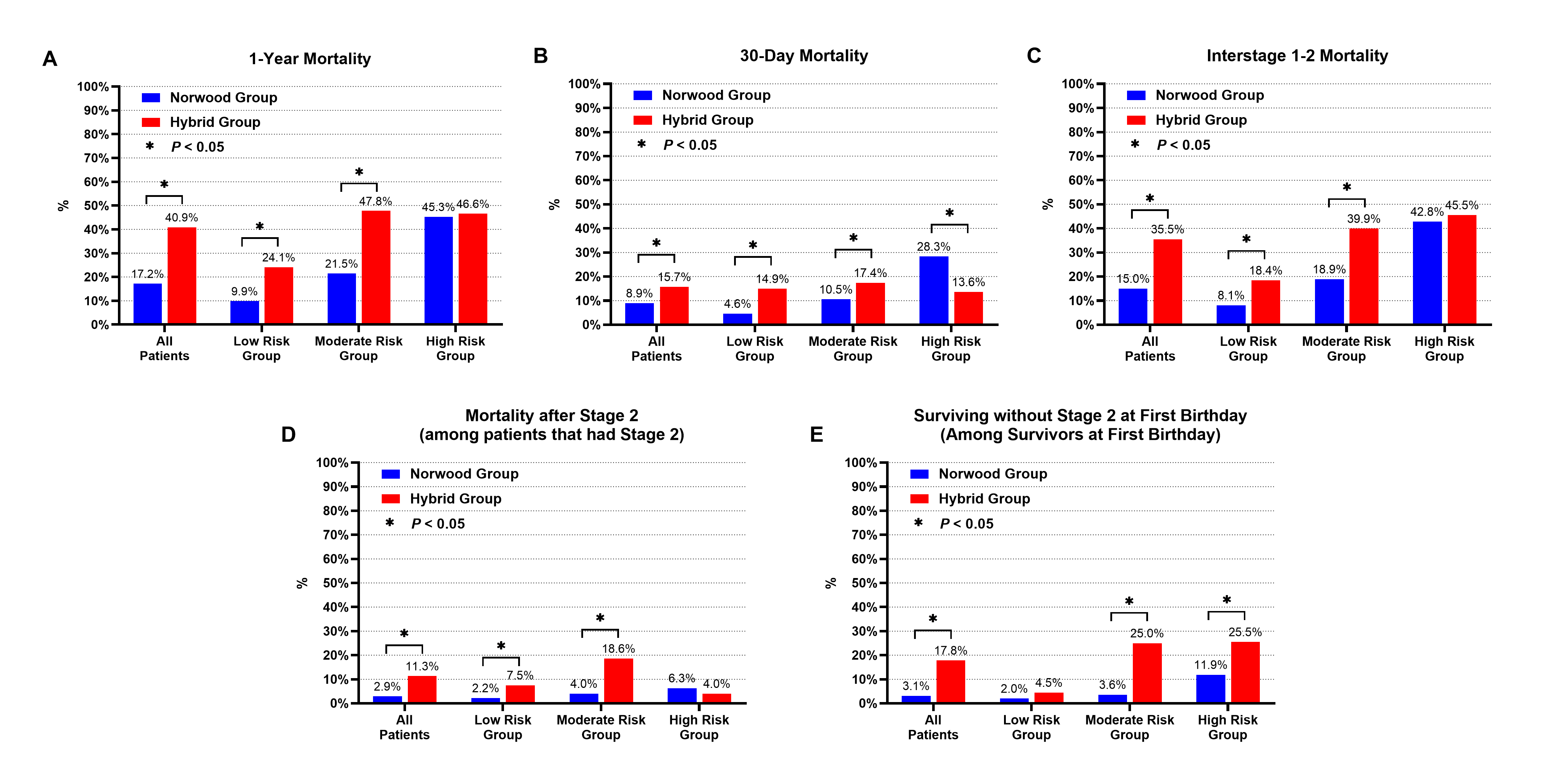
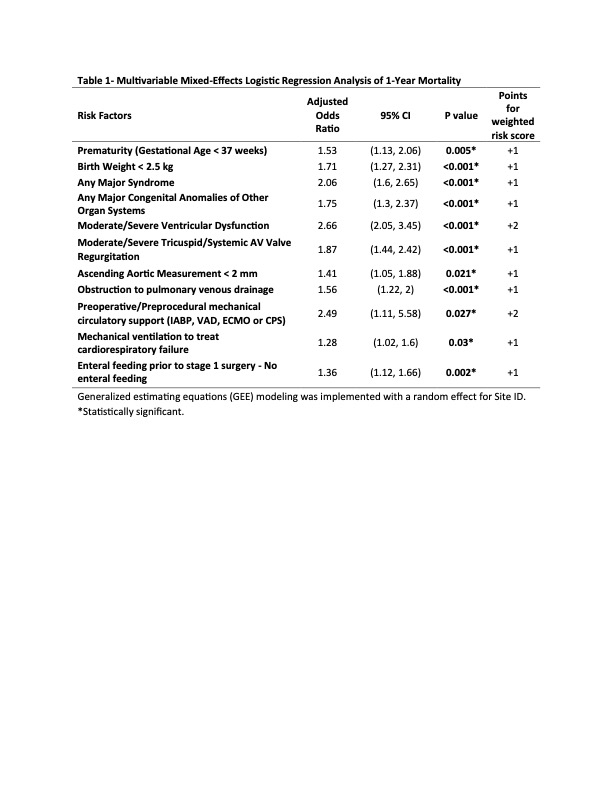
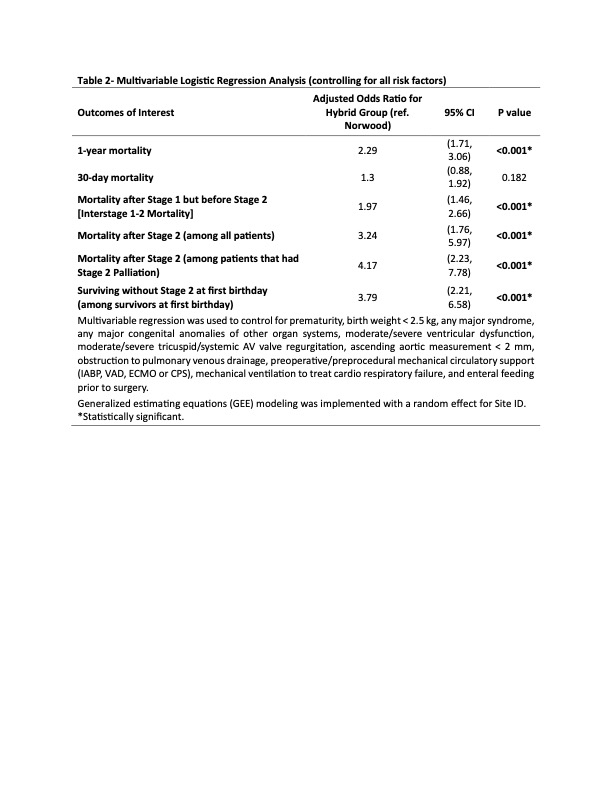
Abstract Body (Do not enter title and authors here): Introduction: The choice of Stage 1 palliation (S1P) in patients with hypoplastic left heart syndrome/complex (HLHS/C) between Norwood Stage 1 (NS1) or Hybrid Stage 1(HS1) palliation is made based on center preference, risk factors & is often based on short term outcomes like operative mortality. Aims: This study aims to risk stratify patients prior to S1P to decide optimal pathway for achieving 1-year survival using the National Pediatric Cardiology Quality Improvement Collaborative (NPC-QIC) Phase II dataset. Methods: NPC-QIC Phase II data were acquired on all infants undergoing S1P for HLHS/C from yrs 2016-2024. All pre-S1P variables were analyzed using univariable and multivariable mixed effect logistic regression. Generalized estimation equations accounted for center variations. Weighted risk stratification was performed using a multivariable risk score (Table 1) with sum of adjusted log-odds ratios to stratify the patients into low, moderate and high-risk groups. The primary endpoint was mortality at 1 year & secondary endpoint was completion of Stage 2 palliation (S2P) by 1 year amongst survivors. Risk stratification score was \validated using Internal bootstrap. Multivariable regression was used to determine the adjusted association between NS1 vs HS1 & outcomes after controlling for clinically relevant risk factors and confounders. Results: Of 3074 patients, 2473 (80.5%) survived to 1 yr (467/2742(17%) for NS1 vs 132/325(41%) for HS1). Significantly superior survival at 1 year was noted with NS1 palliation in the overall, low and moderate risk cohorts. (Figure 1A-D). A significantly higher number of patients completed S2P with the NS1 pathway (96.9%) compared to the HS1 pathway (82.2%) (Figure 1E). The developed risk score demonstrated good internal discrimination and calibration for predicting 1-year mortality with internal bootstrap validation (AUC = 0.700, Brier Score = 0.14, Somer’s D = 0.40) & good calibration (non-significant Hosmer-Lemeshow goodness-of-fit test P=0.817). After adjusting for all risk factors, HS1 was associated with increased risk of mortality at 1-yr, interstage 1-2 & after stage 2(Table 2) Conclusions: Significantly superior survival at 1 year of age and completion of Stage 2 palliation is achieved with NS1 palliation compared to HS1 particularly in the low and moderate risk groups. Indications for HS1 need to be redefined based on longer-term survival and Stage 2 completion especially in low and moderate risk patients.
Zurakowski, David
( Boston Children's Hospital and Harv
, Boston
, Massachusetts
, United States
)
Staffa, Steven
( Boston Children's Hospital and Harv
, Boston
, Massachusetts
, United States
)
Hill, Garick
( Cincinnati Children's Hospital
, Cincinnati
, Ohio
, United States
)
Mccoy, Allison
( Vanderbilt University
, Nashville
, Tennessee
, United States
)
Sinha, Pranava
( University of Minnesota
, Minneapolis
, Minnesota
, United States
)
Author Disclosures:
David Zurakowski:DO NOT have relevant financial relationships
| Steven Staffa:DO NOT have relevant financial relationships
| Garick Hill:DO have relevant financial relationships
;
Consultant:Ultragenyx:Past (completed)
| Allison McCoy:DO NOT have relevant financial relationships
| Pranava Sinha:DO NOT have relevant financial relationships