
Logo

American Heart Association

  11
  0


Final ID: MP2524

Systemwide Implementation of Bridge Clinics Reduces Readmissions and Hospital Utilization in Urban and Rural Heart Failure Populations

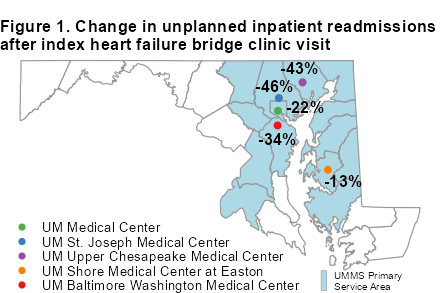
Abstract Body (Do not enter title and authors here): Background: Heart Failure (HF) is a leading cause of 30-day readmissions (20-25% nationally). Interdisciplinary Bridge Clinics (BCs) improve continuity of care, reduce readmissions, and shift care from high-cost inpatient settings to more sustainable outpatient management. The University of Maryland Medical System (UMMS) launched its first BC in 2015 at its quaternary care academic hospital in Baltimore. Since then, four additional clinics have been established across UMMS, most recently in 2024, expanding HF care access in urban and rural areas (Figure 1). This study evaluates whether similar benefits seen at the original site—reduced readmissions and utilization—are observed at new clinics across the health system.
Methods: In this retrospective observational cohort study, we analyzed patients from five UMMS hospitals who attended a BC between January and November 2024. The index event was the first BC visit. Healthcare utilization was assessed using the Chesapeake Regional Information System for our Patients (CRISP) Visit Level Pre/Post Analysis tool, examining up to 12 months before and after the index visit. We analyzed inpatient, observation, emergency department (ED), and outpatient visits, and 30-day readmissions, using CMS criteria to exclude planned hospitalizations.
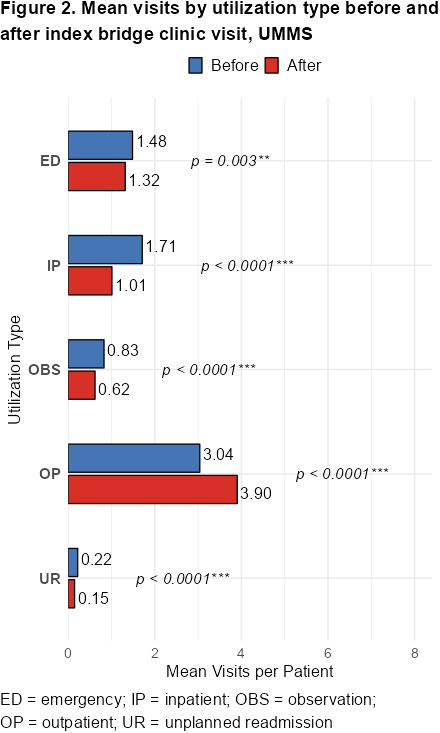
HF subtype was categorized using ICD-10 codes. Utilization changes were analyzed with the Wilcoxon signed-rank test; results by HF subtype and site are presented descriptively (Figure 2).
Results: Each site showed a reduction in inpatient readmissions after BC (Figure 1). Pooled data across all 5 system sites showed statistically that inpatient utilization decreased by 41% (p<0.001), outpatient utilization increased by 28.5% (p<0.001) and readmissions decreased by 32.7% (p<0.001) (Figure 2).
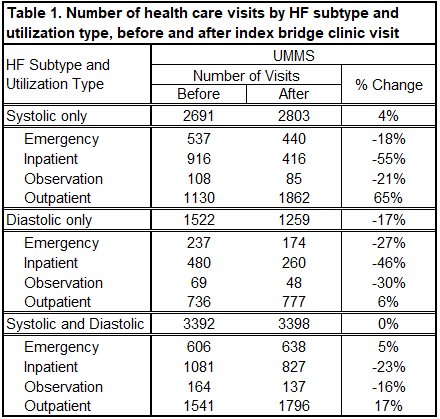
Improved outcomes were evident across the HF spectrum (Table 1). Patients with all HF types had fewer admissions and ED visits following BC visit. This trend was seen across all 5 sites.
Conclusion: Implementation of transitional BCs across a diverse urban and rural hospital system was associated with reductions in utilization and readmissions, with increased outpatient engagement. These improvements were consistent across all HF subtypes. System-wide adoption of post-discharge interdisciplinary follow-up via BCs can improve care transitions and reduce care utilization in HF populations, regardless of setting. Future studies should assess long-term outcomes, cost-effectiveness, and equitable access.
  • Johnson, Trent  ( University of Maryland , Baltimore , Maryland , United States )
  • Ramani, Gautam  ( University of Maryland , Baltimore , Maryland , United States )
  • Pollock, Jeremy  ( UNIVERSITY OF MARYLAND MEDICAL CENT , Luthvle Timon , Maryland , United States )
  • Fakhri, Asghar  ( University of Maryland , Baltimore , Maryland , United States )
  • Landon, Julie  ( University of Maryland , Baltimore , Maryland , United States )
  • Wade, Carol  ( University of maryland medical Cent , Ellicott City , Maryland , United States )
  • Okeefe, Suzanne  ( University of Maryland Health , Bel Air , Maryland , United States )
  • Davis, Ian  ( University of Maryland , Baltimore , Maryland , United States )
  • Zimand, Paul  ( University of Maryland , Baltimore , Maryland , United States )
  • Author Disclosures:
    Trent Johnson: DO NOT have relevant financial relationships | Gautam Ramani: DO NOT have relevant financial relationships | Jeremy Pollock: No Answer | Asghar Fakhri: No Answer | Julie Landon: DO NOT have relevant financial relationships | Carol Wade: No Answer | Suzanne Okeefe: DO NOT have relevant financial relationships | Ian Davis: No Answer | Paul Zimand: DO NOT have relevant financial relationships
Meeting Info:

Scientific Sessions 2025

2025

New Orleans, Louisiana

Session Info:

Bridging the Gaps: Innovative Strategies in Heart Failure Care Delivery

Monday, 11/10/2025 , 01:45PM - 02:55PM

Moderated Digital Poster Session

More abstracts on this topic:
A Quarter Century of Cardiovascular Strain: Mortality Trends in Hypertension and Hypertensive Heart Disease Among U.S. Adults Aged 55+

Ali Muhammad Faizan, Khan Muhammad, Sharif Aleena, Hossain Mohammad, Ahmad Husnain, Eltawansy Sherif, Faizan Muhammad, Ahmed Ashraf, Abdul Malik Mohammad Hamza Bin, Pahwani Ritesh, Patel Rahul, Mehdi Hassan

A Competency-Based Screening Echocardiography Curriculum Designed for Rural American Indian Community Health Representatives

Thoroughman Rose, Riley Alan, De Loizaga Sarah, Adams David, Beaton Andrea, Buonfiglio Samantha, Danforth Kristen, Masyuko Sarah, Miller Mccall, Yadava Mrinal

More abstracts from these authors:
The Wrong Hoofbeats: Chagas Cardiomyopathy Presenting as Ventricular Tachycardia with Misleading Lyme Serology

Pu Alex, Ananthram Manjula, Mysore Manu, Leventhal Sarah, Wade Carol, Bruno Shelby, Naami Robert, Allaham Haytham, Amara Richard, Jones Niya

Enhancing Mobility in Mechanical Support: A Retrospective Analysis of Axillary IABP Use

Kwiatkowski Sara, Alswayed Khalid, Cong Olivia, Sherani Nageen, Soares Cullen, Magder Laurence, Ramani Gautam, Allaham Haytham

You have to be authorized to contact abstract author. Please, Login
Not Available