
Logo

American Heart Association

  24
  0


Final ID: MP1806

Enhancing Mobility in Mechanical Support: A Retrospective Analysis of Axillary IABP Use

Abstract Body (Do not enter title and authors here): Introduction/Background: The axillary approach for intra-aortic balloon pump (IABP) placement offers an alternative to femoral access, with the advantage of preserving mobility during temporary mechanical circulatory support. While femoral insertion is technically easier and widely used, it significantly limits ambulation, potentially worsening outcomes in patients with advanced heart failure (HF) awaiting cardiac replacement therapy.
Research Questions/Hypothesis: We evaluated whether axillary IABP maintains mobility while delivering effective hemodynamic support with acceptable safety. We hypothesized that axillary IABP allows ambulation with low complication and device-related morbidity rates.
Goals/Aims: We conducted a pooled analysis of four retrospective studies to evaluate outcomes and complications associated with axillary IABP in patients with advanced HF, aiming to better define its role as a bridge to definitive therapies.
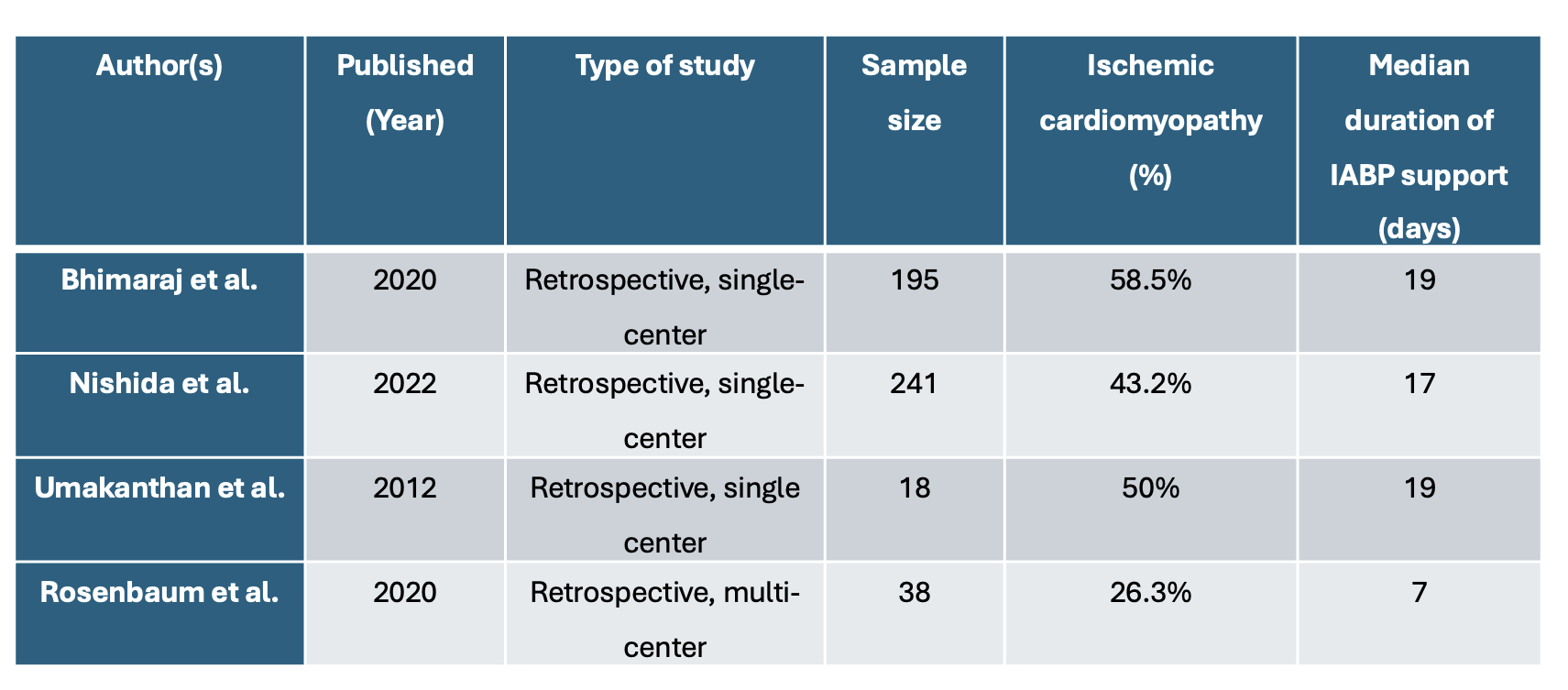
Methods/Approach: A systematic PubMed search identified four retrospective studies of adult HF patients supported with axillary IABP. Inclusion required reporting of clinical outcomes and/or complications. A random-effects meta-analysis estimated pooled probabilities and 95% confidence intervals (CIs) for key outcomes, accounting for inter-study variability. Significance was set at p<0.05.
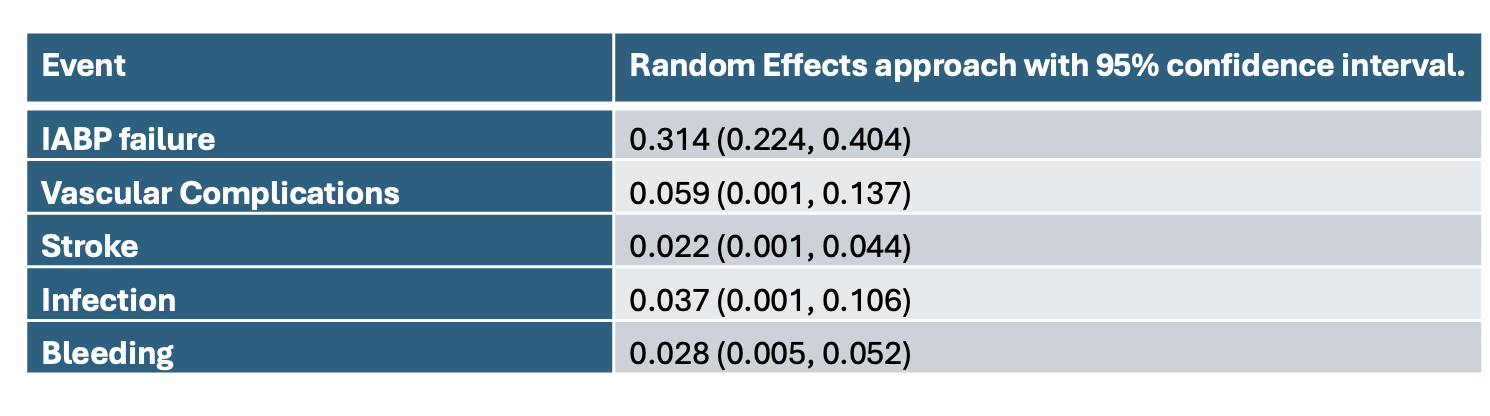
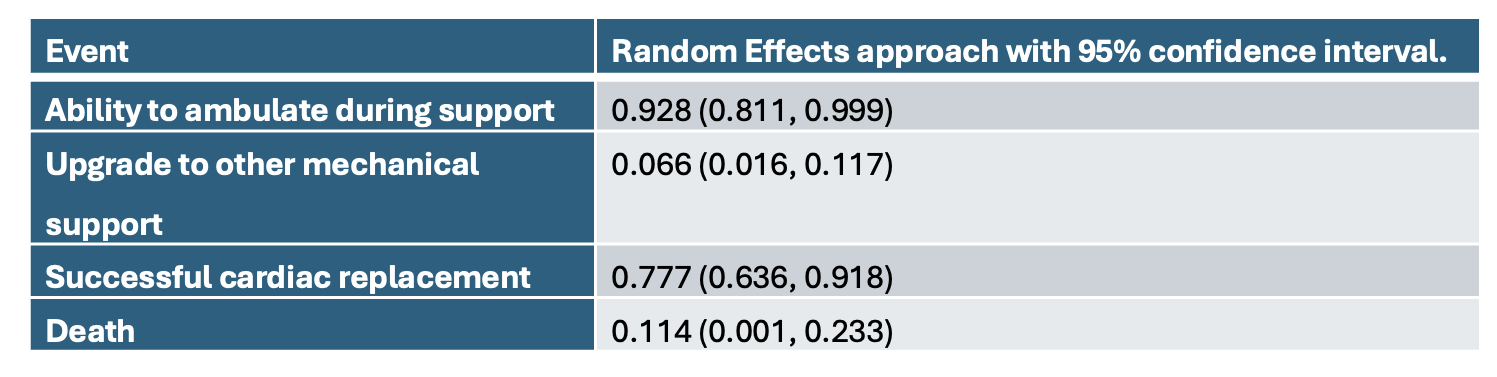
Results/Data: In 492 patients across the studies, hemodynamic indices - including right atrial pressure, mean pulmonary arterial pressure, pulmonary capillary wedge pressure, and cardiac index - improved following IABP placement. Ambulation was achieved in 92.8% (95% CI: 0.811–0.999). Successful bridging to transplant occurred in 77.7% (95% CI: 0.636–0.918). Mortality (11.4%; 95% CI: 0.001–0.233) and escalation to LVAD or ECMO (6.6%; 95% CI: 0.016–0.117) were low. Vascular complications (5.9%), stroke (2.2%), infection (3.7%), and bleeding (2.8%) were similarly low and not statistically significant. Device failure—including kinking, rupture, migration, or malposition—was the most frequent complication (31.4%; 95% CI: 0.224–0.404).
Conclusion(s): Axillary IABP enables ambulation and improves hemodynamics in advanced HF with low complication rates. Device failure is the most common adverse event. Emerging protocols for ambulatory femoral IABP may preserve mobility while potentially reducing device-related issues. Further studies are needed to compare axillary and femoral approaches in terms of safety, durability, and long-term outcomes.
  • Kwiatkowski, Sara  ( University of Maryland , Baltimore , Maryland , United States )
  • Alswayed, Khalid  ( University of Maryland , Baltimore , Maryland , United States )
  • Cong, Olivia  ( University of Maryland , Baltimore , Maryland , United States )
  • Sherani, Nageen  ( University of Maryland , Baltimore , Maryland , United States )
  • Soares, Cullen  ( University of Maryland , Baltimore , Maryland , United States )
  • Magder, Laurence  ( University of Maryland , Baltimore , Maryland , United States )
  • Ramani, Gautam  ( University of Maryland , Baltimore , Maryland , United States )
  • Allaham, Haytham  ( University of Maryland , Baltimore , Maryland , United States )
  • Author Disclosures:
    Sara Kwiatkowski: DO NOT have relevant financial relationships | Khalid Alswayed: No Answer | Olivia Cong: DO NOT have relevant financial relationships | Nageen Sherani: No Answer | Cullen Soares: No Answer | Laurence Magder: No Answer | Gautam Ramani: DO NOT have relevant financial relationships | Haytham Allaham: No Answer
Meeting Info:

Scientific Sessions 2025

2025

New Orleans, Louisiana

Session Info:

It's Shocking: Cardiogenic Shock Research

Sunday, 11/09/2025 , 11:50AM - 01:05PM

Moderated Digital Poster Session

More abstracts on this topic:
A Hypertrophic Cardiomyopathy-Based Model Estimate of the Prevalence of Danon Disease in the United States

Maron Martin, Massera Daniele, Manganaro Susan, Bailey Miranda, Rehbein Fletcher, Taylor Matthew

A-band titin-truncating variant promotes the development of arrhythmia-induced cardiomyopathy in a novel genetically-engineered porcine model

Lee Kwonjae, Del Rio Carlos, Mcnally Elizabeth, Pfenniger Anna, Bhatnagar Ashita, Glinton Kristofor, Burrell Amy, Ober Rebecca, Mcluckie Alicia, Bishop Brian, Rogers Christopher, Geist Gail

More abstracts from these authors:
You have to be authorized to contact abstract author. Please, Login
Not Available