Higher Neighborhood Social Vulnerability is Associated with Lower Life’s Essential 8 Cardiovascular Health Scores: the Coronary Artery Risk Development in Young Adults (CARDIA) Study
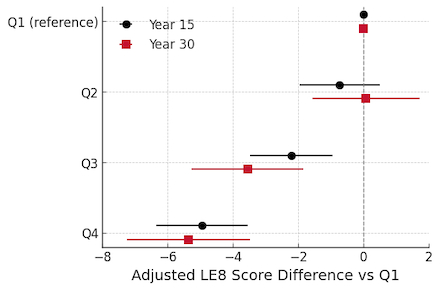
Abstract Body (Do not enter title and authors here): Background: The CDC Social Vulnerability Index (SVI) quantifies community-level social vulnerability across four domains: socioeconomic (SES), household characteristics (e.g., single-parent), minority status, and housing/transportation. We examined differences in Life’s Essential 8 (LE8) cardiovascular health (CVH) scores across SVI quartiles, explored which SVI domains and sex-race subgroups accounted for the largest disparities in LE8 scores, and evaluated associations between LE8 sub-components and SVI. Methods: We analyzed data from CARDIA participants at Year 15 (Y15; 2000–01; n = 3,175; mean age 40 y) and Year 30 (Y30; 2015–16; n = 2,370; mean age 55 y). SVI from years 2000 and 2016, corresponding with Y15 and Y30 of CARDIA, was assigned via geocoded residential address and grouped into quartiles (Q1 = lowest vulnerability, Q4 = highest). Overall LE8 and eight component metric scores were calculated per AHA definitions (range 0-100; higher is better CVH). Using linear regression adjusted for age, sex, race, and maximum education, we compared mean LE8 scores (with 95% CIs) across SVI quartiles. Results: At both Y15 and Y30, there was an inverse association between SVI and LE8 score (Figure). The mean adjusted overall LE8 score difference for Q4 vs. Q1 of SVI was –4.95 (95% CI: –6.36, –3.54) at Y15 and –5.37 points (–7.24, –3.49) at Y30. For Q3 vs. Q1, adjusted LE8 difference was –2.21 (–3.47, –0.94) at Y15 and –3.56 (–5.27, –1.84) at Y30. Among the four SVI domains, SES and household characteristics drove most of the disparity in LE8 scores (Y30 Q4 vs. Q1: SES Δ = –6.59; household Δ = –6.45 points). Across the extremes of SVI quartiles, LE8 metric-level differences were largest for smoking (Y15 Q4 vs. Q1: Δ = –12.37; Y30 Δ = –8.91 points) and physical activity (Y15 Q4 vs. Q1: Δ = –7.57; Y30 Δ = –13.78 points). In the SES domain of SVI, Black participants had mean SVI scores of 0.61 vs. 0.30 for White participants at Y15, with a similar difference at Y30, whereas sex differences within each race were minimal, indicating that racial disparities in community SES vulnerability far exceeded those by sex. Conclusions: Higher social vulnerability is associated with significantly lower CVH, and these disparities endure into midlife, with racial disparities far exceeding those by sex. SES and household factors, along with behavioral gaps in smoking and physical activity, may be key targets for community-level interventions to improve cardiovascular health equity.
Walker, James
(
Northwestern University
, Chicago , Illinois , United States )
Won, Daniel
(
Northwestern University
, Chicago , Illinois , United States )
Lam, Emily
(
Northwestern University
, Chicago , Illinois , United States )
Mcgowan, Cyanna
(
Northwestern University
, Chicago , Illinois , United States )
Juarez, Lucia
(
University of Alabama at Birmingham
, Birmingham , Alabama , United States )
Kershaw, Kiarri
(
Northwestern University
, Chicago , Illinois , United States )
Kiefe, Catarina
(
UNIV OF MASSACHUSETTS MEDICAL SCHOO
, Sterling , Massachusetts , United States )
Ning, Hongyan
(
Northwestern University
, Chicago , Illinois , United States )
Lloyd-jones, Donald
(
Boston University Medical Center
, Boston , Massachusetts , United States )
Author Disclosures:
James Walker:DO NOT have relevant financial relationships
| Daniel Won:DO NOT have relevant financial relationships
| Emily Lam:DO NOT have relevant financial relationships
| Cyanna McGowan:DO NOT have relevant financial relationships
| Lucia Juarez:DO NOT have relevant financial relationships
| Kiarri Kershaw:DO NOT have relevant financial relationships
| Catarina Kiefe:No Answer
| Hongyan Ning:DO NOT have relevant financial relationships
| Donald Lloyd-Jones:DO have relevant financial relationships
;
Employee:American Heart Association:Active (exists now)