Logo

American Heart Association

  19
  0


Final ID: MP1684

Predictors of Left Atrial Compliance and V-Wave Response in Transcatheter Mitral Valve Therapy

Abstract Body (Do not enter title and authors here): Background: Severe mitral regurgitation (MR) is typically associated with large V-waves on invasive hemodynamic monitoring. However, discrepancies often arise between echocardiographic assessments of MR severity using color Doppler and invasive hemodynamic measurements. These inconsistencies are largely influenced by left atrial (LA) compliance, which affects the magnitude of V-waves. We sought to identify non-invasive predictors of invasive LA compliance and V-wave response in patients undergoing transcatheter mitral valve therapies (TMVT).
Hypothesis: Which echocardiographic and clinical factors are predictive of invasive LA compliance in patients undergoing TMVT for severe MR?
Methods: Patients with severe MR who achieved MR resolution (≤1+ post-procedure) following TMVT by either transcatheter edge-to-edge repair (TEER) or transcatheter mitral valve replacement (TMVR) were included in the study. The compliant LA group consisted of patients with severe MR by color Doppler who had either a baseline LA mean pressure ≤12 mmHg or a concordant hemodynamic response, defined as ≥50% reduction in V-wave magnitude along with MR resolution. The non-compliant LA group included patients with a baseline LA mean pressure >12 mmHg and a discordant response, defined as <50% V-wave reduction despite MR resolution. Multivariable logistic regression was performed to identify independent predictors of LA compliance.
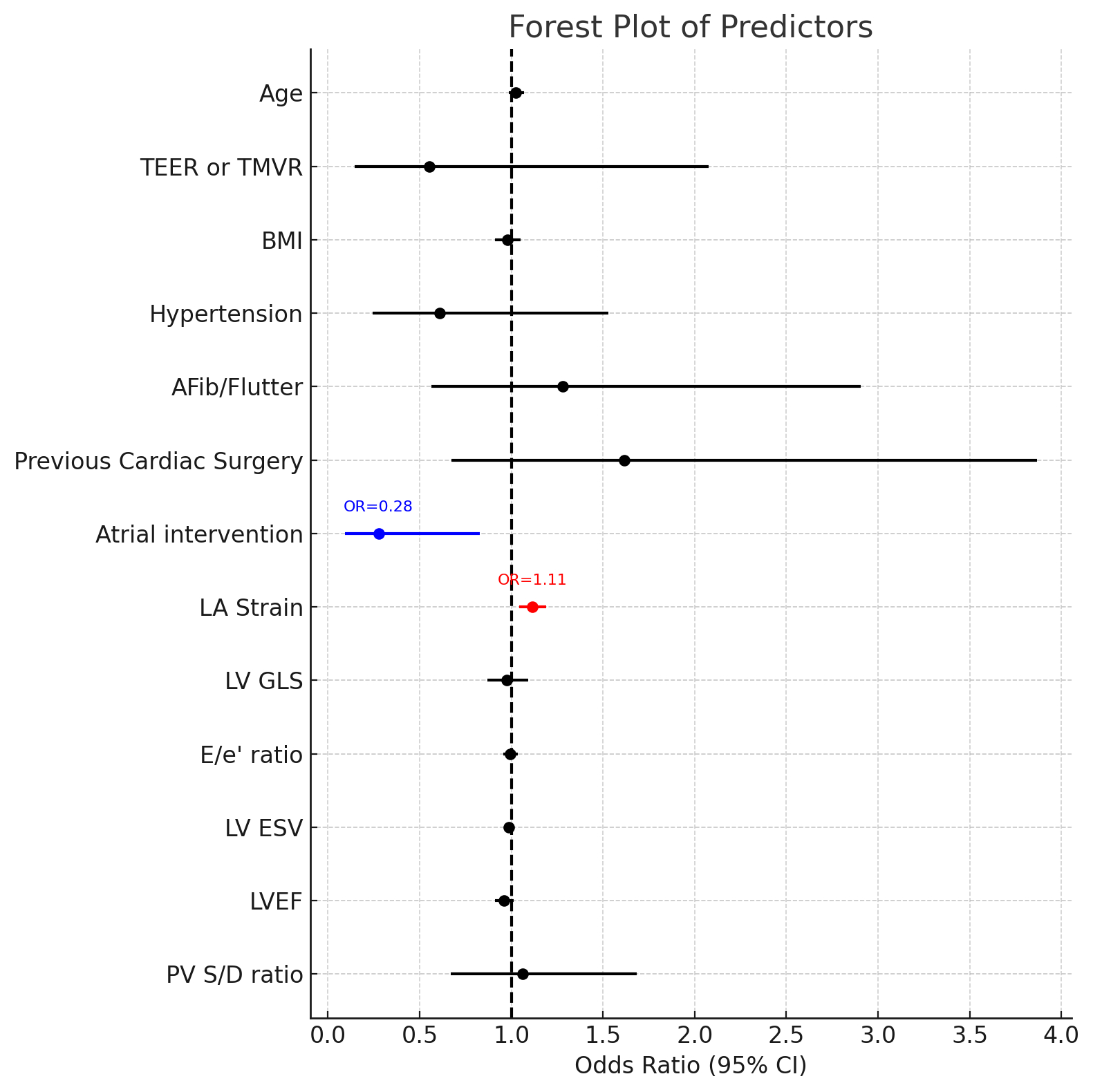
Results: A total of 248 patients were included in the analysis, of whom 41 underwent TMVR and 207 underwent TEER. The mean age was 77.3 years, and 63% were male. Overall, 103 patients (41.5%) were classified as having a compliant LA, while 145 (58.5%) were classified as non-compliant. On multivariable logistic regression, two independent predictors of a non-compliant LA were identified: lower LA reservoir strain (OR 1.11; 95% CI, 1.04–1.19; p=0.002) and a history of prior atrial intervention; either atrial fibrillation intervention or left atrial appendage ligation (OR 0.28; 95% CI, 0.09-0.83; p=0.02) (Figure 1).
Conclusion: Reduced LA reservoir strain and a history of atrial intervention are significantly associated with lower LA compliance and a blunted V-wave response following TMVT. These non-invasive markers may help identify patients with impaired LA mechanics and inform procedural planning and expectations.
  • Zalaquett, Ziad  ( Cleveland Clinic , Cleveland , Ohio , United States )
  • Majeed-saidan, Maryam Muhammad Ali  ( Cleveland Clinic , Cleveland , Ohio , United States )
  • Besir, Besir  ( Cleveland Clinic , Cleveland , Ohio , United States )
  • Rajendran, Judah  ( Cleveland Clinic , Cleveland , Ohio , United States )
  • Hajj, Joseph  ( Cleveland Clinic , Cleveland , Ohio , United States )
  • Miyasaka, Rhonda  ( Cleveland Clinic , Cleveland , Ohio , United States )
  • Krishnaswamy, Amar  ( Cleveland Clinic , Cleveland , Ohio , United States )
  • Harb, Serge  ( Cleveland Clinic , Cleveland , Ohio , United States )
  • Kapadia, Samir  ( Cleveland Clinic , Cleveland , Ohio , United States )
  • Author Disclosures:
    Ziad Zalaquett: DO NOT have relevant financial relationships | Maryam Muhammad Ali Majeed-Saidan: No Answer | Besir Besir: DO NOT have relevant financial relationships | Judah Rajendran: No Answer | Joseph Hajj: DO NOT have relevant financial relationships | Rhonda Miyasaka: No Answer | Amar Krishnaswamy: DO NOT have relevant financial relationships | Serge Harb: No Answer | Samir Kapadia: DO NOT have relevant financial relationships
Meeting Info:

Scientific Sessions 2025

2025

New Orleans, Louisiana

Session Info:

Predicting Successful Surgical And Catheter-Based Mitral and Tricuspid Valve Repair

Sunday, 11/09/2025 , 09:15AM - 10:30AM

Moderated Digital Poster Session

More abstracts on this topic:
Association of transcatheter edge-to-edge repair with clinical outcomes in atrial functional mitral regurgitation

Naser Jwan, Michelena Hector, Pislaru Sorin, Massad Faysal, Scott Christopher, Borlaug Barry, Pellikka Patricia, Kennedy Austin, Simard Trevor, Enriquez-sarano Maurice, Nkomo Vuyisile

Association of Systemic Inflammatory Response Syndrome with Cardiovascular Events after Mitral Transcatheter Edge-to-edge Repair

Mannina Carlo, Sharma Samin, Kini Annapoorna, Lerakis Stamatios, Sharma Akarsh, Carbone Andreina, Bossone Eduardo, Tuttolomondo Antonino, Argulian Edgar, Neibart Eric, Halperin Jonathan, Dangas George

More abstracts from these authors:
Clinical Outcomes and Hemodynamic Findings Following Transcatheter Aortic Valve Replacement with a Balloon-Expandable Valve in Patients with Small and Non-Small Annulus

Besir Besir, Reed Grant, Puri Rishi, Krishnaswamy Amar, Kapadia Samir, Majeed-saidan Maryam Muhammad Ali, Rajendran Judah, Lomaia Tamari, Kathavarayan Ramu Shivabalan, Iskandar Odette, Yun James, Harb Serge, Miyasaka Rhonda

Predictors of Flow Improvement Following Transcatheter Aortic Valve Replacement in Patients with Low-Flow Low-Gradient Aortic Stenosis

Besir Besir, Reed Grant, Puri Rishi, Krishnaswamy Amar, Kapadia Samir, Majeed-saidan Maryam Muhammad Ali, Rajendran Judah, Lomaia Tamari, Kathavarayan Ramu Shivabalan, Iskandar Odette, Yun James, Harb Serge, Miyasaka Rhonda

You have to be authorized to contact abstract author. Please, Login
Not Available