
Logo

American Heart Association

  11
  0


Final ID: MP981

Electrocardiogram-Based Artificial Intelligence to Improve the Efficiency of Atrial Fibrillation Screening: A VITAL-AF Trial Analysis

Abstract Body (Do not enter title and authors here): Background: Atrial fibrillation (AF) is common and highly morbid. AF screening may detect AF earlier and facilitate preventive measures (e.g., anticoagulation to prevent stroke). However, current AF screening approaches using a guideline age-based threshold of 65 years have shown limited yield. AF screening informed by AF risk models, including emerging artificial intelligence (AI)-based methods, may improve AF screening efficiency.
Research Question: In a large AF screening trial, we sought to assess whether the effect of AF screening was higher among individuals with elevated AF risk.
Methods: VITAL-AF was a cluster-randomized trial of patients aged 65 years treated at one of 16 primary care practices affiliated with Massachusetts General Hospital. Patients randomized to a screening practice underwent screening with single-lead ECG. Among individuals in VITAL-AF with 1 12-lead ECG within 3 years prior to enrollment, we estimated AF risk using three validated models derived independent of VITAL-AF: a) the Cohorts of Heart and Aging Research in Genomic Epidemiology-AF (CHARGE-AF) clinical score, b) an AI-based model utilizing 12-lead ECG alone (ECG-AI), and c) a model combining ECG-AI and CHARGE-AF (CH-AI). Discrimination of 2-year incident AF was quantified using the area under the receiver operating characteristic curve (AUROC) and average precision (AP). AF screening effect was defined as the difference in 2-year incident AF diagnosis (%) in screening versus control in the screened population across deciles of AF risk.
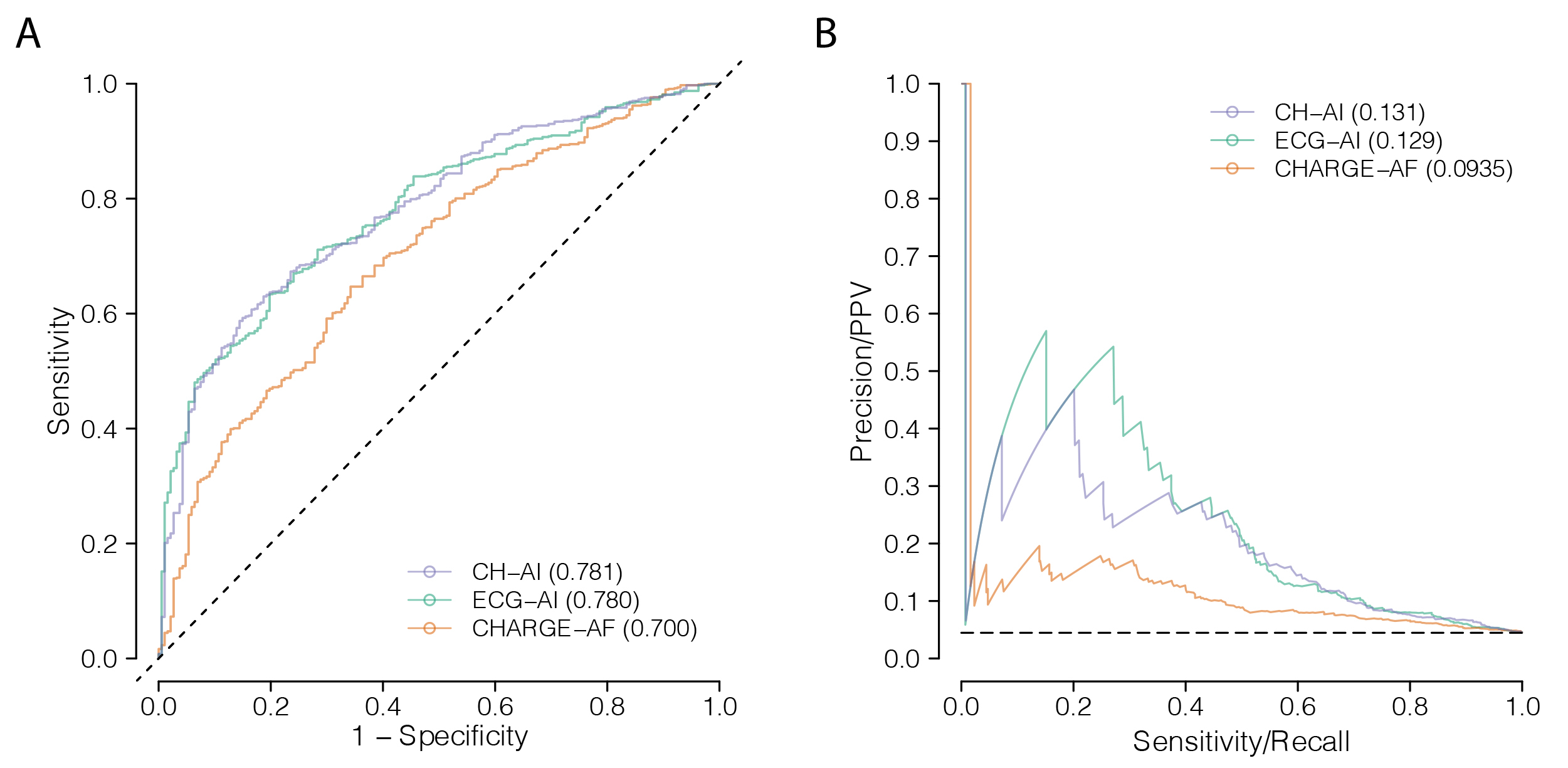
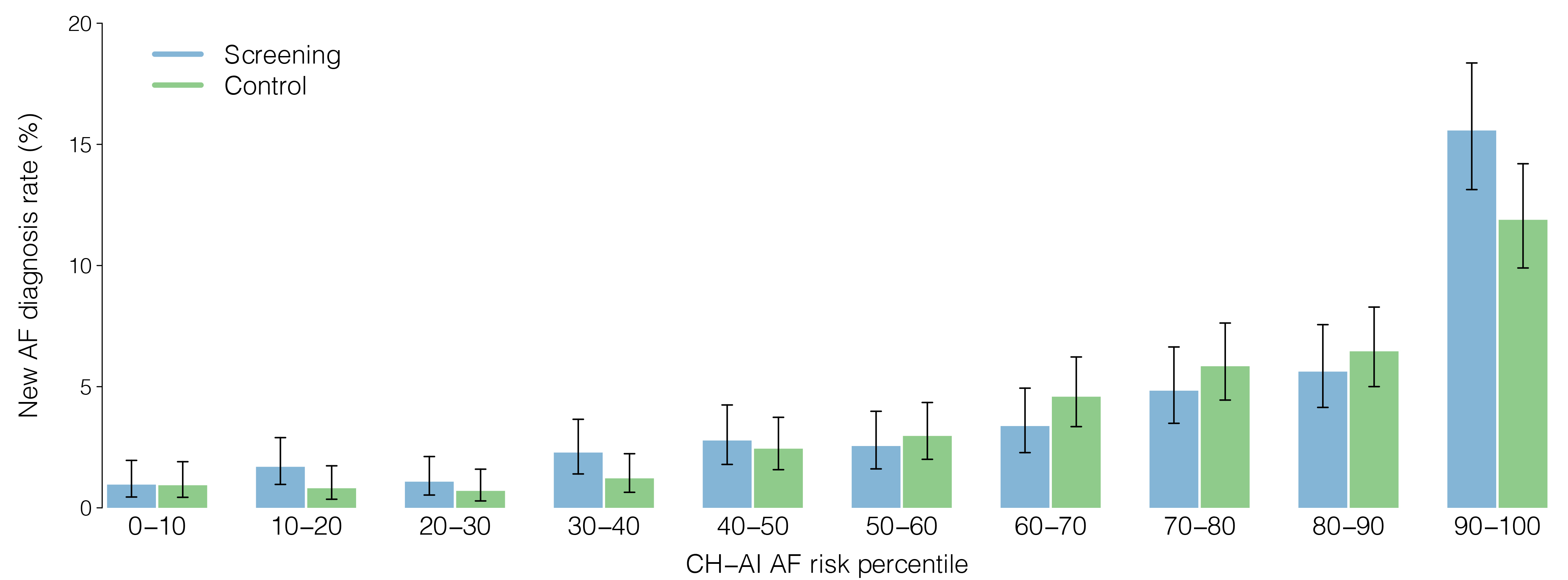
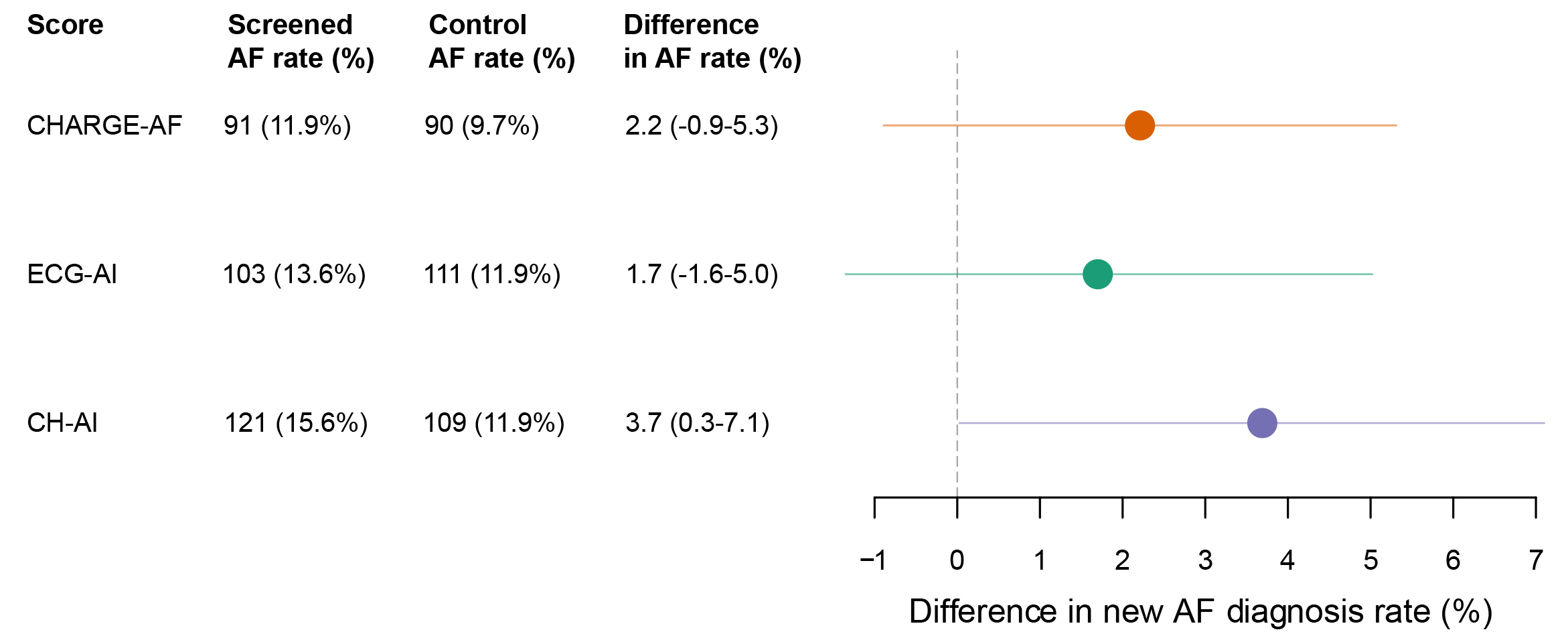
Results: Of 30,630 VITAL-AF participants without prevalent AF, we analyzed 16,937 with available pre-trial ECG and clinical data. Each score discriminated 2-year AF risk (AUROC CHARGE-AF 0.700 [95%CI 0.654-0.739]; ECG-AI 0.780 [0.747-0.810]; CH-AI 0.781 [0.740-0.814]) (AP 0.0935 [0.0818-0.109]; 0.129 [0.111-0.154]; 0.131 [0.115-0.153]) (Figure 1). An AF screening effect was observed in the top decile of CH-AI (2-year AF diagnosis rate 15.6% [13.1-19.4] in screening vs 11.9% [9.9-15.6] in control; difference 3.7% [0.3-7.1]) (Figure 2). The AF screening effect was largest in the top decile of all three scores, but was numerically highest with CH-AI (Figure 3).
Conclusions: In VITAL-AF, the yield of AF screening appeared larger among individuals at high AF risk, particularly using a model combining clinical factors and AI-based ECG analysis. Future trials should assess whether risk-informed AF screening improves outcomes.
  • Vedage, Natasha  ( Massachusetts General Hospital , Jamaica Plain , Massachusetts , United States )
  • Ellinor, Patrick  ( Massachusetts General Hospital , Jamaica Plain , Massachusetts , United States )
  • Khurshid, Shaan  ( Massachusetts General Hospital , Jamaica Plain , Massachusetts , United States )
  • Friedman, Sam  ( Broad Institute , Cambridge , Massachusetts , United States )
  • Chang, Yuhao  ( Massachusetts General Hospital , Jamaica Plain , Massachusetts , United States )
  • Borowsky, Leila  ( Massachusetts General Hospital , Boston , Massachusetts , United States )
  • Shah, Sachin  ( Massachusetts General Hospital , Boston , Massachusetts , United States )
  • Atlas, Steven  ( Massachusetts General Hospital , Boston , Massachusetts , United States )
  • Singer, Daniel  ( Massachusetts General Hospital , Wellesley , Massachusetts , United States )
  • Lubitz, Steven  ( Massachusetts General Hospital , Jamaica Plain , Massachusetts , United States )
  • Maddah, Mahnaz  ( Broad Institute , Cambridge , Massachusetts , United States )
  • Author Disclosures:
    Natasha Vedage: DO NOT have relevant financial relationships | Patrick Ellinor: No Answer | Shaan Khurshid: No Answer | Sam Friedman: No Answer | Yuhao Chang: DO NOT have relevant financial relationships | Leila Borowsky: DO NOT have relevant financial relationships | Sachin Shah: DO NOT have relevant financial relationships | Steven Atlas: No Answer | Daniel Singer: DO have relevant financial relationships ; Research Funding (PI or named investigator):Bristol Myers Squibb:Past (completed) ; Royalties/Patent Beneficiary:UpToDate:Active (exists now) ; Consultant:Pfizer:Past (completed) ; Consultant:Bristol Myers Squibb:Past (completed) | Steven Lubitz: DO have relevant financial relationships ; Employee:Novartis:Active (exists now) | Mahnaz Maddah: No Answer
Meeting Info:

Scientific Sessions 2025

2025

New Orleans, Louisiana

Session Info:

Harnessing AI: Innovations in Arrhythmia Detection and Management

Saturday, 11/08/2025 , 09:15AM - 10:30AM

Moderated Digital Poster Session

More abstracts on this topic:

A Large Animal Model of Persistent Atrial Fibrillation

Mostafizi Pouria, Goldman Steven, Moukabary Talal, Lefkowitz Eli, Ref Jacob, Daugherty Sherry, Grijalva Adrian, Cook Kyle Eric, Chinyere Ike, Lancaster Jordan, Koevary Jen

A Machine Learning Approach to Simplify Risk Stratification of Patients with Atherosclerotic Cardiovascular Disease

Li Hsin Fang, Gluckman Ty, Nute Andrew, Weerasinghe Roshanthi, Wendt Staci, Wilson Eleni, Sidelnikov Eduard, Kathe Niranjan, Swihart Charissa, Jones Laney

More abstracts from these authors:
Incidence, Risk Factors, and Outcomes in Triggered Atrial Fibrillation: Insights from the VITAL-AF Trial

Haimovich Julian, Kany Shinwan, Chang Yuchiao, Borowsky Leila, Singer Daniel, Atlas Steven, Lubitz Steven, Ellinor Patrick, Khurshid Shaan

Targeted Atrial Fibrillation Screening in Older Adults: A Secondary Analysis of the VITAL-AF Trial

Shah Sachin, Singer Daniel, Iyer Jay, Agha Leila, Chang Yuchiao, Atlas Steven, Ashburner Jeffrey, Mcmanus David, Ellinor Patrick, Lubitz Steven

You have to be authorized to contact abstract author. Please, Login
Not Available