Distinguishing Syndromic and Nonsyndromic Familial Aortopathies Using Electronic Health Record and Genetic Data from the All of Us Research Program
Abstract Body (Do not enter title and authors here): Familial aortopathies are inherited conditions that weaken the aortic wall and may be classified as syndromic, affecting multiple organ systems (e.g., Marfan syndrome), or nonsyndromic, where disease is largely confined to the aorta. This study compares cardiovascular phenotypes between syndromic and nonsyndromic aortopathy cohorts using genetic and electronic health record (EHR) data from the All of Us Research Program to inform diagnosis and surveillance strategies.
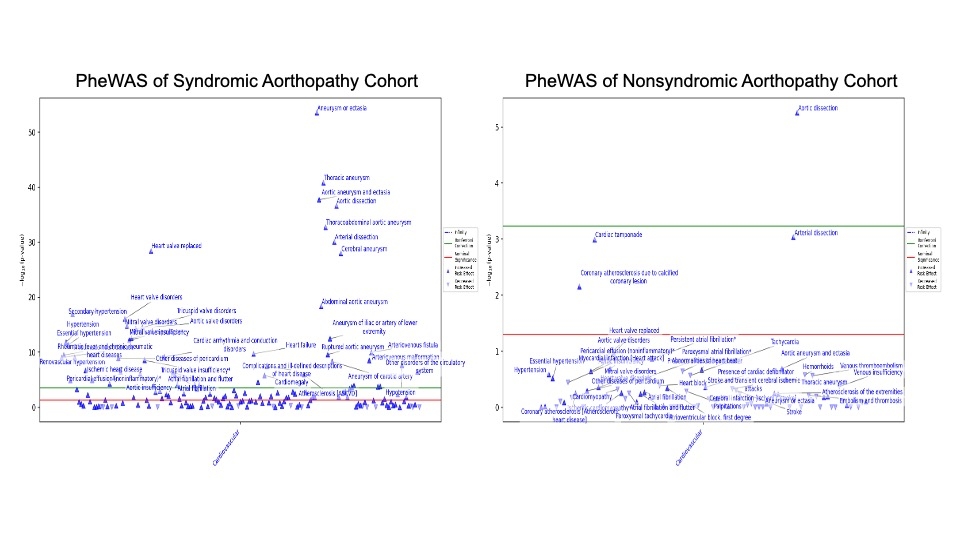
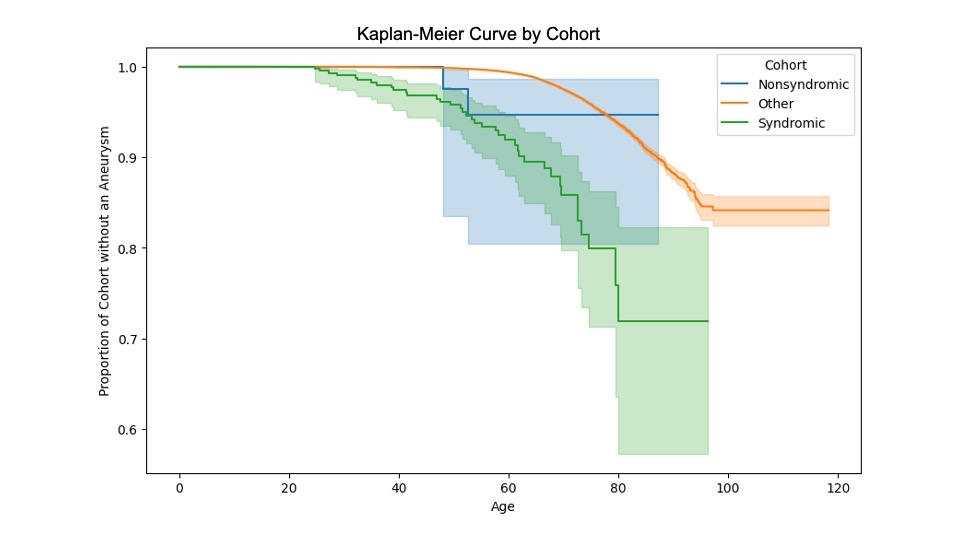
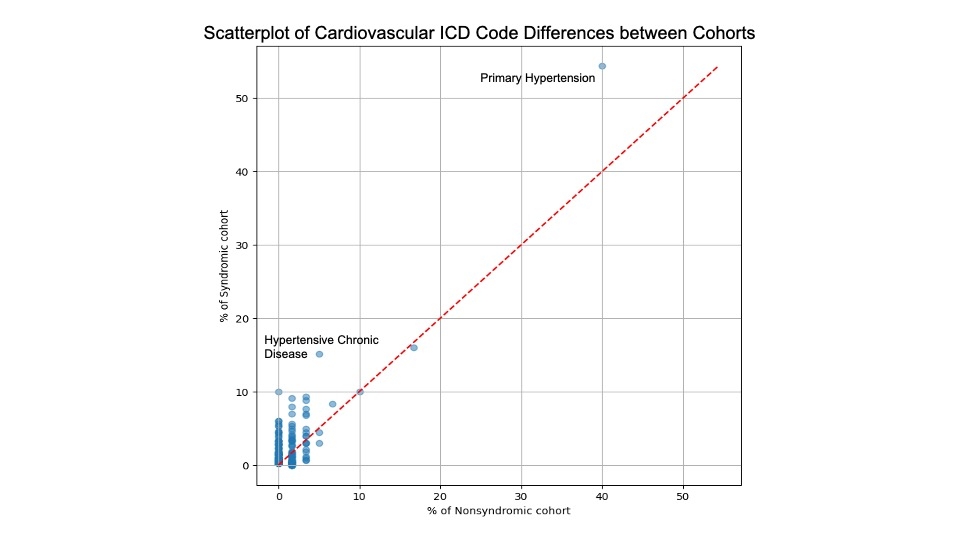
We analyzed two All of Us v8 cohorts with both EHR and genetic data: a syndromic cohort (n=430) with pathogenic/likely pathogenic (P/LP) variants in COL3A1, FBN1, PKD1, PKD2, SMAD3, TGFBR1, TGFBR2, TGFB2, and TGFB3, and a nonsyndromic cohort (n=60) with P/LP variants in ACTA2, MYH11, MYLK, NOTCH1, and PRKG1. We conducted phenome-wide association studies (PheWAS), Kaplan-Meier survival analysis for time-to-aneurysm, and ICD-10-based comparisons of cardiovascular disease frequency.
Syndromic individuals were significantly associated with classic aortic phenotypes: abdominal aortic aneurysm (OR=10.42, p=4.39e-19), thoracic aortic aneurysm (OR=10.24, p=1.45e-41), and arterial dissection (OR=15.65, p=8.69e-31). Broader cardiovascular associations, such as mitral valve disorders (OR=6.31, p=2.84e-13) and arrhythmias (OR=2.18, p=6.96e-10), were also observed. In the nonsyndromic group, only aortic dissection (OR=28.20, p=5.52e-6) met Bonferroni significance. Aneurysm prevalence was higher in the syndromic cohort compared to the nonsyndromic group (+6.25%). Kaplan-Meier curves demonstrated delayed or absent aneurysm onset in nonsyndromic individuals. ICD-10 analysis showed higher rates of primary hypertension (+14.4%) and hypertensive chronic kidney disease (+10.1%) among syndromic individuals; most other codes had similar frequencies. Demographic variables (sex at birth, race, ethnicity) and genetic variant types showed no major differences between cohorts. Diagnostic burden and EHR length were broadly overlapping, though more variable in the syndromic group.
In summary, syndromic familial aortopathies are associated with earlier and broader cardiovascular involvement than nonsyndromic forms. Despite harboring genetic risk, nonsyndromic individuals show limited aneurysm penetrance in All of Us. These findings support gene-specific surveillance approaches and underscore the value of integrating genomic and EHR data in hereditary cardiovascular disease research.
Kesanapally, Anirudh
(
National Institutes of Health
, Bethesda , Maryland , United States )
Ferrara, Tracey
(
National Institutes of Health
, Bethesda , Maryland , United States )
Denny, Josh
(
National Institutes of Health
, Bethesda , Maryland , United States )
Mo, Huan
(
National Institutes of Health
, Bethesda , Maryland , United States )
Author Disclosures:
Anirudh Kesanapally:DO NOT have relevant financial relationships
| Tracey Ferrara:No Answer
| Josh Denny:No Answer
| Huan Mo:No Answer