
Logo

American Heart Association

  15
  0


Final ID: Mo1018

Sex-Based Disparities In Mechanical Circulatory Support Usage Among Postmenopausal Patients With Cardiogenic Shock

Abstract Body (Do not enter title and authors here): Background: Cardiogenic shock often leads to hemodynamic compromise requiring immediate intervention, typically involving mechanical circulatory support (MCS). While treatment methods have advanced, there continues to be disparities in management, especially in women. While prior studies have highlighted differences in myocardial infarctions and heart failure, very few have investigated cardiogenic shock. This study aims to evaluate sex-based differences in MCS utilization and in-hospital mortality in postmenopausal women.

Hypothesis: Based on trends in other cardiac diseases, we hypothesize that postmenopausal women with cardiogenic shock are less likely to receive MCS and therefore experience higher in-hospital mortality compared to men of similar age range.

Methods: We analyzed the National Inpatient Sample database from 2018 to 2021, identifying adults over the age of 55 hospitalized with cardiogenic shock (International Classification of Diseases, Tenth Revision code R57.0). Primary outcomes included MCS usage determined by procedure codes for standard treatments and in-hospital mortality. Multivariable logistic regression models were created to estimate odds ratio, later adjusted for demographic data and Elixhauser comorbidity index calculated using the Van Walraven weights.

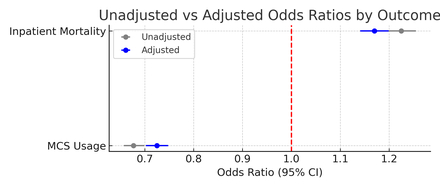
Results: Out of the 155,728 patients with cardiogenic shock sampled, 43% were female. Compared to men, women tended to be slightly older with lower comorbidity index (17.4 vs 18.0) and lower MCS usage (15% vs 20%). Unadjusted regression showed women overall had 32% lower odds of receiving MCS (OR: 0.677; 95% CI: 0.657–0.699) and 22.5% higher odds of inpatient mortality (OR: 1.225; 95% CI: 1.196–1.255). After adjusting for age, Elixhauser index, race, type of insurance, and income, women still had 27.5% lower odds of receiving MCS (OR: 0.725; 95% CI: 0.702–0.748) and 17% higher odds of inpatient mortality (OR: 1.170; 95% CI: 1.141–1.199). All values were statistically significant (p-value < 0.05).

Conclusion: This study showed that postmenopausal women, although with slightly less comorbidities than men, still are less likely to receive MCS leading to higher inpatient mortality even after adjusting for socioeconomic factors. Combined with sex-specific disparities in other cardiac diseases, this highlights a strong necessity for investigating possible barriers to treatment at an individual and system level.
  • Gupta, Shubham  ( Virtua Health , Philadelphia , Pennsylvania , United States )
  • Syed, Taha Wasim  ( Virtua Health , Voorhees , New Jersey , United States )
  • Timilsina, Bibek  ( Virtua Health , Camden , New Jersey , United States )
  • Beshai, Rafail  ( Virtua Health , Philadelphia , Pennsylvania , United States )
  • Author Disclosures:
    Shubham Gupta: DO NOT have relevant financial relationships | Taha Wasim Syed: DO NOT have relevant financial relationships | Bibek Timilsina: DO NOT have relevant financial relationships | Rafail Beshai: No Answer
Meeting Info:

Scientific Sessions 2025

2025

New Orleans, Louisiana

Session Info:

Heart in Crisis: Cutting-Edge Tools and Trends in Cardiogenic Shock Management

Monday, 11/10/2025 , 10:30AM - 11:30AM

Abstract Poster Board Session

More abstracts on this topic:
10-Year Trends in Last Known Well to Arrival Time in Acute Ischemic Stroke Patients: 2014-2023

Ferrone Nicholas, Sanmartin Maria, O'hara Joseph, Jimenez Jean, Ferrone Sophia, Wang Jason, Katz Jeffrey, Sanelli Pina

Effects of Impella 5.5 on Right Ventricular Load and Adaptation

Silkowski Molly, Olson Alex, Asempah Moses, Houston Brian

More abstracts from these authors:
You have to be authorized to contact abstract author. Please, Login
Not Available