
Logo

American Heart Association

  14
  0


Final ID: Su2055

Prevalence of Cardiovascular-Kidney-Metabolic Syndrome and Association with Target Organ Injury in Youth with Hypertension Disorders Who Have Congenital Heart Disease: A SUPERHERO Analysis

Abstract Body (Do not enter title and authors here): Introduction/Background
Cardiovascular-kidney-metabolic (CKM) syndrome is the interplay between metabolic risk factors such as obesity and diabetes, chronic kidney disease (CKD), and cardiovascular disease (CVD). Youth with congenital heart disease (CHD) can have increased baseline CVD risk due to structural heart disease and associated procedures, but data on CKM syndrome in this group are limited. Presence of CKM syndrome with CHD could further increase cardiac risk in these youth.

Research Questions/Hypothesis
Estimate prevalence of CKM syndrome in youth with hypertension disorders who have CHD and estimate its association with target organ injury (TOI).

Methods/Approach
A cross-sectional analysis was performed on baseline data from 7 sites in the Study of the Epidemiology of Pediatric Hypertension (SUPERHERO), a retrospective registry of electronic health record data. Data were acquired using standardized biomedical informatics scripts and validated by randomly selected manual record review. Inclusion criteria were youth <19 years old with CHD who received subspecialty care for hypertension disorders from 1/1/2016–12/31/2023 defined by ICD-10 codes. Exclusion criteria were kidney failure on dialysis, kidney transplantation, or pregnancy by ICD-10 codes. We estimated CKM syndrome stage prevalence and used directed acyclic graph-informed multivariable generalized linear models to evaluate the association between CKM stages 0-2 and risk of TOI by ICD-10 codes.

Results/Data
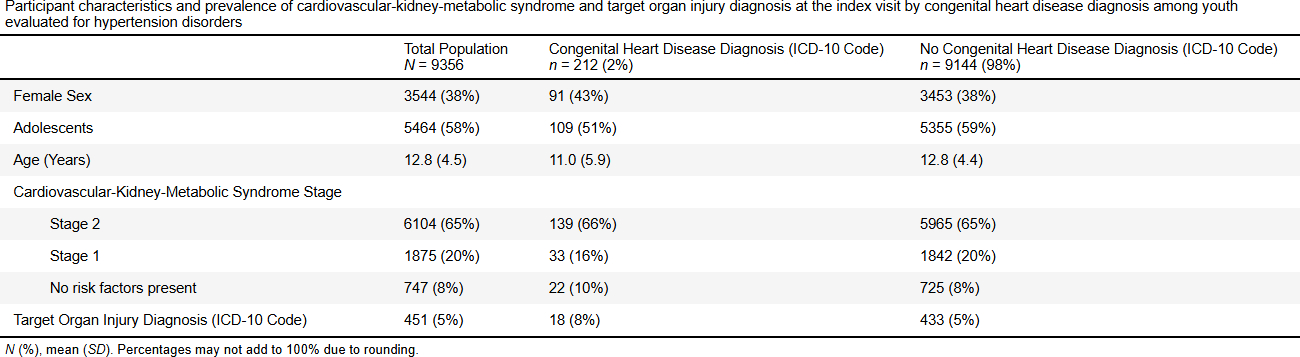
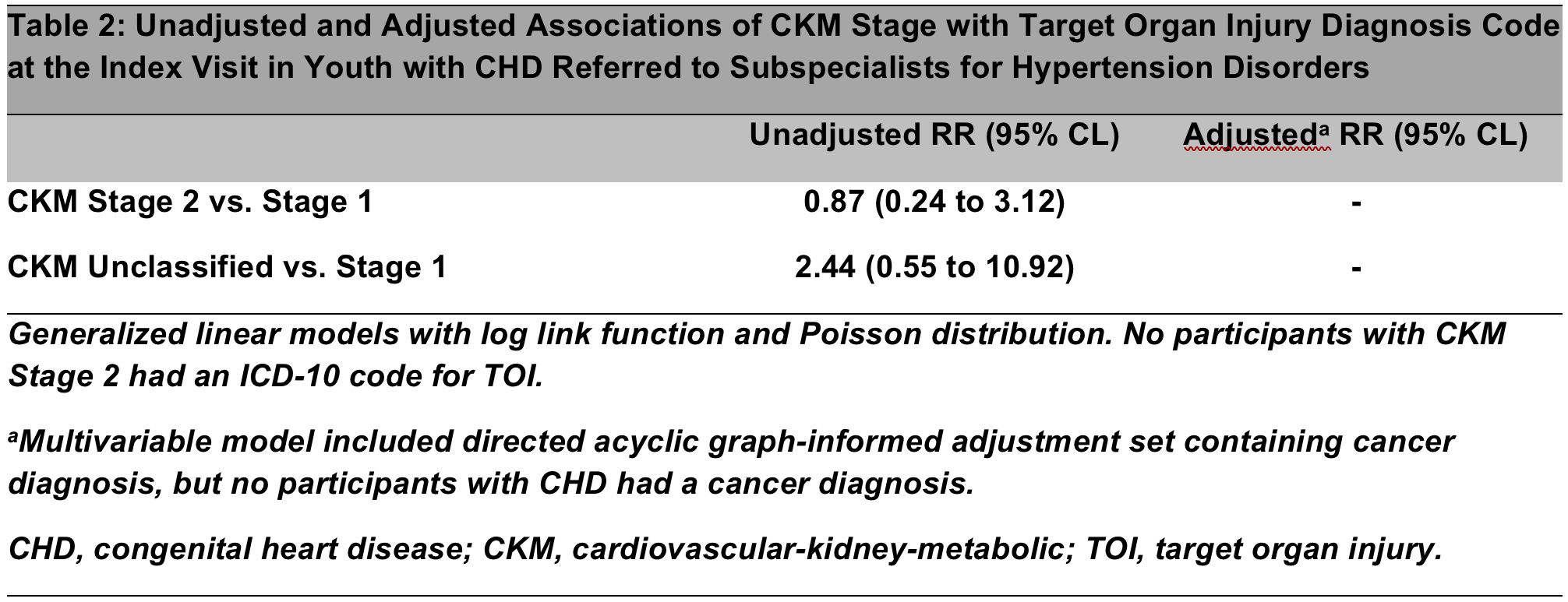
There were 9356 participants (Table 1: 38% female, mean age 12.8 years [SD 4.5]). There were 212 participants (2%) with CHD—10% having CKM Stage 0, 16% CKM Stage 1, and 66% CKM Stage 2. There was no difference in CKM syndrome prevalence between youth with CHD and those without CHD. TOI was seen in 8% of youth with CHD; however, CKM syndrome was not found to be associated with TOI (Table 2).

Conclusion(s)
Nearly two-thirds of youth with hypertension disorders and CHD had CKM Stage 2. However, there was no difference in CKM syndrome prevalence between those with CHD versus those without CHD, and there was no association between CKM syndrome and TOI in those with CHD. Ongoing steps are to improve accuracy and validity of CHD, CKM, and TOI definitions within SUPERHERO by validating with medical and surgical histories to better assess potential risk in these patients.
  • Tran, Andrew  ( Nationwide Children’s Hospital , Columbus , Ohio , United States )
  • Kallash, Mahmoud  ( Nationwide Children’s Hospital , Columbus , Ohio , United States )
  • Khalid, Omar  ( Nationwide Children’s Hospital , Columbus , Ohio , United States )
  • South, Andrew  ( WAKE FOREST SCHOOL OF MEDICINE , Winston Salem , North Carolina , United States )
  • Author Disclosures:
    Andrew Tran: DO have relevant financial relationships ; Research Funding (PI or named investigator):Inozyme Pharma:Active (exists now) | Mahmoud Kallash: No Answer | Omar Khalid: DO NOT have relevant financial relationships | Andrew South: No Answer
Meeting Info:

Scientific Sessions 2025

2025

New Orleans, Louisiana

Session Info:

Metabolic Disease and Heart Failure: Mechanisms, Clinical Care and Population Outcomes

Sunday, 11/09/2025 , 11:30AM - 12:30PM

Abstract Poster Board Session

More abstracts on this topic:
2 Dimensional Echocardiography versus 3 Dimentional Echocardiography to Assess Right Ventricular Function in Pulmonary Hypertension: A Systematic Review

Chaudhry Waleed Razzaq, Hajj Fatima, Bathula Satyamedha, Meghji Mohammed Askari, Pasupuleti Hemalatha, Kiyani Madiha, Shah Syeda Simrah, Neelakantan Ramaswamy Sanathanan, Mirzaeidizaji Nakisa, St. Jacques Jahnoy, Khan Khalil Ullah, Veluchamy Elakkiya, Jesse Joshanna

A Comparative Study Of Social Determinants, Hypertension, And Life Essential Factors In Alabama And Colorado From The 2021 Behavioral Risk Factor Surveillance System

Chukwunyere Chibuike, Owuor Kevin

You have to be authorized to contact abstract author. Please, Login
Not Available