
Logo

American Heart Association

  119
  0


Final ID: Su4148

Cardiac Magnetic Resonance Imaging in Tetrology of Fallot Patients and Relationship to Obesity

Abstract Body (Do not enter title and authors here): Obesity is associated with increased cardiovascular risk and adverse cardiac changes such as left ventricular hypertrophy (LVH) and in TOF higher body mass index (BMI) contributed to increase risk. Previous multicenter study concluded that right ventricular (RV) dysfunction contributed to cardiovascular event. Current recommendations for pulmonary valve replacement (PVR) in TOF patients use indexed RV endiastolic volume (RVEDVi) to determine timing of PVR. In the presence of obesity, RVEDVi may underestimate the severity of RV volume load. We sought to determine both diastolic (RVEDV) and systolic (REVSV) volume in obese and non-obese patients and the impact of the volume on right ventricular ejection fraction (RVEF).
We conducted a retrospective study of adult TOF patients > 18 years age in obese (BMI ≥ 30 kg/m2) and non-obese (BMI < 30 kg/m2) patients with a cardiac magnetic resonance imaging (CMR) prior to PVR for pulmonary regurgitation (PR). CMR database and electronic records were reviewed to compare anthropometric, demographic, and CMR variables between obese and non-obese patients.
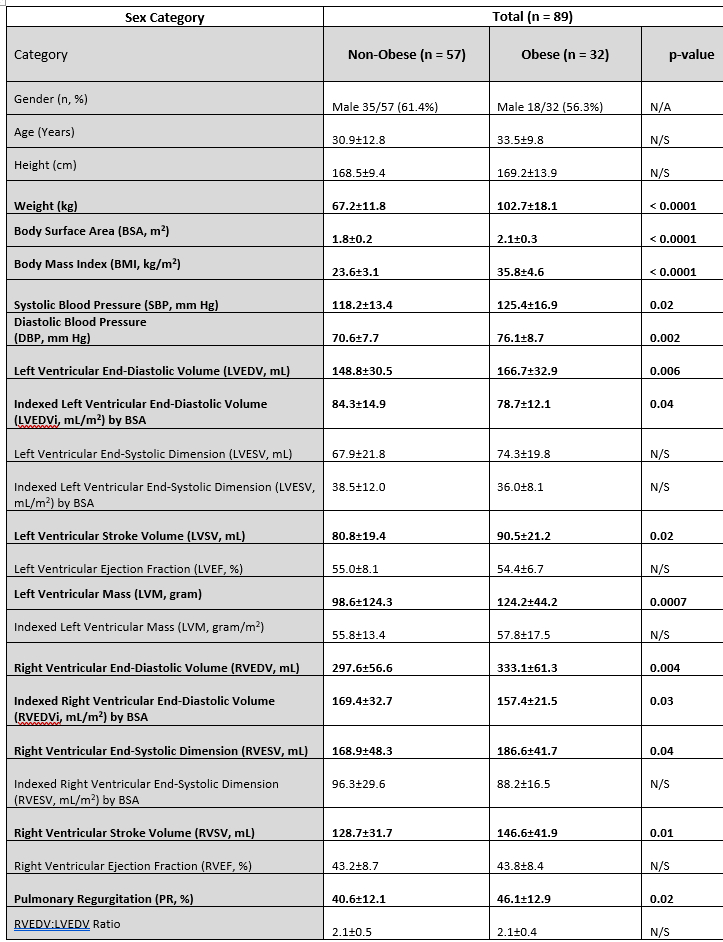
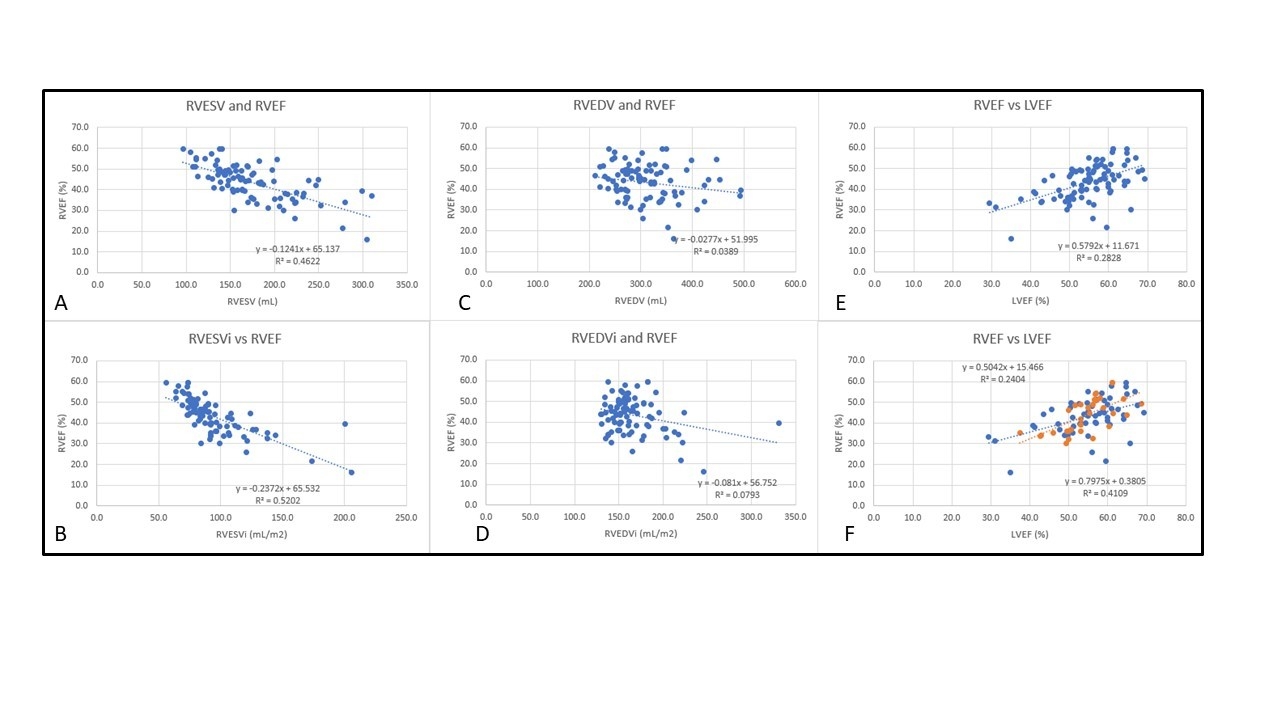
Table 1 shows demographic and CMR results between non-obese (n = 57) and obese (n = 32) patients. Indexed ventricular volume were smaller in obese compared to non-obese patients (LVEDVi 78.7±12.1 vs 84.3±14.9 mL/m2, p=0.04; RVEDVi 157.4±21.5 vs 169.4±32.7 mL/m2, p=0.03), in contrast the non-indexed volume were significantly larger (LVEDV, 166.7±32.9 vs 148.8±30.5 mL, p=0.006; RVEDV 333.1±61.3 vs RVEDV 297.6±56.6 mL, p=0.004). There is an association with ventricular volume with lower RVEF. In both groups the mean RVEF was abnormal but not different (43.2±8.7 vs 43.8±8.4%, P=NS). Patients with lower RVEF trended towards a lower LVEF especially in the obese group (Figure 1A-F).
Our study showed that indexed ventricular volume was smaller in obese patients and may lead to false reassurance suggesting underestimation of the volume load from the PR. Our patients have lower RVEF which correlated with larger volume and evidence of ventricular-ventricular interaction with lower LVEF in patients with lower RVEF. When assessing timing of PVR in asymptomatic TOF patients, other parameters beyond indexed volume in those with elevated BMI should be considered including ejection fraction and different methods of indexing RV volume similar to LVM. Future larger and longitudinal studies are needed to determine if delayed repair in obese patients lead worse remodeling and outcomes.
  • Dusza, Patrick  ( Nationwide Children's Hospital , Columbus , Ohio , United States )
  • Tran, Andrew  ( Nationwide Childrens Hospital , Columbus , Ohio , United States )
  • Hor, Kan  ( Nationwide Childrens Hospital , Columbus , Ohio , United States )
  • Author Disclosures:
    Patrick Dusza: DO NOT have relevant financial relationships | Andrew Tran: DO NOT have relevant financial relationships | Kan Hor: DO NOT have relevant financial relationships
Meeting Info:

Scientific Sessions 2024

2024

Chicago, Illinois

Session Info:

Hot Topics in Cardiovascular Imaging

Sunday, 11/17/2024 , 11:30AM - 12:30PM

Abstract Poster Session

More abstracts on this topic:
18F-NaF and 18F-FDG and calcification predict the development of abdominal aortic aneurysms and is attenuated by drug therapy

Nakahara Takehiro, Miyazawa Raita, Iwabuchi Yu, Tonda Kai, Narula Nupoor, Strauss Harry, Narula Jagat, Jinzaki Masahiro

Novel Deep Learning Aligned Strain Techniques in Repaired Tetralogy of Fallot

Koehler Sven, Lee Ji Hae, Latus Heiner, Pickardt Thomas, Greil F. Gerald, Beerbaum Philipp, Sarikouch Samir, Hussain Mohammad, Engelhardt Sandy, Tandon Animesh, Deng Lifu, Shah Ansh, Mascha Edward, Li Shuyi, Nguyen Christopher, Karamlou Tara, Geva Tal, Valente Anne

More abstracts from these authors:
You have to be authorized to contact abstract author. Please, Login
Not Available