CKD and CKM Syndrome: Accelerated Progression to Arrhythmias in a National Cohort
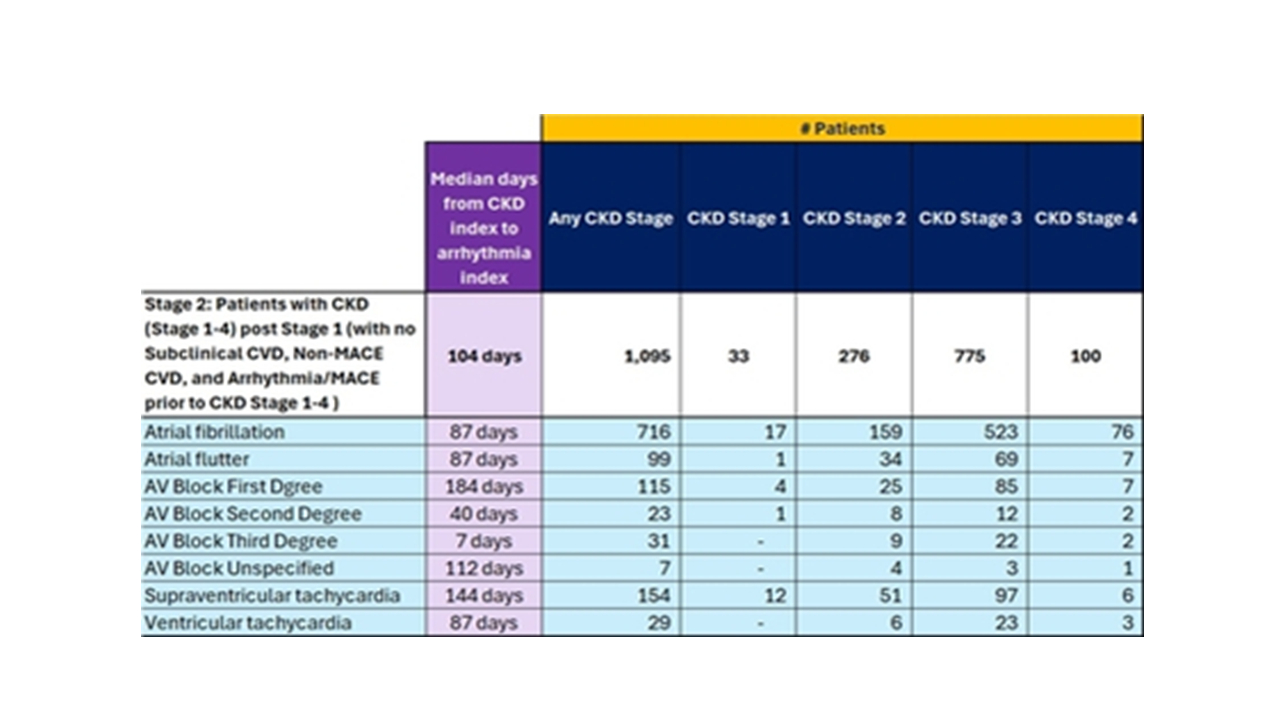
Abstract Body (Do not enter title and authors here): Introduction Chronic kidney disease (CKD), a key element of the AHA Cardiovascular-Kidney-Metabolic (CKM) framework, is increasingly recognized as an independent risk factor for arrhythmias, especially atrial fibrillation (AF). Studies like ARIC and recent guidelines highlight higher arrhythmia risk with declining kidney function, but real-world data (RWD) on this progression are limited. This study examines arrhythmia onset in patients progressing from obesity to CKD. Methods We conducted a retrospective real-world evidence study using the Symphony Integrated Dataverse (2018–2024) to examine arrhythmia development in adults with obesity initially classified as CKM Stage 1—defined by the absence of metabolic or cardiac risk factors at the time of obesity diagnosis (Fig. 1). A subset who progressed to CKD (Stages 1–4) but remained free of cardiac risk factors at CKD onset, were followed longitudinally to evaluate the incidence of major arrhythmias. All patients had a minimum of 12 months of baseline (lookback) data and 12 months of follow-up after their initial obesity diagnosis. Results The cohort included 3.5 million adults with obesity (33% male, 67% female; median age 37 years) (Fig. 2). Of these, 26,478 patients (41% male, 59% female; median age 60 years) progressed to CKD: Stage 1 (7%), Stage 2 (32%), Stage 3 (57%), and Stage 4 (3%). After CKD onset, 1,095 patients (4%) (54% male, 46% female; median age 70 years) developed a major arrhythmia—65% atrial fibrillation (AF), 14% supraventricular tachycardia, 16% atrioventricular block, and 3% ventricular tachycardia—within a median of 4 months (Fig. 3). Between obesity diagnosis and CKD development, 27% developed hypertension, 12% diabetes, and 7% both (Fig. 4). Notably, 70% of all arrhythmia cases occurred in patients with CKD Stage 3. Conclusion In this real-world cohort, progression from cardiometabolic dysfunction to CKD was associated with a marked rise in new arrhythmias, particularly AF. Early-onset obesity patients who developed CKD had a markedly higher progression to arrhythmia or MACE before age 40. These findings support CKD as a key inflection point in arrhythmia risk and reinforce the CKM framework. Enhanced surveillance for arrhythmias may be warranted as kidney function declines.
Russo, Pierantonio
(
EVERSANA LLC
, Overald Park, KS , Kansas , United States )
Nathan, Ramaa
(
EVERSANA LLC
, Overald Park, KS , Kansas , United States )
Poh, Jason
(
EVERSANA LLC
, Overald Park, KS , Kansas , United States )
Singh, Harjeet
(
EVERSANA LLC
, Overald Park, KS , Kansas , United States )
Boyle, Ken
(
Irhythm Technology
, San Francisco , California , United States )
Wright, Brent
(
iRhythm Tech
, Washougal , Washington , United States )
Hendrickson, Erik
(
iRhythm Tech
, Washougal , Washington , United States )
Author Disclosures:
Pierantonio Russo:DO NOT have relevant financial relationships
| Ramaa Nathan:DO NOT have relevant financial relationships
| Jason Poh:No AnswerKen Boyle:No Answer
| Brent Wright:DO have relevant financial relationships
;
Employee:iRhythm Technologies:Active (exists now)
; Individual Stocks/Stock Options:iRhythm Technologies:Active (exists now)
| Erik Hendrickson:DO have relevant financial relationships
;
Employee:iRhythm Technologies:Active (exists now)
; Individual Stocks/Stock Options:iRhythm Technologies:Active (exists now)