Logo

American Heart Association

  23
  0


Final ID: MP1792

Inappropriate Ventricular Fibrillation Annotation and Defibrillator Discharge During Stable Supraventricular Tachycardia: What Went Wrong?

Abstract Body (Do not enter title and authors here):
Background:
Detection of very low amplitude ("fine") ventricular fibrillation (VF) remains a challenge for implantable cardioverter-defibrillators (ICDs), as such signals may fall below programmed sensitivity thresholds. To address this, Abbott ICDs incorporate the VF Therapy Assurance (VFTA) algorithm, which adjusts detection criteria when low-amplitude signals are sensed, aiming to reduce delayed therapy for hemodynamically unstable arrhythmias. However, this case illustrates a novel pitfall: inappropriate ICD shock triggered by misclassification of supraventricular tachycardia (SVT) as fine VF due to far-field signal distortion and VFTA activation.
Case:
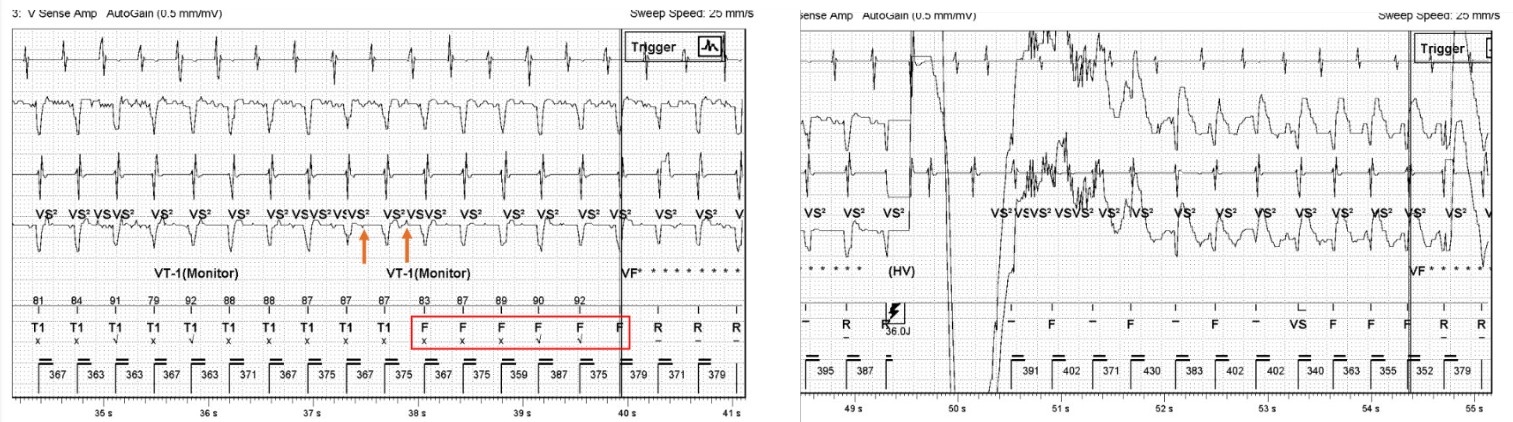
A 53-year-old male with heart failure with recovered ejection fraction (LVEF 45–50%) from non-ischemic cardiomyopathy, paroxysmal atrial fibrillation, and an Abbott CRT-D, experienced an unexpected ICD shock while performing light housework. He had no preceding symptoms. Device interrogation revealed a regular tachycardia at 160 bpm with low-amplitude ventricular signals on the far-field Coil-Can vector. These were misclassified by the VFTA algorithm as fine VF. Once triggered, VFTA collapsed all detection zones into a single therapy zone and suppressed supraventricular discriminators. Only six ventricular beats labeled “F,” each with a cycle length faster than 400 ms, were required to fulfill VF detection criteria, and a shock was delivered. SecureSense markers showed low-amplitude R-waves annotated as “VS2,” especially before “F” annotations (Figure 1). After identifying the mechanism, the sensing vector was reprogrammed from Coil-Can to Tip-Can, improving signal fidelity and preventing recurrence.
Discussion:
This case highlights how VFTA, though designed to enhance VF detection, can override SVT discriminators and result in inappropriate shocks in the setting of low-amplitude far-field signals. The algorithm modifies detection criteria in response to signal dropout, but in patients with intrinsically low amplitudes, especially on far-field vectors, this may paradoxically increase misclassification risk. Reprogramming the sensing vector proved a simple and effective solution. As ICD algorithms become more sophisticated, individualized vector selection and device programming remain critical to ensuring accurate arrhythmia detection.
  • Shukla, Krunal  ( University of Florida , Gainesville , Florida , United States )
  • Federico, Roland-austin  ( University of Florida , Gainesville , Florida , United States )
  • Given, Conor  ( Abbott , Gainesville , Florida , United States )
  • Bromirski, Jason  ( Abbott , Gainesville , Florida , United States )
  • Xiang, Kun  ( University of Florida , Gainesville , Florida , United States )
  • Author Disclosures:
    Krunal Shukla: DO NOT have relevant financial relationships | Roland-Austin Federico: No Answer | Conor Given: DO NOT have relevant financial relationships | Jason Bromirski: No Answer | Kun Xiang: No Answer
Meeting Info:

Scientific Sessions 2025

2025

New Orleans, Louisiana

Session Info:

Innovations and Safety Considerations in Cardiac Implantable Electronic Devices

Sunday, 11/09/2025 , 03:15PM - 04:30PM

Moderated Digital Poster Session

More abstracts on this topic:
A rare case of ventriculobronchial fistula caused by an epicardial defibrillator patch

Alampoondi Venkataramanan Sai Vikram, Windle John

Lyme Disease and Its Cardiovascular Complications: When Time Slowly Runs Out

Isfan Ioana Patricia, Ciobanu Andrea, Mateescu Iulia Elena, Suran Maria Claudia Berenice, Vinereanu Dragos

You have to be authorized to contact abstract author. Please, Login
Not Available