
Logo

American Heart Association

  15
  0


Final ID: MP2536

Gemella morbillorum Prosthetic Aortic Valve Endocarditis Following TAVR in a Patient with Prior Lymphoma: A Rare Intersection of Structural and Immunologic Risk

Abstract Body (Do not enter title and authors here):
Background:
Infective endocarditis (IE) due to Gemella species is extremely rare and typically associated with dental disease, mucosal disruption, or valvular pathology. To our knowledge, this is the first reported case of Gemella morbillorum IE involving a transcatheter aortic valve replacement (TAVR) prosthesis. This case underscores the importance of recognizing uncommon pathogens in prosthetic valve endocarditis (PVE), even in the absence of typical infection sources.

Case:
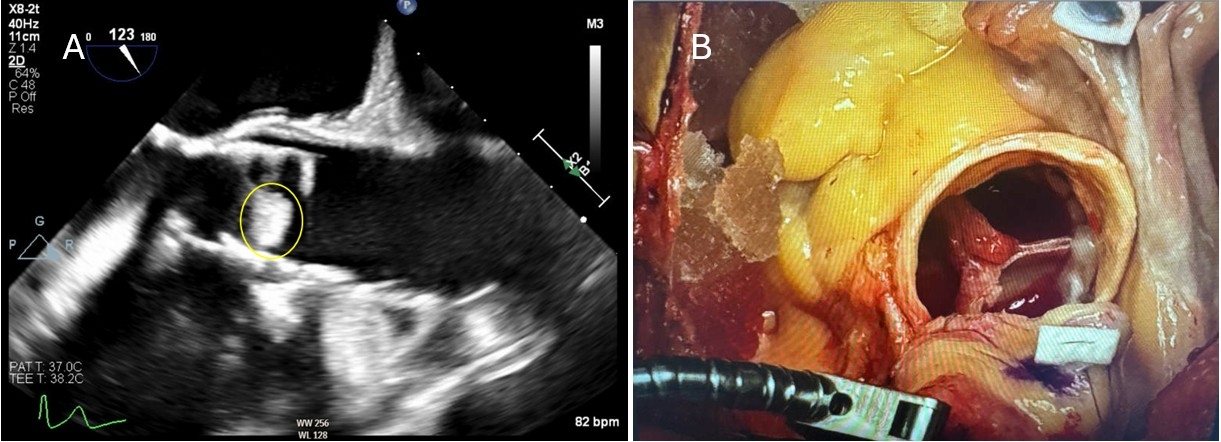
A 70-year-old man with a remote history of lymphoma (treated with abdominal tumor resection and radiation) and severe aortic stenosis status post-TAVR presented with a 1.2 cm vegetation on the bioprosthetic valve. One month prior, he had Gemella bacteremia, treated with IV vancomycin and oral minocycline. Although clinically improved, repeat transesophageal echocardiography (TEE) revealed a new valve vegetation (Figure 1A). Blood cultures were negative, and he remained afebrile and hemodynamically stable. He denied recent dental work. Maxillofacial CT showed no dental infection. Abdominal imaging revealed a stable soft tissue mass in the posterior mediastinum, consistent with residual changes from his prior lymphoma. His abdominal surgery and radiation likely led to long-term mucosal barrier injury, predisposing to translocation of Gemella, a GI tract commensal. With recent bacteremia, a new valve vegetation, and a prosthetic valve, PVE was diagnosed. He received six weeks of IV vancomycin and ultimately underwent surgical TAVR explant and valve replacement (Figure 1B).

Discussion:
TAVR-related PVE is rare (0.5–1.5% annually) and typically involves Staphylococcus or Enterococcus. Gemella morbillorum is an exceptionally uncommon cause, with only isolated reports of IE involving surgically implanted valves and none in TAVR recipients. Misidentification as viridans streptococci may delay diagnosis. TAVR imaging is also challenging due to prosthetic shadowing. This case is unique in its presentation of culture-negative TAVR PVE caused by Gemella morbillorum. The patient's prior oncologic treatment likely disrupted mucosal integrity, enabling bacterial translocation. This report highlights the need to consider rare pathogens like Gemella morbillorum in PVE, particularly in patients with prior mucosal compromise or immunosuppression.
  • Shukla, Krunal  ( University of Florida , Gainesville , Florida , United States )
  • Brand, Stephen  ( University of Florida , Gainesville , Florida , United States )
  • Saulat, Faiz  ( University of Florida , Gainesville , Florida , United States )
  • Dutta, Mudit  ( University of Florida , Gainesville , Florida , United States )
  • Simek, Shawn  ( University of Florida , Gainesville , Florida , United States )
  • Author Disclosures:
    Krunal Shukla: DO NOT have relevant financial relationships | Stephen Brand: DO NOT have relevant financial relationships | Faiz Saulat: No Answer | Mudit Dutta: No Answer | Shawn Simek: No Answer
Meeting Info:

Scientific Sessions 2025

2025

New Orleans, Louisiana

More abstracts on this topic:
A Rare Case of Haemophilus influenzae Endocarditis Leading to Valvular Cardiogenic Shock and Acute Respiratory Distress Syndrome

Aruleba Oluwabunmi, Ho Matthew, Kong Darren, Tanayan Christopher, Brinster Derek, Vullaganti Sirish

Diverse Morphology and Proteomic Phenotypes of Calcification in Bioprosthetic Structural Valve Degeneration

Cahalane Rachel, Muehlschlegel Jochen, Aikawa Masanori, Mcnamara Laoise, Meuris Bart, Singh Sasha, Aikawa Elena, Clift Cassandra, Blaser Mark, Turner Mandy, Kasai Taku, Campedelli Alesandra, Hendrickx Amber, Rega Filip, Billaud Marie

More abstracts from these authors:
You have to be authorized to contact abstract author. Please, Login
Not Available