Logo

American Heart Association

  21
  0


Final ID: MP1138

Finerenone Attenuates Cardiac Hypertrophy in a Mouse Model of HFpEF by Modulating Glucocorticoid and Mineralocorticoid Receptor Signaling

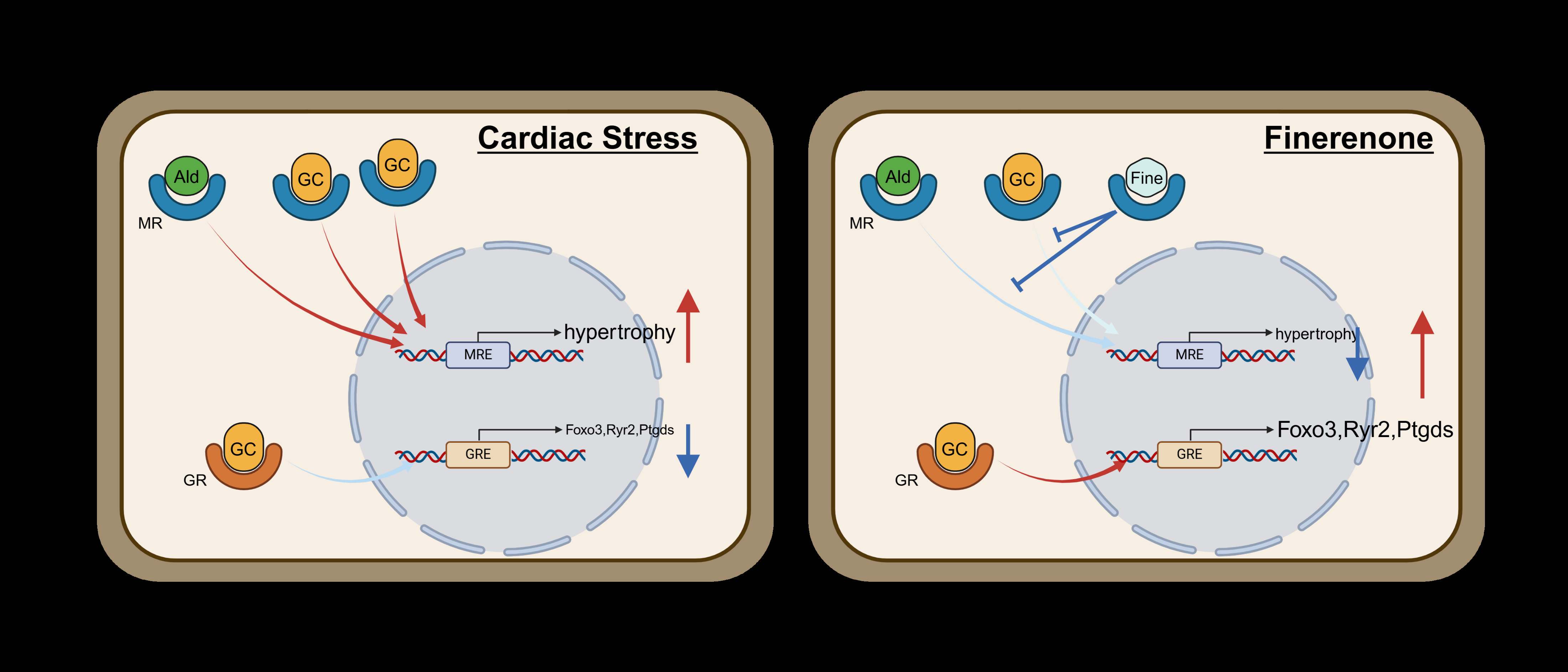
Abstract Body (Do not enter title and authors here): Background: The FINEARTS-HF trial demonstrated that finerenone significantly reduced cardiovascular death and total heart failure events in patients with mildly reduced or preserved ejection fraction compared to placebo. However, the pharmacological mechanisms by which this highly selective, non-steroidal mineralocorticoid receptor antagonist (MRA) exerts cardioprotective effects in heart failure with preserved ejection fraction (HFpEF) remain insufficiently defined. Recent studies have indicated that mineralocorticoid receptor (MR) and glucocorticoid receptor (GR) not only interact but also mutually regulate their signaling across multiple organs, including the myocardium.
Methods: A murine HFpEF model was established by inducing obesity, diabetes, and metabolic dysfunction-associated fatty liver disease (MAFLD) in conjunction with hypertension. Wild-type C57BL/6J mice were fed a high-fat diet and administered NG-nitro-L-arginine methyl ester (L-NAME) for 10 weeks. During the pathological hypertrophy phase, mice were treated with either finerenone or placebo for two weeks via oral gavage. Cardiac function and arterial pressure were evaluated using transthoracic echocardiography and continuous invasive blood pressure monitoring. Myocardial tissue underwent histological evaluation, immunoblotting, and transcriptomic analysis from cardiomyocyte-enriched nuclear fractions to elucidate finerenone-specific cardiac effects.
Results: Combined metabolic and hypertensive stress induced obesity, glucose intolerance, elevated blood pressure, and MAFLD, alongside increased MR nuclear localization in cardiomyocytes. Despite no significant group difference in 24-hour arterial pressure, finerenone-treated mice exhibited significantly reduced cardiomyocyte cross-sectional area (placebo: 235.9 ± 41.7 μm^2; finerenone: 213.7 ± 60.3 μm^2; p = 0.0189) and preserved capillary density. RNA sequencing revealed that finerenone suppressed expression of hypertrophic gene signatures while maintaining GR target gene expression associated with cardiac resilience. Protein analysis confirmed that GR nuclear translocation was preserved in the finerenone group.
Conclusion: Finerenone mitigates cardiomyocyte hypertrophy in a metabolic HFpEF model, independent of blood pressure reduction. This effect may be attributable to rebalancing MR and GR signaling in the myocardium, offering novel insight into finerenone’s mode of action beyond mineralocorticoid blockade.
  • Morikawa, Kei  ( Kumamoto University , Kumamoto , Japan )
  • Nagakura, Takumi  ( Kumamoto University , Kumamoto , Japan )
  • Fujiyama, Akira  ( IRCMS.kumamoto university , Kumamoto , Japan )
  • Yuquing, Xu  ( IRCMS.kumamoto university , Kumamoto , Japan )
  • Hanatani, Shinsuke  ( KUMAMOTO UNIVERSITY , Kumamoto-shi , Japan )
  • Izumiya, Yasuhiro  ( Kumamoto University Hospital , Kumamoto , Japan )
  • Arima, Yuichiro  ( Kumamoto University , Kumamoto , Japan )
  • Tsujita, Kenichi  ( Kumamoto University , Kumamoto , Japan )
  • Author Disclosures:
    Kei Morikawa: DO NOT have relevant financial relationships | Takumi Nagakura: DO NOT have relevant financial relationships | Akira Fujiyama: DO NOT have relevant financial relationships | Xu Yuquing: No Answer | Shinsuke Hanatani: DO NOT have relevant financial relationships | Yasuhiro Izumiya: DO NOT have relevant financial relationships | Yuichiro Arima: No Answer | Kenichi Tsujita: DO NOT have relevant financial relationships
Meeting Info:

Scientific Sessions 2025

2025

New Orleans, Louisiana

Session Info:

Epidemiology Meets Mechanism: Translational Insights into Cardiometabolic Mortality

Saturday, 11/08/2025 , 01:45PM - 03:00PM

Moderated Digital Poster Session

More abstracts on this topic:
A new mouse model for the study of cardiogenic TFs Tbx5, Gata4, and Mef2c during cardiogenesis

Leonard Riley, Sweat Mason, Eliason Steve, Zimmerman Kathy, Zhao Yi, Li Xiao, Hatcher Cathy, Weiss Robert, Amendt Brad

Abundance Of Long-Chain Acylcarnitines As a Key Regulator Of Metabolic Reprogramming During Postnatal Cardiac Maturation In Mice

Ramasamy Saminathan, Shrestha Pratikshya, Muthu Sakthijothi, Tran Zinnia, Velayutham Murugesan, Sundararajan Venkatesh

More abstracts from these authors:
Role of Ketone Body Metabolism in MASLD Progression and Pemafibrate Efficacy

Fujiyama Akira, Arima Yuichiro, Nagakura Takumi, Morikawa Kei, Ishii Masanobu, Hanatani Shinsuke, Yamamoto Eiichiro, Matsuzawa Yasushi, Izumiya Yasuhiro, Tsujita Kenichi

Ketone Body Metabolism Exerts an Anti-hypertrophic Effect on Cardiomyocytes by Alleviating Fatty Acid Overload and Increasing Glucose Utilization.

Yamada Toshihiro, Hino Shinjiro, Bundo Miki, Iwamoto Kazuya, Ahmed Zeeshan, Linna-kuosmanen Suvi, Hanatani Shinsuke, Usuku Hiroki, Matsuzawa Yasushi, Izumiya Yasuhiro, Yamamoto Eiichiro, Morikawa Kei, Tsujita Kenichi, Arima Yuichiro, Fujiyama Akira, Nagakura Takumi, Yuquing Xu, Kataoka Miho, Kikuchi Kenta, Kurotaki Daisuke, Umemoto Terumasa

You have to be authorized to contact abstract author. Please, Login
Not Available