
Logo

American Heart Association

  21
  0


Final ID: MP1733

Recovery of Aortic Wall Structure in Mouse Models of Marfan Syndrome with Conditional Inactivation of ADAMTS6

Abstract Body (Do not enter title and authors here): Background
Marfan syndrome (MFS), a complex multisystem disorder, is caused by autosomal dominant mutations in the FBN1 gene, leading to a deficiency in fibrillin-1 microfibrils, an extracellular matrix component critical for aortic wall structure and function. Recently, the ADAMTS6 gene was shown to co-localize, bind, and cleave fibrillin-1, leading to downregulation of fibrillin-1 microfibril quantity, and thus represents a potential therapeutic target for restoration of aortic wall structure, and prevention of aortic aneurysm formation.
Methods
We generated a conditional smooth muscle cell deletion of Adamts6 in a known chronic MFS mouse model. Echocardiograms were completed in MFS mice with Adamts6 inactivation (“Rescue” mice), non-disease wild type controls (“WT” mice), and MFS mice. Measurements of aortic root size, outflow velocity, left ventricular end diastolic volume (LVEDV), ejection fraction (EF), and mitral E/A ratio were completed to assess cardiac phenotype. Histological sections were then created and used to further assess differences in aortic composition among groups.
Results
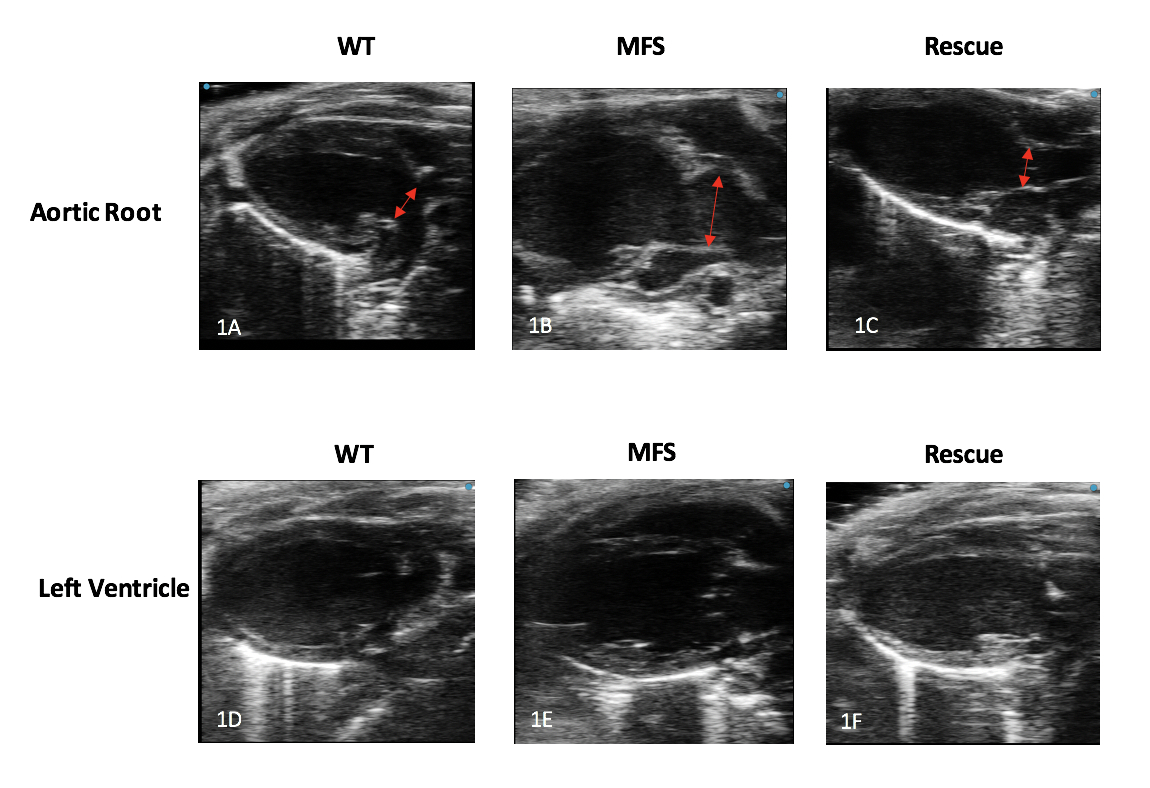
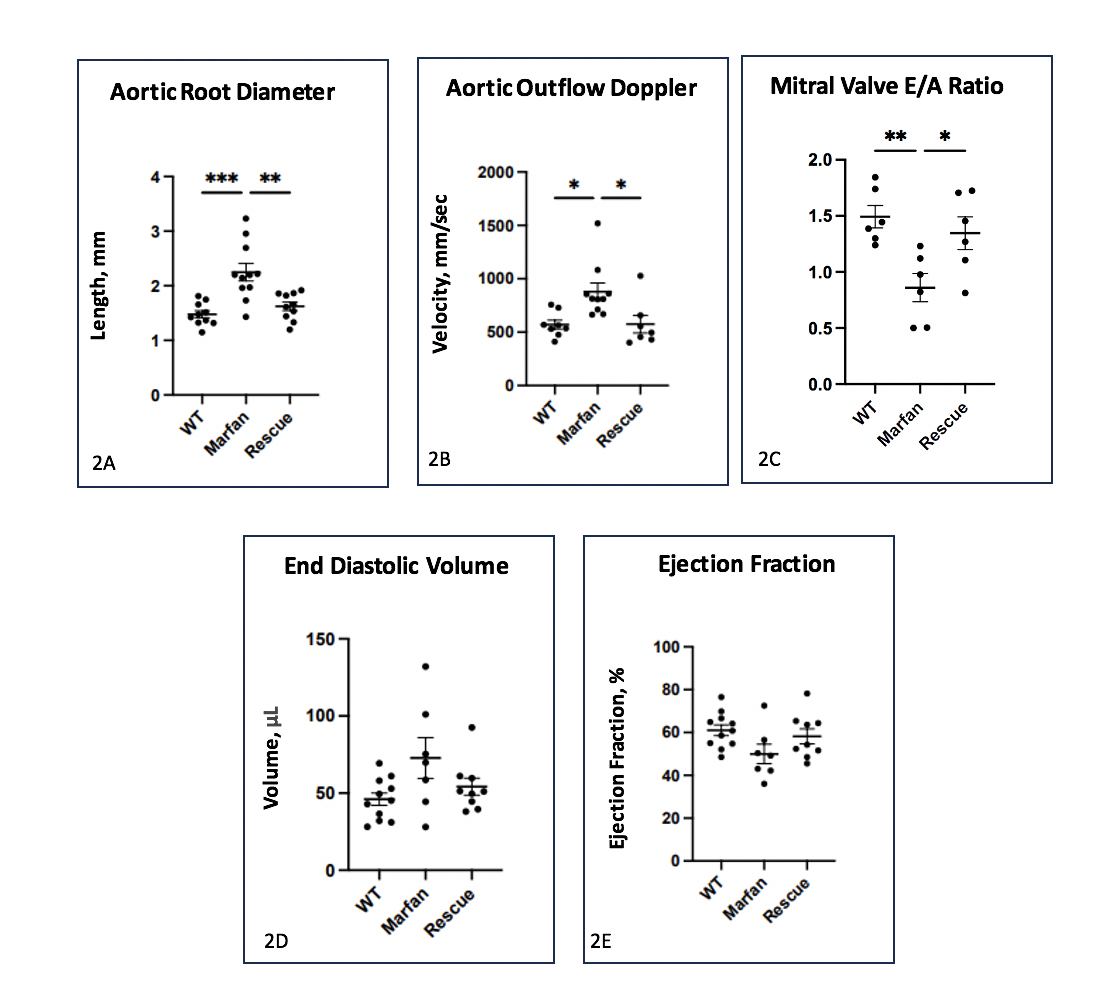
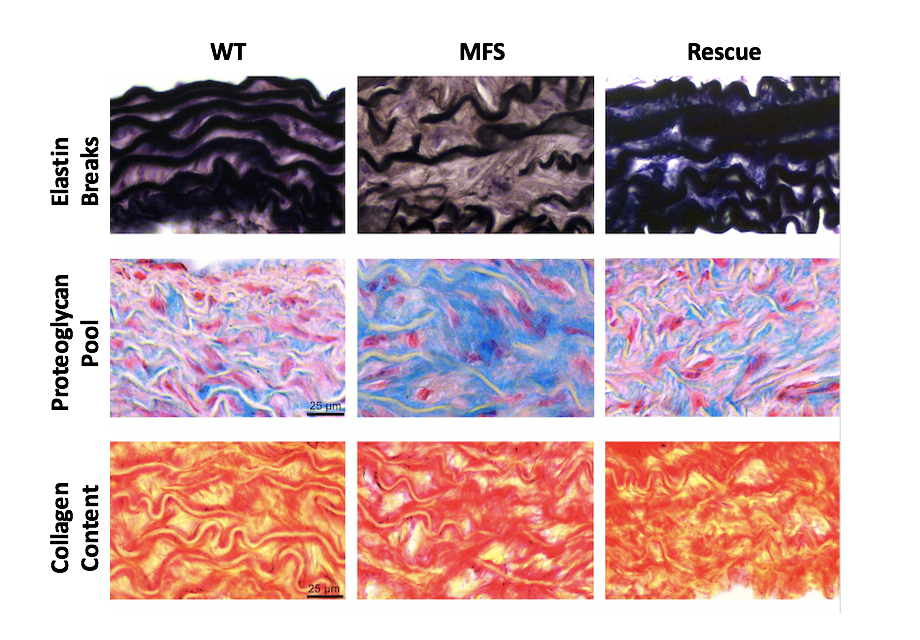
Echocardiography revealed a statistically significant difference in aortic root diameter between WT and MFS mice (Mean difference: 0.77 mm +/- 0.16 mm, p <0.001) and between MFS and Rescue mice (Mean difference: 0.62 mm +/- 0.16 mm, p = 0.002). Pulsed-wave doppler across the aortic valve also showed significantly reduced velocity in Rescue vs. MFS mice (Mean difference: 304.4 mm/sec +/- 103.2 mm/sec). There was a significant reduction in mitral valve E wave to A wave ratio when comparing WT and MFS mice (Mean difference: 0.49 +/- 0.18, p = 0.05). Importantly, there was no significant differences in aortic root size, outflow velocity or mitral E/A ratio between WT and Rescue mice (Figures 1 and 2). There were no statistical differences in LVEDV and EF among the three groups. Histologically, Rescue mice sections resembled those of WT mice, with decreased elastin breaks and proteoglycan and collagen accumulation compared to the MFS cohort (Figure 3).
Conclusion
Findings from this study suggest recovery of aortic wall strength and morphology in Rescue mice, consistent with the idea that Adamts6 inhibition may indeed present a possible target for MFS treatment. Ongoing work includes further quantification of aortic structure by histology and single-cell RNA sequencing of aortic tissue from across the three groups to discern changes at the cellular level.
  • Mital, Rahul  ( UH Rainbow Babies and Children's , Cleveland , Ohio , United States )
  • Seifert, Deborah  ( Case Western Reserve University , Cleveland , Ohio , United States )
  • Alcocer, Ana  ( Case Western Reserve University , Cleveland , Ohio , United States )
  • Lin, Connie  ( Case Western Reserve University , Cleveland , Ohio , United States )
  • Rush, Elizabeth  ( University of Pennsylvania , Philadelphia , Pennsylvania , United States )
  • Mead, Timothy  ( Case Western Reserve University , Cleveland , Ohio , United States )
  • Author Disclosures:
    Rahul Mital: DO NOT have relevant financial relationships | Deborah Seifert: DO NOT have relevant financial relationships | Ana Alcocer: No Answer | Connie Lin: No Answer | Elizabeth Rush: No Answer | Timothy Mead: No Answer
Meeting Info:

Scientific Sessions 2025

2025

New Orleans, Louisiana

Session Info:

Basic Science Innovations in Vascular Medicine

Sunday, 11/09/2025 , 03:15PM - 04:15PM

Moderated Digital Poster Session

More abstracts on this topic:
A Blood(y) Pressure Crisis: Diffuse Alveolar Hemorrhage as a Rare Manifestation of Severely Uncontrolled Hypertension

Nandyal Shreyas, Amdetsion Gedion Yilma, Varma Revati, Kohli Saksham, Hammo Hasan

A New Biomarker of Aging Derived From Electrocardiogram Improves Risk Prediction of Incident Myocardial Infarction and Stroke.

Wilsgaard Tom, Rosamond Wayne, Schirmer Henrik, Lindekleiv Haakon, Attia Zachi, Lopez-jimenez Francisco, Leon David, Iakunchykova Olena

More abstracts from these authors:
A CRISPR-Activation CROP-seq Screen Identifies HMGN1 as a Dosage-Sensitive Regulator of Heart Defects in Down Syndrome

Ranade Sanjeev, Mital Rahul, Boileau Ryan, Koback Frances, Padmanabhan Arun, Merriman Alexander, Wallace Langley, Nguyen Annie, Poulis Nikolaus, Gifford Casey, Pollard Katherine, Li Feiya, Srivastava Deepak, Whalen Sean, Angelo Pelonero, Ye Lin, Huang Yu, Brand Abigail, Nishino Tomohiro, Costa Mauro

You have to be authorized to contact abstract author. Please, Login
Not Available