
Artificial Intelligence-Enabled Electrocardiogram for Screening Asymptomatic Left Ventricular Systolic Dysfunction in Health Check-Up Populations
Abstract Body (Do not enter title and authors here): Background Asymptomatic left ventricular systolic dysfunction (LVSD) often precedes overt heart failure but frequently goes undetected in the general population. With the rise of artificial intelligence-enabled electrocardiogram (AI-ECG) now offer a scalable approach for early detection.
Hypothesis We hypothesize that AI-ECG is capable of identifying LVSD in apparently healthy individuals undergoing routine check-ups.
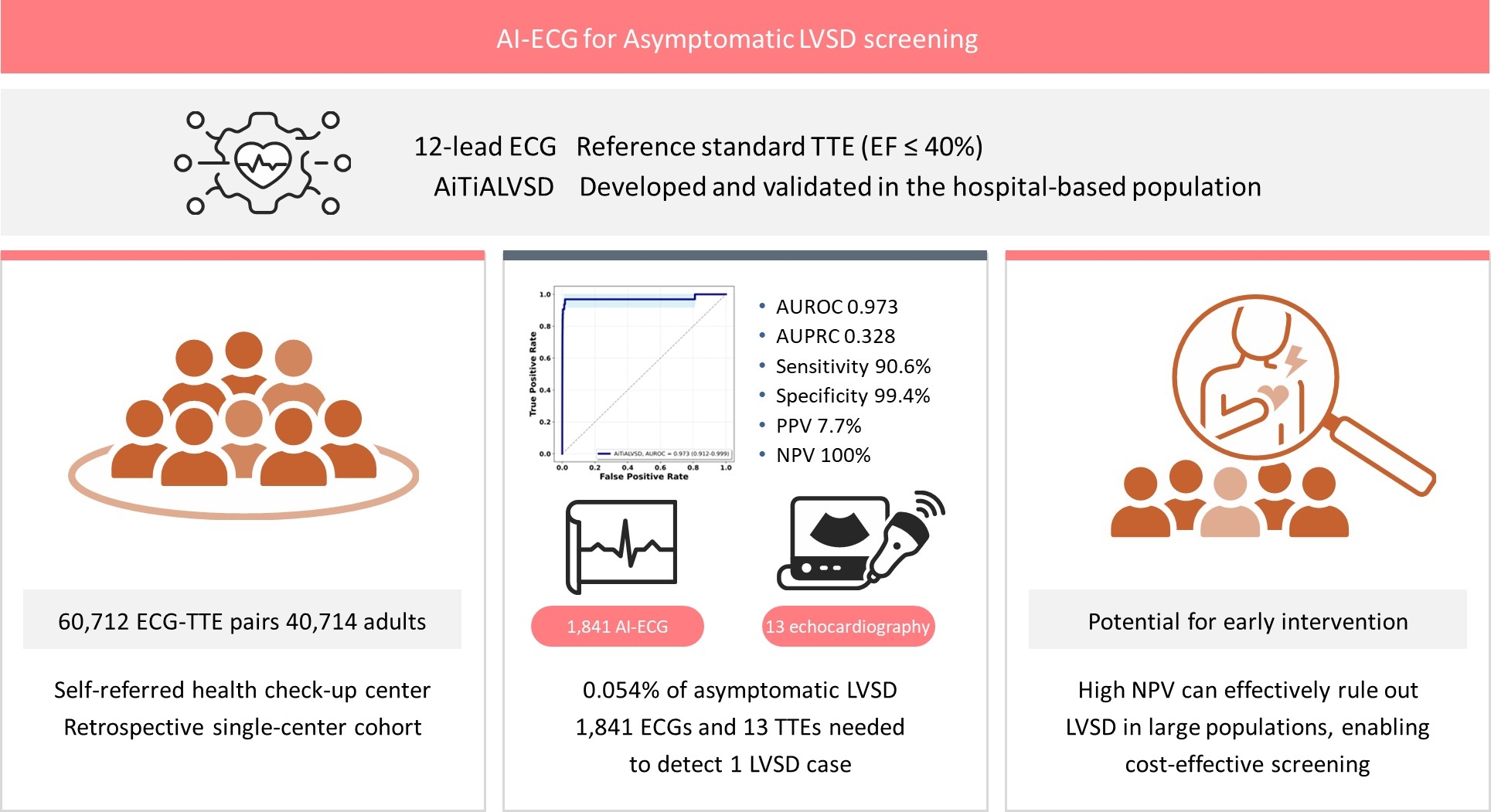
Methods This retrospective single-center study evaluated the performance of an AI-ECG model (AiTiALVSD) among 40,713 asymptomatic adults who underwent 60,711 paired ECG and echocardiography exams as part of self-referred health screenings from 2011 to 2023. LVSD was defined as left ventricular ejection fraction ≤40%. (Figure 1) Model performance was compared against two conventional heart failure risk scores.
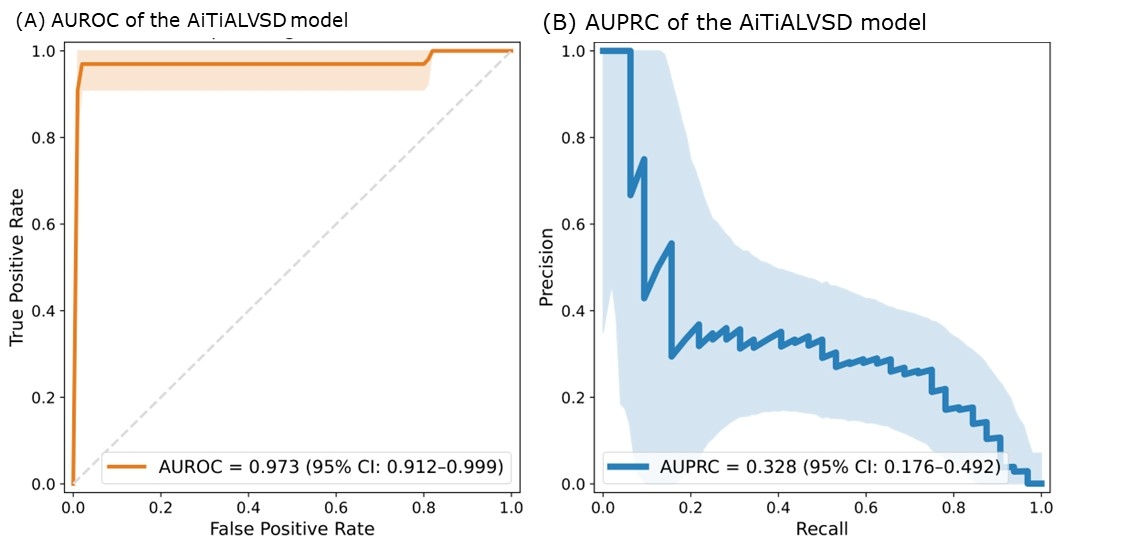
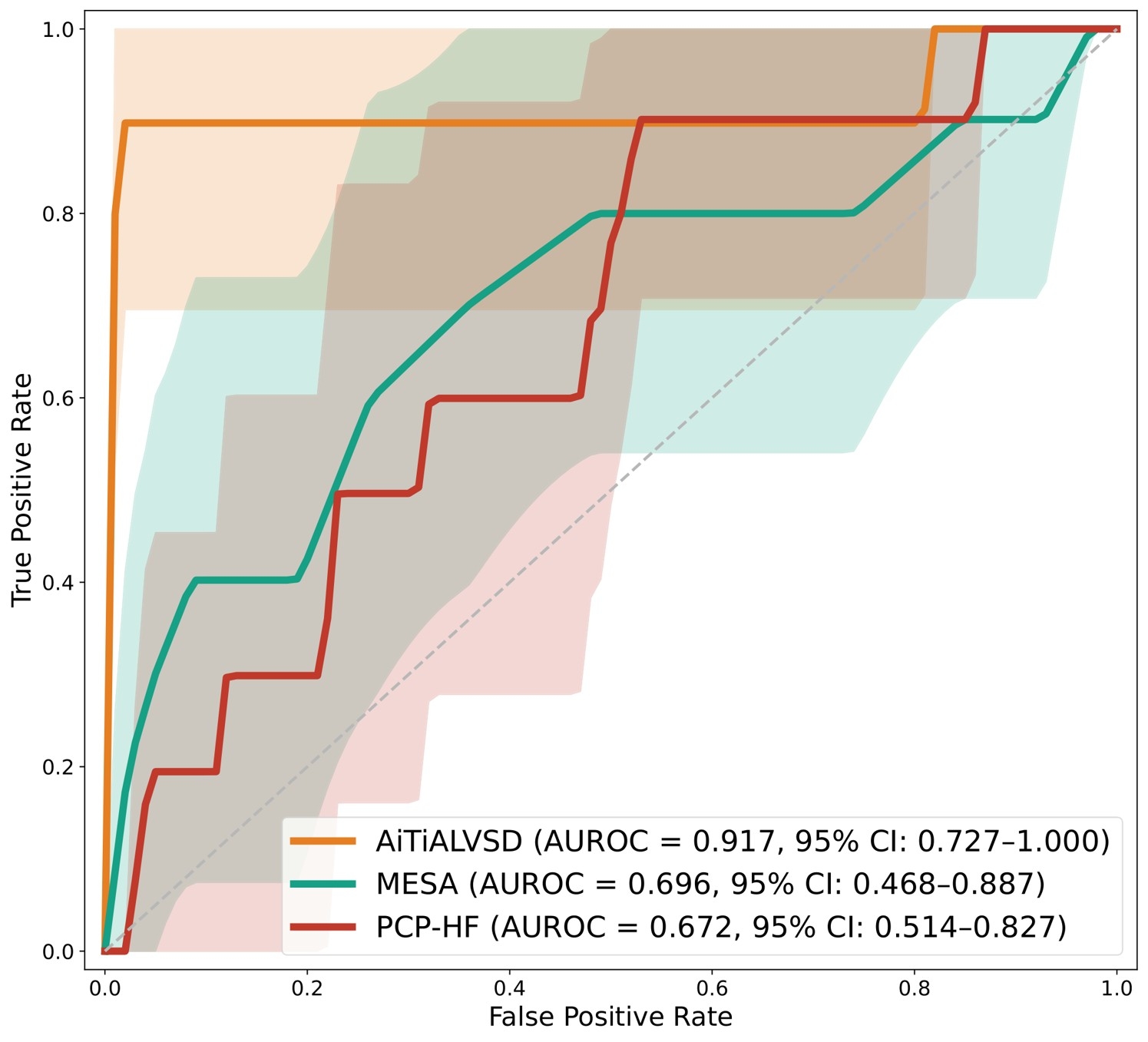
Results The AiTiALVSD model demonstrated excellent diagnostic accuracy with an area under the receiver operating characteristic curve of 0.973 and a precision-recall area of 0.328. (Figure 2) At the prespecified threshold, the model achieved 90.6% sensitivity, 99.4% specificity, 7.7% positive predictive value, and 100% negative predictive value. In comparison, conventional models performed worse (area under the curve of 0.696 for MESA and 0.672 for PCP-HF). (Figure 3) Simulation suggested that 1,841 ECGs and 13 echocardiograms would be required to identify one LVSD case. Notably, most false positives exhibited other echocardiographic abnormalities.
Conclusions The AI-ECG model showed high diagnostic performance in a real-world low-prevalence setting, supporting its potential as a cost-effective, noninvasive screening tool for early detection of LVSD. These findings warrant prospective validation and suggest a promising role for AI in community-based heart failure prevention strategies.
Lee, Hak Seung
( Medical AI
, Arlington
, Virginia
, United States
)
Kwon, Joon-myoung
( Medical AI
, Arlington
, Virginia
, United States
)
Lee, Heesun
( SEOUL NATIONAL UNIVERSITY HOSPITAL
, Seoul
, Korea (the Republic of)
)
Rhee, Tae-min
( Seoul National University Hospital
, Seoul
, Korea (the Republic of)
)
Kang, Sora
( MedicalAI
, Seoul
, Korea (the Republic of)
)
Lee, Min Sung
( Medical AI Co., Ltd.
, Seoul
, Korea (the Republic of)
)
Han, Ga In
( Medical AI
, Arlington
, Virginia
, United States
)
Yoo, Ah-hyun
( Medical AI
, Arlington
, Virginia
, United States
)
Jang, Jong-hwan
( Medical AI
, Arlington
, Virginia
, United States
)
Jo, Yong-yeon
( Medical AI
, Arlington
, Virginia
, United States
)
Son, Jeong Min
( Medical AI
, Arlington
, Virginia
, United States
)
Author Disclosures:
Hak Seung Lee:DO have relevant financial relationships
;
Employee:Medical AI:Active (exists now)
| Joon-myoung kwon:No Answer
| Heesun Lee:No Answer
| Tae-Min Rhee:DO NOT have relevant financial relationships
| Sora Kang:DO NOT have relevant financial relationships
| Min Sung Lee:DO have relevant financial relationships
;
Employee:Medical AI Co., Ltd.:Active (exists now)
| Ga In Han:DO NOT have relevant financial relationships
| Ah-Hyun Yoo:DO NOT have relevant financial relationships
| Jong-Hwan Jang:DO NOT have relevant financial relationships
| Yong-Yeon Jo:No Answer
| Jeong Min Son:DO have relevant financial relationships
;
Employee:Medical AI, Co., Ltd.:Active (exists now)
Yoo Ah-hyun, Kim Kyung-hee, Lee Soo Youn, Lee Hak Seung, Kang Sora, Lee Min Sung, Han Ga In, Son Jeong Min, Jang Jong-hwan, Jo Yong-yeon, Kwon Joon-myoung
Lee Hak Seung, Kwon Joon-myoung, Kim Kyung-hee, Lee Soo Youn, Kang Sora, Han Ga In, Yoo Ah-hyun, Jang Jong-hwan, Jo Yong-yeon, Son Jeong Min, Lee Min Sung
4361582_File000000.jpg
4361582_File000001.jpg
4361582_File000002.jpg
You have to be authorized to contact abstract author. Please, Login