
Diverging Trends in Cardiovascular Mortality: A Comparative Analysis of GBD and CDC WONDER for Five Conditions (1999–2020)
Abstract Body (Do not enter title and authors here): Background Understanding cardiovascular mortality is key for shaping public health priorities. Two major sources in the U.S.—CDC WONDER and the Global Burden of Disease (GBD) study—report mortality differently. While CDC WONDER reflects death certificate data, GBD employs modeling techniques and redistributes ill-defined ("garbage") codes to improve cause of death attribution. Prior comparisons have focused on ischemic heart disease and stroke, but other cardiovascular conditions remain understudied.
Methods We examined trends in valvular heart disease (I34.0-I37.9), hypertensive heart disease (I11.0, I11.9), peripheral arterial disease (I70.2), infective endocarditis (I38), and aortic aneurysm (I71) using both databases from 1999–2020. Annual U.S. mortality data from GBD and CDC WONDER were analyzed. For each condition, absolute deaths and crude mortality rates (CMRs) per 100,000 population were extracted. Percent change from 1999 to 2020 was calculated. CMRs were reported with 95% uncertainty intervals (UI) for GBD and 95% confidence intervals (CI) for CDC WONDER.
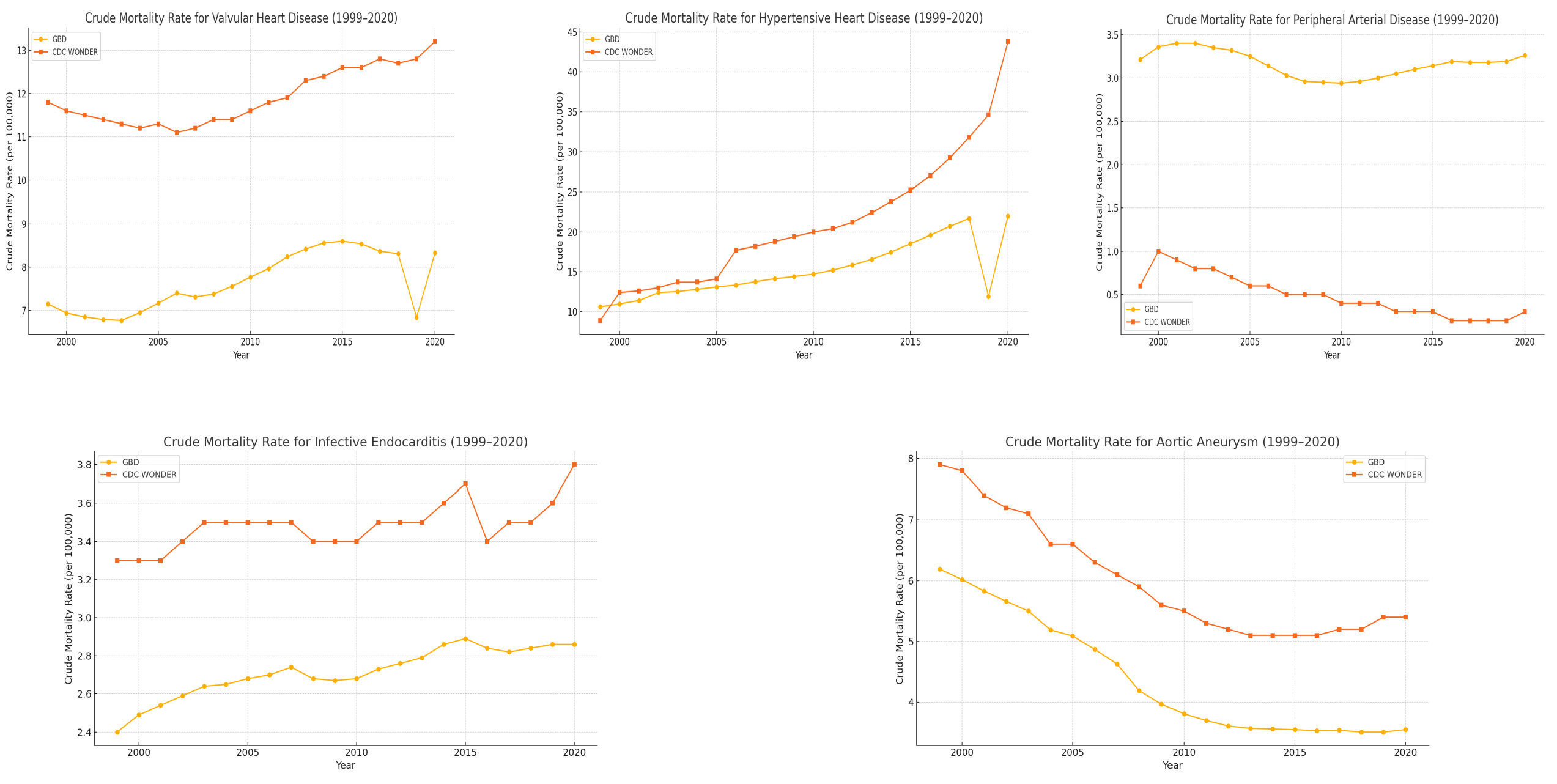
Results Substantial differences were found between the databases. Valvular heart disease deaths rose by 38.8% (GBD) and 32.2% (CDC). CMRs increased from 7.15 (UI: 7.62–6.18) to 8.33 (9.12–6.74) in GBD and from 11.8 (CI: 11.7–11.9) to 13.2 (13.1–13.4) in CDC. Hypertensive heart disease exhibited the most pronounced increase where deaths rose by 147.2% (GBD) and 474.7% (CDC). GBD CMRs rose from 10.6 (11.2–9.46) to 22.0 (23.62–19.21); CDC from 8.9 (9.2–8.9) to 43.8 (44.3–43.8). Peripheral arterial disease deaths rose 20.9% (GBD) but fell 50.4% (CDC). CMRs changed from 3.21 (3.45–2.82) to 3.26 (3.55–2.78) in GBD and from 0.6 (0.6–0.7) to 0.3 (0.3–0.3) in CDC. Infective endocarditis deaths increased by 41.9% (GBD) and 36.4% (CDC). CMRs rose from 2.4 (2.53–2.17) to 2.86 (3.07–2.50) in GBD and from 3.3 (3.4–3.3) to 3.8 (3.9–3.8) in CDC. Aortic aneurysm deaths declined 31.6% (GBD) and 18.9% (CDC). GBD CMRs fell from 6.19 (6.45–5.63) to 3.55 (3.76–3.15); CDC from 7.9 (8.0–7.8) to 5.4 (5.5–5.3).
Conclusion Cardiovascular mortality trends varied significantly between GBD and CDC WONDER. Differences were especially striking in hypertensive heart disease and peripheral arterial disease, likely due to methodological variation in death coding and redistribution. Awareness of these discrepancies is crucial for interpreting national mortality data and informing policy.
Fernandes, Warren
( Saint Vincent Hospital
, Worcester
, Massachusetts
, United States
)
Gobeil, Kyle
( UMass Chan - Baystate Medical Center
, Springfield
, Massachusetts
, United States
)
Majmundar, Vidit
( Saint Vincent Hospital
, Worcester
, Massachusetts
, United States
)
Fernandes, Bolivia
( The NYMC GME at Saint Mary’s General Hospital and Saint Clare’s Health
, Denville
, New Jersey
, United States
)
Sudheer, Aishwarya
( Saint Vincent Hospital
, Worcester
, Massachusetts
, United States
)
Deo, Rohan
( Saint Vincent Hospital
, Worcester
, Massachusetts
, United States
)
Pamreddy, Hrushikesh Reddy
( Saint Vincent Hospital
, Worcester
, Massachusetts
, United States
)
V Ganesan, Ajitha
( The NYMC GME at Saint Mary’s General Hospital and Saint Clare’s Health
, Denville
, New Jersey
, United States
)
Bohra, Rhea
( Saint Vincent Hospital
, Worcester
, Massachusetts
, United States
)
Yamparala, Aishwarya
( Saint Vincent Hospital
, Worcester
, Massachusetts
, United States
)
Author Disclosures:
Warren Fernandes:DO NOT have relevant financial relationships
| Kyle Gobeil:No Answer
| Vidit Majmundar:DO NOT have relevant financial relationships
| Bolivia Fernandes:No Answer
| Aishwarya Sudheer:No Answer
| Rohan Deo:DO NOT have relevant financial relationships
| Hrushikesh Reddy Pamreddy:DO NOT have relevant financial relationships
| AJITHA V GANESAN:DO NOT have relevant financial relationships
| RHEA BOHRA:No Answer
| Aishwarya Yamparala:DO NOT have relevant financial relationships