Serial changes in post-heart transplant ejection fraction predict recipient mortality
Abstract Body (Do not enter title and authors here): Background Heart transplantation (HTx) is the gold standard therapy for refractory class IV NYHA heart failure. While it has been widely observed that donor ejection fraction (EF) at the time of procurement has little to no significant impact on recipient survival, particularly when ischemic time is less than 4-hours, there are few studies which investigate the role of post-transplant EF. Namely, it has not been fully established how serial changes in follow-up EF impact HTx outcomes.
Research question Do serial changes in post-transplant EF impact HTx recipient survival, and if so, which pattern of change has the highest risk of mortality?
Goals Our study seeks to evaluate the role of post-transplant EF changes and its impact on HTx recipient survival. By addressing this gap in knowledge, clinicians may better identify and treat hazardous EF trajectories earlier in their course.
Methods The UNOS thoracic database was analyzed for first-time, isolated orthotopic HTx patients (≥18yrs) between 2000-2023. The absolute difference between EF values at 1- (EF1) and 2-years (EF2) post-HTx was analyzed; patients with missing data in EF1 or EF2 were excluded. Recipients were stratified into 5 groups: severe reduction in EF: <-10% points (n=1403), mild reduction in EF: -5.1 to -10% (n=2381), stable EF: -5 to +5% (n=19194), mild increase in EF: +5.1 to +10% (n=2414), and substantial increase in EF: >+10% (n=1314). Survival was assessed utilizing Kaplan-Meier curves, log-rank test, and Cox regression modelling.
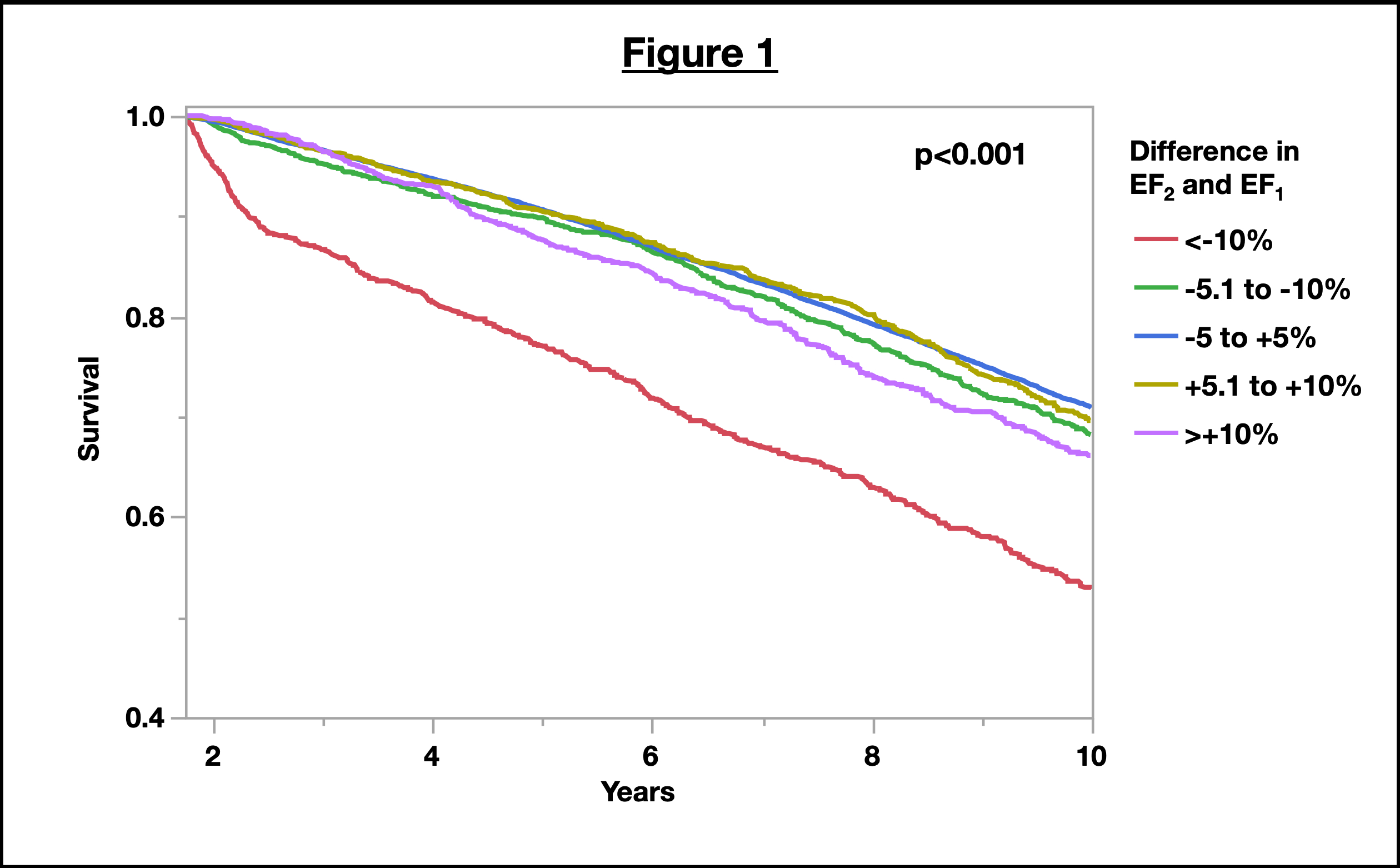
Results In total, 26706 patients were included in this study. Kaplan-Meier curves are displayed in Figure 1, with median survival estimates for each EF group as follows: severe reduction (10.6yrs), mild reduction (14.3yrs), stable (14.4yrs), mild increase (14.5yrs), and substantial increase (14.2yrs). There was a significant difference in survival based on log-rank test (p<0.001). Cox regression modelling found the following mortality risk results with reference to a stable EF: severe EF reduction (HR=1.88, p<0.001), mild EF reduction (HR=1.11, p=0.035), mild EF increase (HR=1.04, p=0.426), and substantial EF increase (HR=1.24, p<0.001).
Conclusion Our investigation found a significant increase in mortality risk for HTx recipients who develop a reduction or substantial increase in EF. Special attention and care should be given to such recipients – particularly those who are observed to have a drop in their EF of >10%, as their risk for mortality may increase by 88%.
Firoz, Ahad
(
UC Davis Medical Center
, Sacramento , California , United States )
Jimenez, Shirin
(
UC Davis Medical Center
, Sacramento , California , United States )
Author Disclosures:
Ahad Firoz:DO NOT have relevant financial relationships
| Shirin Jimenez:DO NOT have relevant financial relationships