
Logo

American Heart Association

  19
  0


Final ID: MP1055

Amyloid Pathway Markers and Cardiovascular Outcomes: A Systematic Review and Meta-Analysis

Abstract Body (Do not enter title and authors here): Background:
Amyloid beta 1–40 (Aβ1–40), a cleavage product of amyloid precursor protein, is emerging as a vascular inflammation marker with prognostic value in cardiovascular disease (CVD). Its predictive utility, however, remains inconsistent across clinical settings. BACE1-AS, a regulatory long non-coding RNA of Aβ1–40, has also been implicated in adverse cardiovascular outcomes. We aimed to synthesize available evidence and quantify the prognostic strength of these markers across CVD populations.

Methods:
We conducted a systematic search of PubMed, Embase, Scopus, and Google Scholar using predefined PICO criteria. Filters: human studies, English language, adults (≥18), observational cohorts or clinical trials. Outcomes of interest included mortality, heart failure, and major adverse cardiovascular events (MACE). Risk of bias was assessed via the Newcastle-Ottawa Scale. Pooled hazard ratios were calculated using the generic inverse variance method. Sensitivity analyses were performed to assess heterogeneity.

Results:
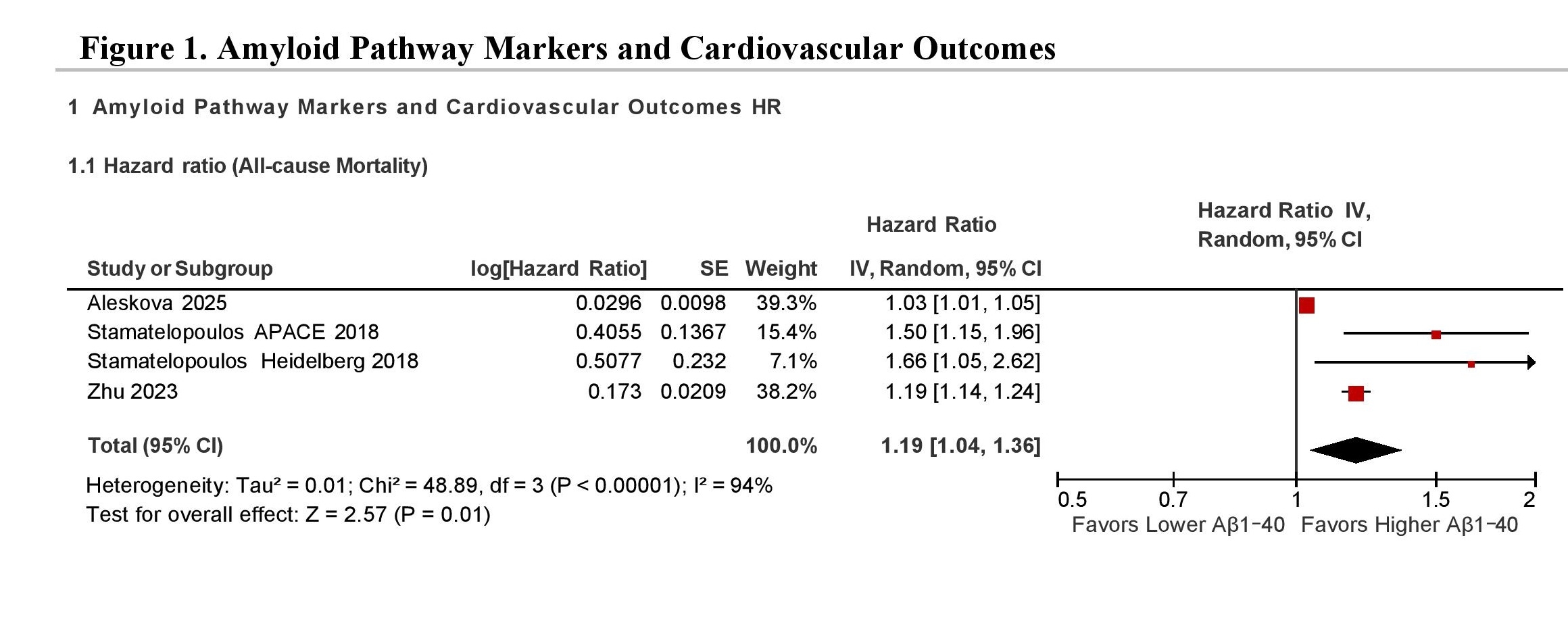
Four studies (n = 7,154). Pooled hazard ratio for all-cause mortality: HR = 1.19 (95% CI: 1.04–1.36; p = 0.01). Heterogeneity was high (I2 = 94%). One-out sensitivity analysis identified Aleksova et al. as the primary driver; excluding it reduced I2 to 59%. This study uniquely combined STEMI and NSTEMI patients in a high-risk cohort with longer follow-up, enriched for older age, renal dysfunction, and systolic failure—conditions known to amplify Aβ1–40 levels. Another study reported a 32% increased heart failure risk per 1-SD rise in Aβ1–40. Elevated BACE1-AS tertiles predicted a 1.86-fold increase in MACE risk.

Conclusion:
Aβ1–40 is a significant prognostic biomarker for mortality and heart failure in CVD populations. The heterogeneity across studies is largely explained by the Aleksova et al. study, which captured a more acute, high-risk phenotype with STEMI dominance and systemic inflammation. Its removal in sensitivity analysis reveals more consistent effect sizes across stable cohorts. These results reinforce the pathobiological relevance of the amyloid axis in cardiovascular disease and call for standardized measurement protocols and phenotype-stratified validation. Aβ1–40 and BACE1-AS should be investigated further as tools for early risk stratification in precision cardiology.
  • Sharma, Gaurav  ( Jaipur National University Institute for Medical Sciences & Research Centre , Jaipur , India )
  • Gutta, Durga Prasad  ( Siddhartha medical college , Chilakaluripet , India )
  • Javid, Saman  ( Combined Military Hospital , Kharian , Pakistan )
  • Haider, Salar  ( King Edward Medical University , Lahore , Pakistan )
  • Lanka, Nidhi  ( Lokmanya Tilak Municipal Medical Co , Mumbai , India )
  • Mishra, Tushar  ( The Mount Sinai Hospital , New York , New York , United States )
  • Author Disclosures:
    Gaurav Sharma: DO NOT have relevant financial relationships | Durga prasad Gutta: DO NOT have relevant financial relationships | Saman Javid: No Answer | Salar Haider: DO NOT have relevant financial relationships | Nidhi Lanka: DO NOT have relevant financial relationships | Tushar Mishra: DO NOT have relevant financial relationships
Meeting Info:

Scientific Sessions 2025

2025

New Orleans, Louisiana

Session Info:

Heart Failure Potpourri: From Horses to Zebras

Saturday, 11/08/2025 , 12:15PM - 01:15PM

Moderated Digital Poster Session

More abstracts on this topic:
A Biomarker Based on Aneurysm Wall Enhancement and Blood Gene Expression to Identify Symptomatic Intracranial Aneurysms

Veeturi Sricharan, Poppenberg Kerry, Jaikumar Vinay, Pinter Nandor, Levy Elad, Siddiqui Adnan, Tutino Vincent

A First-in-Class EV-miRNA Diagnostic System for Early Identification of IVIG-Resistant Kawasaki Disease

Nakaoka Hideyuki, Hirono Keiichi, Hara Akane, Tsuboi Kaori, Ibuki Keijiro, Ozawa Sayaka, Ichida Fukiko

You have to be authorized to contact abstract author. Please, Login
Not Available