
Logo

American Heart Association

  22
  0


Final ID: MP279

Impact of Aortic Insufficiency Severity on ECPELLA-provided Hemodynamic Support and Left Ventricular Unloading: A Triadic In Vitro–In Vivo–In Silico Analysis

Abstract Body (Do not enter title and authors here): Introduction: The combination therapy of venoarterial extracorporeal membrane oxygenation (VA-ECMO) and transaortic valve micro-axial flow pump catheter (Impella), so-called ECPELLA, provides powerful hemodynamic support and left ventricular (LV) unloading for cardiogenic shock (CS). However, aortic insufficiency (AI) caused by Impella placement reduces those benefits of ECPELLA.
Research Questions: This study investigated the impact of Impella-induced AI on the effects of hemodynamic support and LV unloading by ECPELLA. We examined the relationship between AI severity and regurgitant flow (AI flow) using mock circulation and confirmed the presence of AI-induced hemodynamic deficit in a goat model of ECPELLA. Furthermore, we evaluated the impact of varying AI severity on hemodynamics and LV pressure-volume (PV) loop in ECPELLA circulation by our developed cardiovascular simulation.
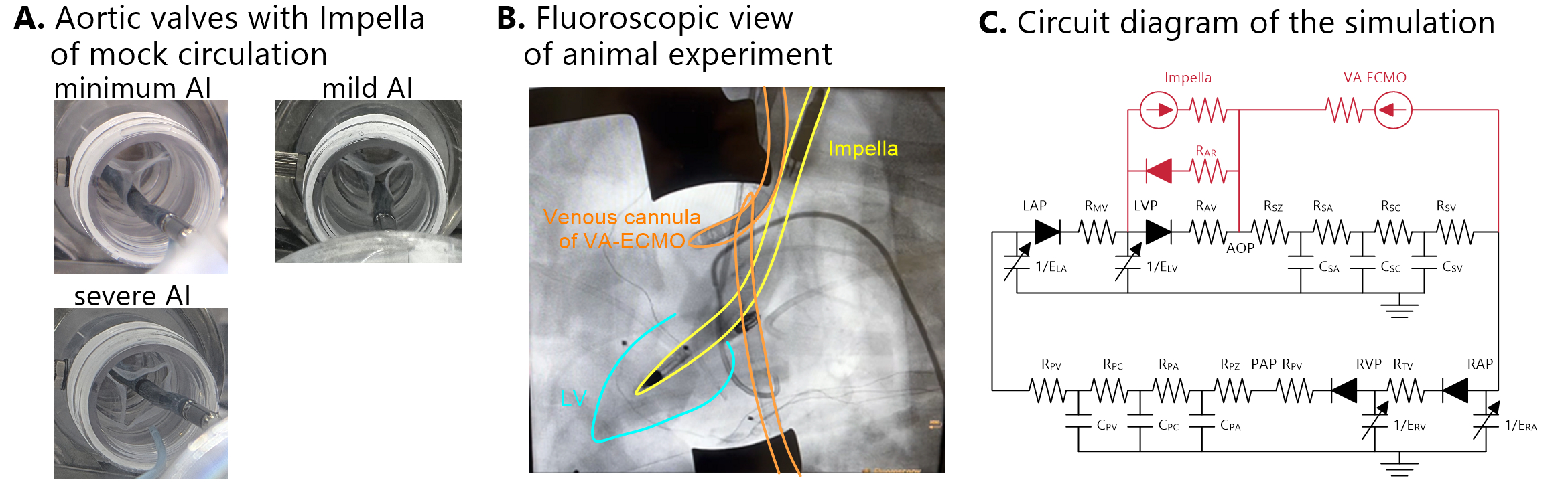
Methods: In a closed mock circuit with a centrifugal pump, we evaluated the relationship between the AI severity, which was altered by the position of the Impella at the aortic valve (Fig. 1A), and the effective regurgitant orifice area (EROA) estimated from AI flow and pressure gradient. Five Saanen goats (53±2 kg) were used for animal experiments of ECPELLA (Fig. 1B). VA-ECMO flow was set at 1.0, 1.5, and 2.0 L/min. AI flow was calculated from the difference between pulmonary artery and Impella flows. We developed a cardiovascular simulation that employed four cardiac chambers with resistance-compliance networks incorporating ECPELLA (Fig. 1C). Using four AI severity levels, we calculated the hemodynamics and illustrated PV loops by changing Impella CP settings from P0 to P9 under VA-ECMO support.
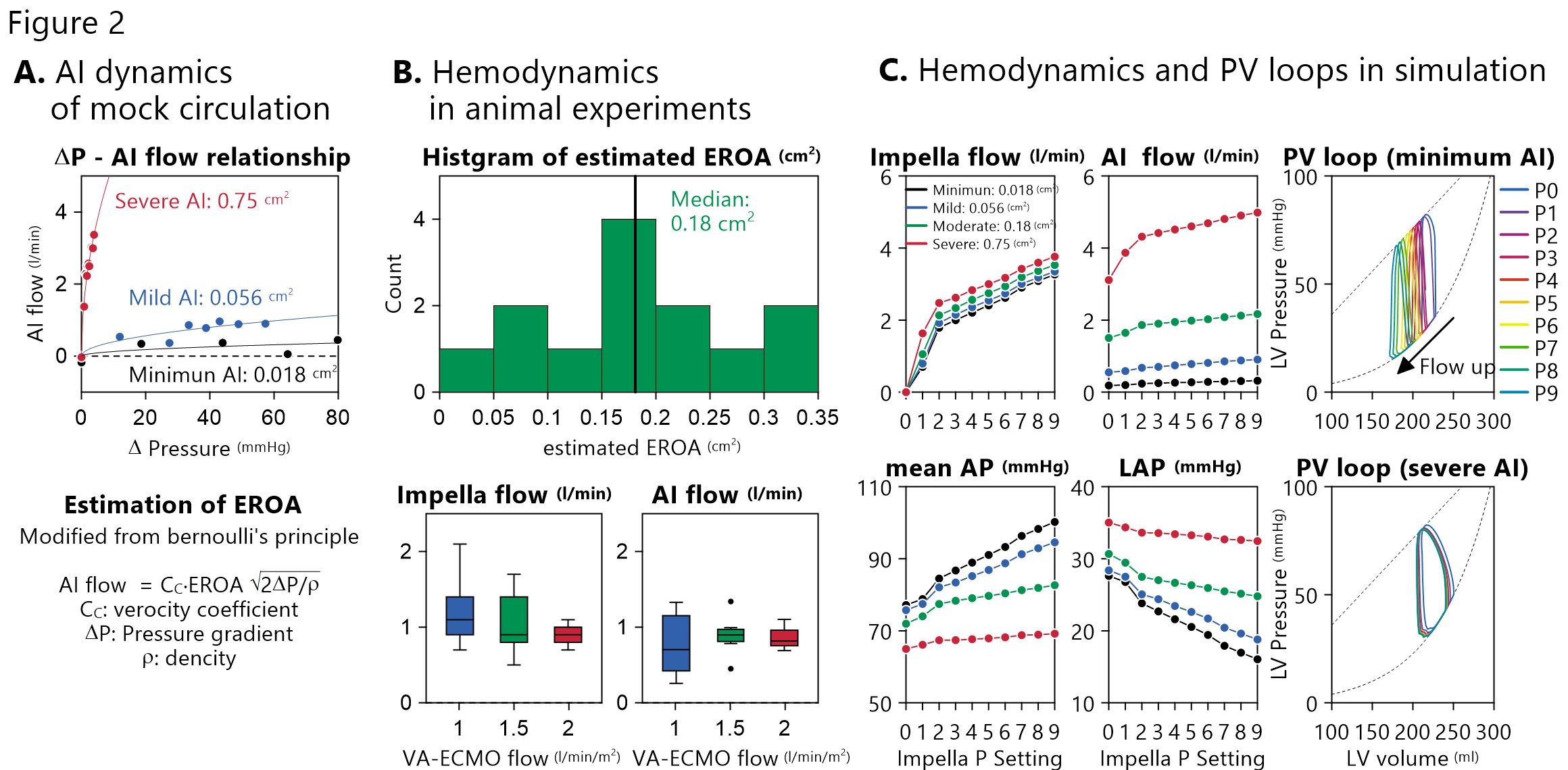
Results: In mock circulation, AI flow increased according to the pressure gradient in each AI severity. Estimated EROA values were 0.018, 0.056, and 0.75 cm2 for minimal, mild, and severe AI, respectively (Fig. 2A). In goats with ECPELLA, we observed the presence of AI with EROA of 0.18 cm2 (Fig. 2B). In the simulation, the higher AI severity markedly attenuated the Impella impact on hemodynamic improvement and the leftward and downward shift in PV loop (Fig. 2C).
Conclusion: Inappropriate Impella position can cause severe AI. Severe AI substantially reduces both hemodynamic support and LV unloading effects of ECPELLA. Systematic AI assessment is critical for optimal ECPELLA management in CS patients.
  • Nishikawa, Takuya  ( National Cerebral and Cardiovascular Center , Suita , Osaka , Japan )
  • Ohba, Kenta  ( National Cerebral and Cardiovascular Center , Suita , Osaka , Japan )
  • Yoshida, Yuki  ( National Cerebral and Cardiovascular Center , Suita , Osaka , Japan )
  • Fukumitsu, Masafumi  ( National Cerebral and Cardiovascular Center , Suita , Osaka , Japan )
  • Uemura, Kazunori  ( National Cerebral and Cardiovascular Center , Suita , Osaka , Japan )
  • Kawada, Toru  ( National Cerebral and Cardiovascular Center , Suita , Osaka , Japan )
  • Saku, Keita  ( National Cerebral and Cardiovascular Center , Suita , Osaka , Japan )
  • Unoki, Takashi  ( Saiseikai Kumamoto Hospital , Kumamoto , Kumamoto , Japan )
  • Otake, Masahiro  ( National Cerebral and Cardiovascular Center , Suita , Osaka , Japan )
  • Kakuuchi, Midori  ( National Cerebral and Cardiovascular Center , Suita , Osaka , Japan )
  • Yokota, Shohei  ( National Cerebral and Cardiovascular Center , Suita , Osaka , Japan )
  • Matsushita, Hiroki  ( National Cerebral and Cardiovascular Center , Suita , Osaka , Japan )
  • Sato, Kei  ( National Cerebral and Cardiovascular Center , Suita , Osaka , Japan )
  • Morita, Hidetaka  ( National Cerebral and Cardiovascular Center , Suita , Osaka , Japan )
  • Hiraki, Nana  ( National Cerebral and Cardiovascular Center , Suita , Osaka , Japan )
  • Author Disclosures:
    Takuya Nishikawa: DO NOT have relevant financial relationships | Kenta Ohba: DO NOT have relevant financial relationships | Yuki Yoshida: DO NOT have relevant financial relationships | Masafumi Fukumitsu: DO NOT have relevant financial relationships | Kazunori Uemura: DO NOT have relevant financial relationships | Toru Kawada: No Answer | Keita Saku: DO have relevant financial relationships ; Advisor:Cubec:Active (exists now) ; Research Funding (PI or named investigator):Zeon Medical Inc.:Active (exists now) ; Research Funding (PI or named investigator):Neuroceuticals Inc.:Active (exists now) ; Research Funding (PI or named investigator):Asahi Kasei ZOLL Medical Corporation:Active (exists now) ; Research Funding (PI or named investigator):NTT Research:Active (exists now) ; Research Funding (PI or named investigator):Abiomed Inc.:Active (exists now) ; Speaker:Mallinckrodt Pharma K.K.:Active (exists now) ; Speaker:Abiomed Japan K.K.:Active (exists now) ; Advisor:WION:Active (exists now) | Takashi Unoki: No Answer | Masahiro Otake: DO NOT have relevant financial relationships | Midori Kakuuchi: DO NOT have relevant financial relationships | Shohei Yokota: No Answer | Hiroki Matsushita: No Answer | Kei Sato: DO NOT have relevant financial relationships | Hidetaka Morita: DO NOT have relevant financial relationships | NANA HIRAKI: DO NOT have relevant financial relationships
Meeting Info:

Scientific Sessions 2025

2025

New Orleans, Louisiana

Session Info:

Powering the Failing Heart: Advances and Outcomes in Mechanical Support and Transplantation

Saturday, 11/08/2025 , 01:45PM - 03:00PM

Moderated Digital Poster Session

More abstracts on this topic:
A recombinant protein oxygen carrier with reduced nitric oxide scavenging as a blood substitute for resuscitation

Xu Qinzi, Rochon Elizabeth, Bocian Kaitlin, Huang Xue, Poropatich Ronald, Gladwin Mark, Tejero Jesus, Rose Jason, Rodriguez Deborah, Hwang Hyon, Turner Bryan, Hunt Thomas, Dent Matthew, Demartino Anthony, Abdelghany Youmna, Chen Xiukai

A Rare Cause of Recurrent Heart Failure Exacerbations After Transcatheter Aortic Valve Replacement: Ventricular Septal Defect and Significant Paravalvular Leak

Medina Jesse, Vincent Louis, Rodriguez Ferreira Esteban, Spence-miller Shanice, Fernandez Joel, Colombo Rosario, Calfa Marian

More abstracts from these authors:
Total Support by a Trans-Aortic Valve Micro-Axial Flow Pump Reduces Coronary Blood Flow in Both Normal and Post-reperfusion Coronary Arteries in a Goat Model of Ischemia-Reperfusion

Ohba Kenta, Kawada Toru, Saku Keita, Otake Masahiro, Hiraki Nana, Yoshida Yuki, Morita Hidetaka, Sato Kei, Nishikawa Takuya, Fukumitsu Masafumi, Uemura Kazunori

Impact of Advanced Mechanical Circulatory Support on Hemodynamics and Oxygen Delivery in Ventricular Septal Perforation with Severe Biventricular Failure: A Systematic Simulation Study

Otake Masahiro, Uemura Kazunori, Nakazawa Gaku, Saku Keita, Nishikawa Takuya, Morita Hidetaka, Sato Kei, Yoshida Yuki, Hiraki Nana, Ohba Kenta, Fukumitsu Masafumi, Kawada Toru

You have to be authorized to contact abstract author. Please, Login
Not Available