Update to Non-invasive, Automated Approach to Estimate Septal Curvature as a Surrogate of Mean Pulmonary Arterial Pressure for Pediatric Pulmonary Hypertension Patients
Abstract Body (Do not enter title and authors here): Background: Pediatric pulmonary hypertension can be diagnosed by echocardiography and right heart catheterization, but cardiac MRI-based septal curvature (SC) measurement can also be used as a surrogate of mean pulmonary arterial pressure (mPAP), which is an invasive measurement to follow-up patients. We developed an automated approach to measure SC, demonstrating its superiority over a manual measurement. However, its performance relative to other septal wall measurements and clinical markers are unclear.
Hypothesis: Automated SC is better correlated with mPAP, less observer dependent, and better associated with adverse outcomes than interventricular septal angle (IVS) and right ventricular ejection fraction (RVEF).
Aims: To compare the automated SC, IVS, and RVEF in terms of observer variability, correlation to mPAP, and correlation with adverse outcomes.
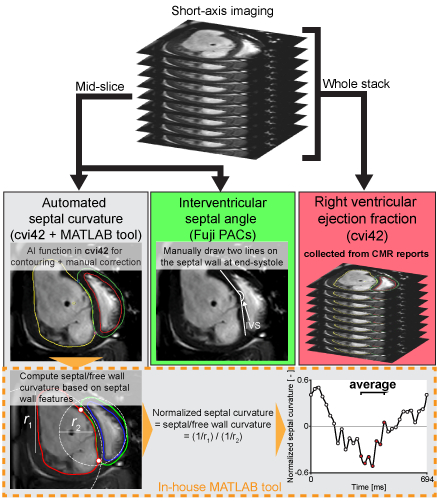
Methods: Patients with pulmonary hypertension who had both catheterization and cardiac MRI were retrospectively included. Automated SC and IVS were measured using a mid-slice of short-axis stack imaging for both ventricles using cvi42, a custom MATLAB tool and Fuji PACs (Fig.1). RVEF was collected from the MRI scan report. Adverse outcomes were death, transplant, and/or indication for transplant of heart and/or lung and were collected from electronic health record. Pearson correlation was used for correlation between the metrics and mPAP. A receiver-operating characteristic (ROC) curve was used to investigate the association between the metrics and outcomes. Intraclass correlation coefficient (ICC) was used for interobserver variability analysis. P<0.05 was considered statistically significant.
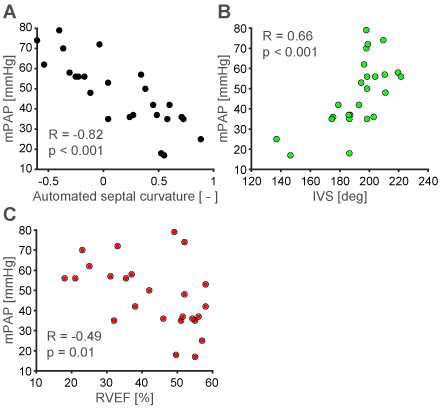
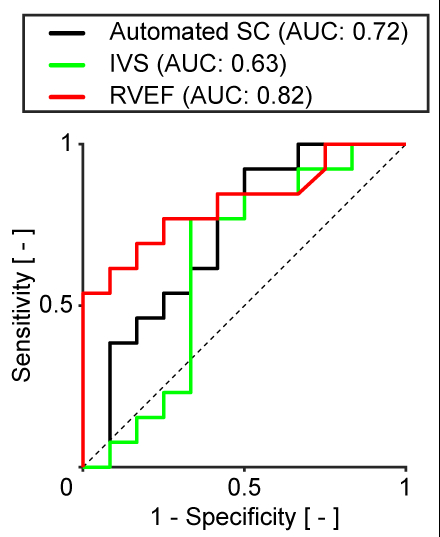
Results: 25 patients (17.0 [12.0 – 18.0] years; 13 with adverse outcomes) were included. Automated SC had a better correlation with mPAP (R=-0.82, p<0.001) than IVS (R=0.66, p<0.001) and RVEF (R=-0.49, p=0.01) (Fig.2). The capability to differentiate adverse outcomes was significant and better for RVEF (area under the curve of 0.82, p=0.007) while it was not significant for automated SC (0.72, p=0.06) and IVS (0.63, p=0.28) (Fig.3). Interobserver analysis found comparable ICCs (0.98, 95%CI, 0.97 – 0.99 for automated SC; 0.97, 95%CI 0.94 – 0.98 for IVS). ICC was not estimated for RVEF due to retrospective nature of the data collection.
Conclusion: The automated SC better correlated with mPAP, with comparable observer dependency to IVS but was not able to better differentiate adverse outcomes than RVEF.
Fujiwara, Takashi
(
Children's Hospital Colorado, University of Colorado Anschutz Medical Campus
, Aurora , Colorado , United States )
Lu, Vivian
(
Children's Hospital Colorado, University of Colorado Anschutz Medical Campus
, Aurora , Colorado , United States )
Frank, Benjamin
(
Children's Hospital Colorado, University of Colorado Anschutz Medical Campus
, Aurora , Colorado , United States )
Ivy, Dunbar
(
Children's Hospital Colorado, University of Colorado Anschutz Medical Campus
, Aurora , Colorado , United States )
Fonseca, Brian
(
Children's Hospital Colorado, University of Colorado Anschutz Medical Campus
, Aurora , Colorado , United States )
Neves Da Silva, Helio
(
Children's Hospital Colorado, University of Colorado Anschutz Medical Campus
, Aurora , Colorado , United States )
Sassoon, Daniel
(
Children's Hospital Colorado, University of Colorado Anschutz Medical Campus
, Aurora , Colorado , United States )
Gerstner Saucedo, Jochen
(
Children's Hospital Colorado, University of Colorado Anschutz Medical Campus
, Aurora , Colorado , United States )
Burkett, Dale
(
Children's Hospital Colorado, University of Colorado Anschutz Medical Campus
, Aurora , Colorado , United States )
Browne, Lorna
(
Children's Hospital Colorado, University of Colorado Anschutz Medical Campus
, Aurora , Colorado , United States )
Barker, Alex
(
Children's Hospital Colorado, University of Colorado Anschutz Medical Campus
, Aurora , Colorado , United States )
Author Disclosures:
Takashi Fujiwara:DO NOT have relevant financial relationships
| Lorna Browne:No Answer
| Alex Barker:No Answer
| Vivian Lu:No Answer
| Benjamin Frank:No Answer
| Dunbar Ivy:DO have relevant financial relationships
;
Consultant:Merck:Active (exists now)
; Research Funding (PI or named investigator):Actelion:Active (exists now)
; Research Funding (PI or named investigator):Merck:Active (exists now)
; Consultant:Actelion:Active (exists now)
| Brian Fonseca:No Answer
| Helio Neves da Silva:No Answer
| Daniel Sassoon:No Answer
| Jochen Gerstner Saucedo:DO NOT have relevant financial relationships
| Dale Burkett:No Answer